
Labor Matters: Manhattan's Office Jobs Stayed. Its Lunch Crowd Didn't.
Six years after the pandemic, the businesses that live off weekday commuters are still well below 2019, and they stopped recovering in 2023.
Before the pandemic, about 2.3 million private-sector jobs were in Manhattan, many of them held by people commuting in from the other boroughs and the suburbs, and those people spent money near work. Lunch, coffee, a haircut near the office, a gym before work, a dry cleaner on the way to the train. In 2020 that stopped, and it has only partly resumed. The Partnership for New York City's employer surveys put Manhattan office attendance at 72% of pre-pandemic levels in spring 2024 and 76% in March 2025. I wanted to see what that did to the businesses that depended on the other 25%.
The data are the BLS Quarterly Census of Employment and Wages, which counts jobs at every employer by county, through March 2026. I compare Manhattan's share of those jobs with the rest of the region: the other boroughs, the New York suburbs and nine North Jersey counties. In the charts after the first one, 100 is Manhattan's 2019 share, so a reading of 85 means Manhattan's share of that industry is 15% smaller than it was in 2019.
Manhattan's share of the region's jobs is down
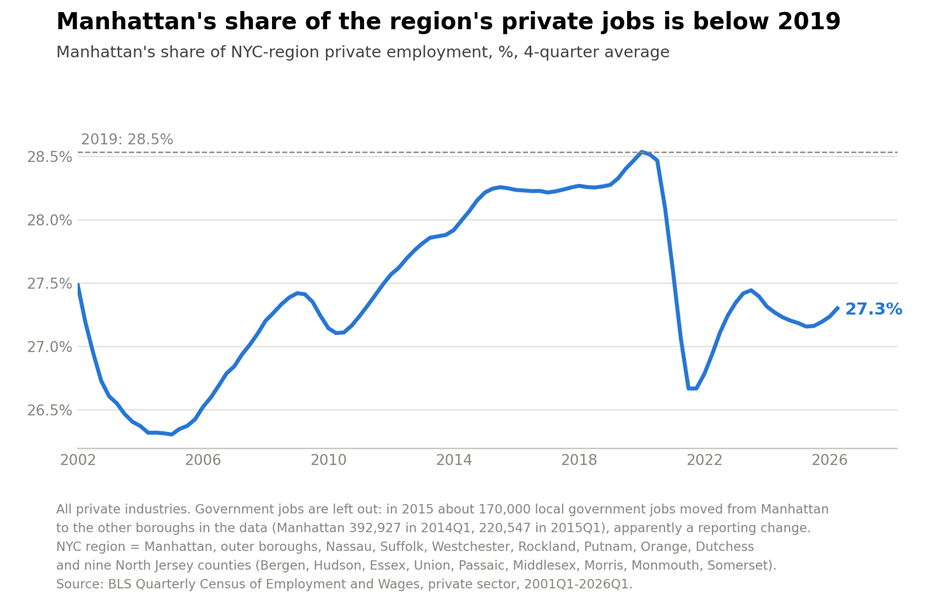
Start with the big picture. Manhattan's share of the region's private-sector jobs rose from 26.3% in 2004 to 28.5% in 2019. It averaged 26.8% in 2021 and has stayed close to 27.3% since 2022.
Industry by industry
Here is the picture for selected industries, sorted by the percent change in Manhattan's share since 2019. The businesses that serve people near work lost the most share. Office industries gained.
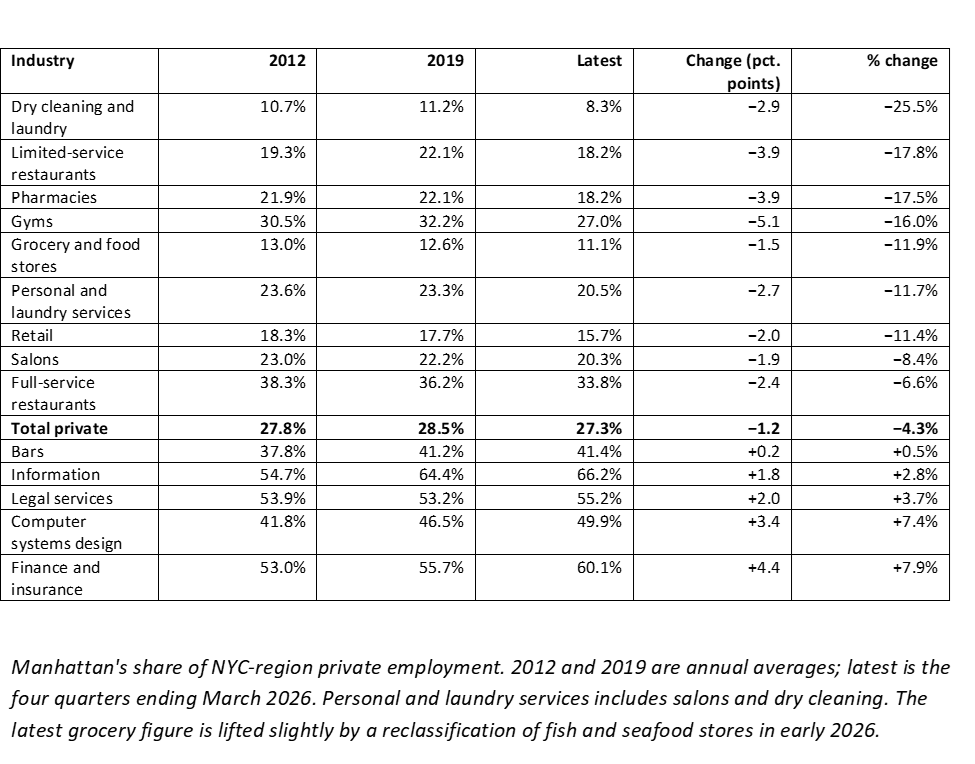
The 2012 column shows that some of this started before the pandemic. Salons and retail were already losing share from 2012 to 2019, so not all of their drop is about commuting. Gyms, lunch spots and dry cleaners were gaining share until 2019, and then lost it.
Lunch took the biggest hit
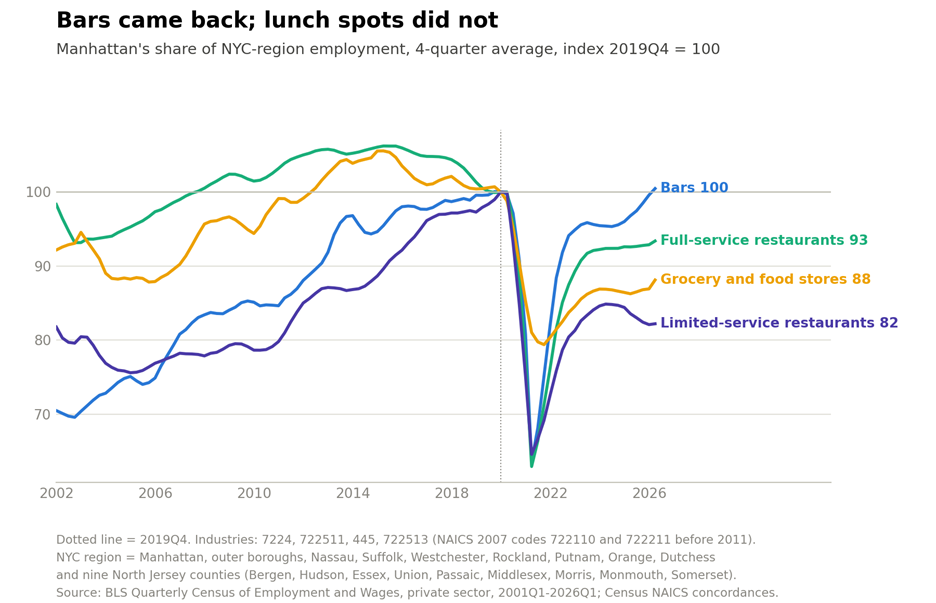
Restaurants are where the change is clearest. Manhattan's share of limited-service restaurant jobs, the delis, salad places and fast food that feed office workers at lunch, is 18% below 2019, and it has slipped further since 2024. In jobs, Manhattan had 37,500 of them in 2019 and 31,700 in 2025. Full-service restaurants are 7% below and grocery and food stores 12% below. Bars are back to their 2019 share, though both bars and lunch spots were gaining share fast before 2020, so 100 is below where the trend was heading.
My reading is that bars recovered because residents, visitors and people going out after work came back, and the lunch trade didn't because it depends on people being in the office five days a week. Part of the lunch-spot drop could also be delivery apps and ghost kitchens, which put food-prep jobs where kitchens are cheap, in Queens and Brooklyn, even when the customer is in Manhattan. I can't separate that out.
Counting restaurants and bars together, Manhattan had about 192,500 of those jobs in 2019 and has about 14,000 fewer now, while the outer boroughs, the New York suburbs and North Jersey all have more. If Manhattan had kept its 2019 share of the region's restaurant and bar jobs, it would have about 17,000 more than it does.
Gyms, pharmacies, dry cleaners and other services
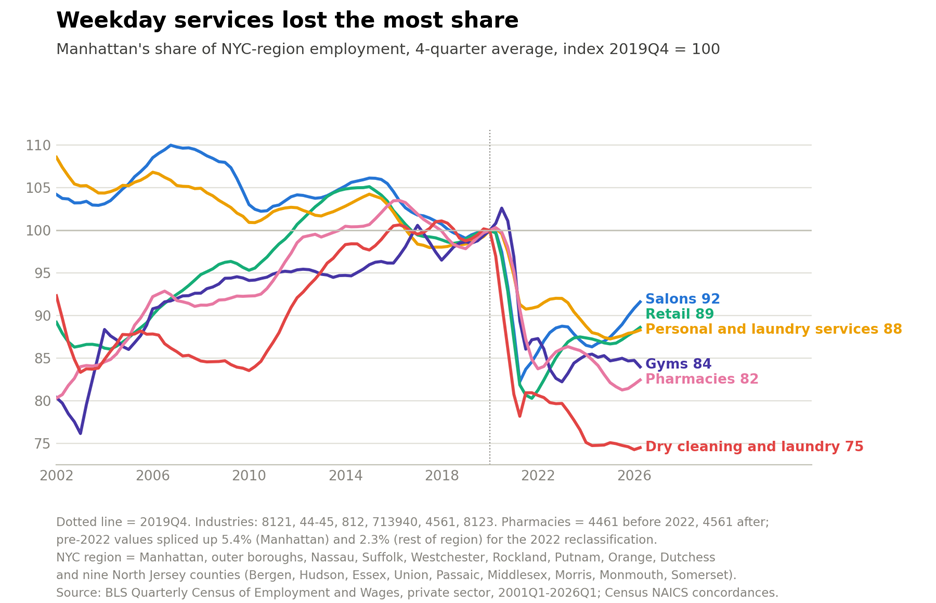
The same thing shows up in services people buy near work. Manhattan's share of dry cleaning and laundry jobs is 25% below 2019, the biggest percentage drop of any industry I looked at. Manhattan had 2,900 of these jobs in 2019 and 1,900 in 2025. My guess is that fewer office days and more casual clothes on the days people do come in is a bad combination for that business. Gyms are 16% below, with Manhattan's gym jobs down from 19,400 to 14,500. Pharmacies are 18% below. The rest are on the chart.
The recovery has split. The lines that depend on office workers, dry cleaning, gyms and lunch spots, have been flat or slipping since 2023, and so has Manhattan's share of all private jobs. The lines that depend on residents, salons, retail, grocery and bars, are still crawling back. That looks to me like a new level for the commuter businesses rather than a recovery still under way.
The office jobs stayed
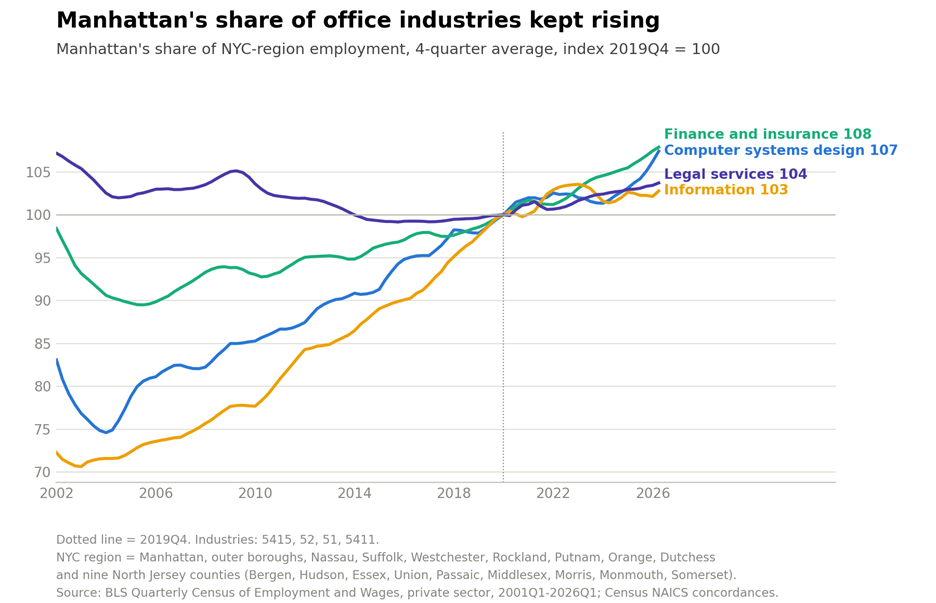
It isn't that the office jobs left Manhattan. Its share of the region's finance and insurance jobs is 8% higher than in 2019, and its share of computer systems design jobs 7% higher. Legal services and information are up 3% to 4%. In levels, Manhattan had about 612,000 jobs in these four industries in 2019 and has about 666,000 now, up 9%. Most of these shares were rising before the pandemic too.
So the office jobs are still in Manhattan. The big change is how many days a week the people holding them come in.
What this means
I think this is what Manhattan's weekday economy looks like now. The office jobs stayed, and in finance and tech they grew, but the people holding them come in three or four days a week, and the delis, gyms and dry cleaners near their offices are smaller for it. The spending didn't disappear. Some of it probably moved to the boroughs and the suburbs, where people buy lunch on the days they work from home.
Data note: BLS Quarterly Census of Employment and Wages, private employment, 2001Q1 to 2026Q1; the latest quarter is preliminary. NYC region = Manhattan (New York County), Bronx, Brooklyn, Queens, Staten Island, Nassau, Suffolk, Westchester, Rockland, Putnam, Orange and Dutchess in New York, and Bergen, Hudson, Essex, Union, Passaic, Middlesex, Morris, Monmouth and Somerset in New Jersey. Shares are 4-quarter averages; the indexed charts set each industry's 2019 share (the four quarters ending 2019Q4) to 100. I matched industry codes across the five NAICS revisions since 2002. Where BLS suppresses a county's figure, I bound it using the county's industry totals; for the industries shown this moves the shares by a quarter of a point at most. Pharmacies are adjusted for the 2022 reclassification that moved online health and beauty sellers into the industry. Visitor counts: NYC Tourism + Conventions (2025) and the New York State Comptroller (2019).