
Labor Matters: The Second AI Boom
The first boom is about building AI. The next will be about building what AI makes possible.
The second AI boom has already begun. Within five years, I expect it to be a major force in the U.S. economy and one of the main reasons growth runs well above the conventional forecasts.
I'm writing this because my view of AI has evolved. Compared with a year ago, I'm more convinced that AI will keep getting rapidly better for the foreseeable future. I'm also more convinced that AI is already working at a superhuman level in some sciences, starting with mathematics, and that in the coming years it will lead to dramatic new discoveries across many fields. Everything in this piece follows from those two convictions.
The first boom is spending to build AI capacity, driven by expectations of widespread adoption. It has already produced a surge in infrastructure investment and in stock-market wealth.
The second boom will be spending to build what that capacity makes possible. It has two sources. First, AI itself is getting better, and better AI goes straight into products: digital ones like tutors and agents, physical ones like robots and driverless cars and trucks.
Second, AI is getting good at science, and the discoveries it produces in medicine, materials, energy, and chemistry will have to be developed and commercialized.
Both will lift investment and consumption long before their final products arrive.
The first boom is already moving the economy
The latest GDP report shows the first boom's power. Over the four quarters through September 2026, inflation-adjusted business fixed investment rose 8.4%. Equipment investment jumped 14.1%, including a 46.1% increase in computers and peripheral equipment. Software investment rose 12.8%. Together, the four AI-related categories in the chart below (information processing equipment, software, R&D, and data centers) have added about 1.3 percentage points to real GDP growth over the past four quarters. Not all of this is AI, and imports offset part of its contribution to domestic GDP. But the AI infrastructure buildup is clearly a major driver.
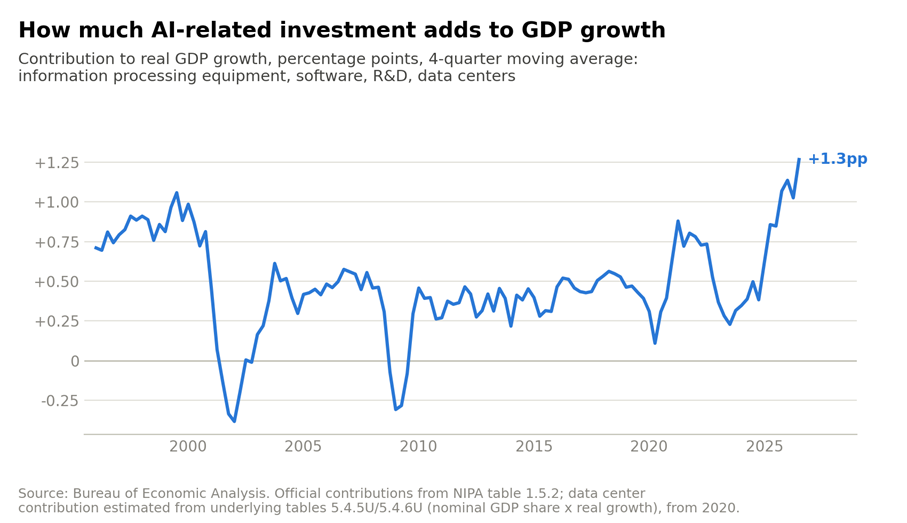
Investment is half the story. Valuations of companies expected to benefit from AI have risen sharply. Minneapolis Fed economist Alisdair McKay estimates that these gains could already be supporting annual consumption equivalent to roughly 0.5 to 1% of GDP.
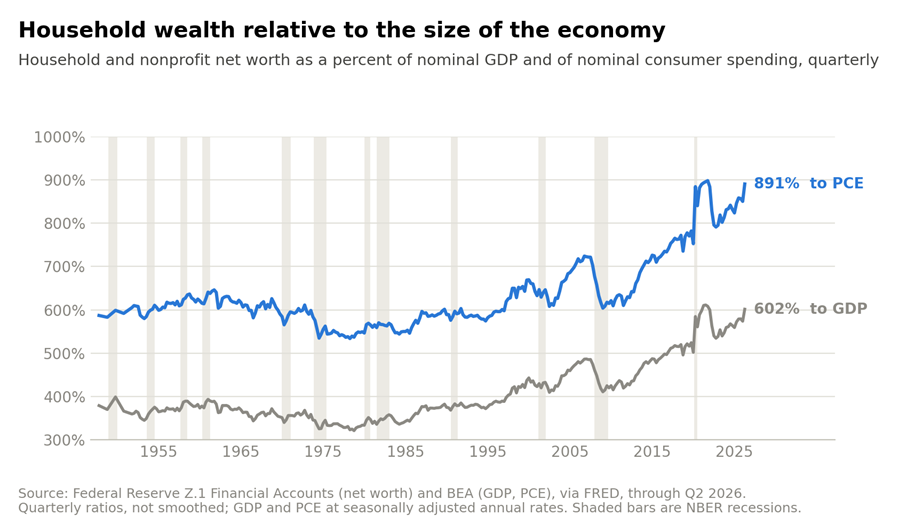
That is how the first boom works: businesses build capacity for the demand they expect, and households spend wealth created by the same expectation. The second boom will work the same way, across a much larger part of the economy.
Better AI is a product in itself
The most visible part of the second boom doesn't need a laboratory. It needs the models to keep improving, and they are.
Digital products come first, and they're already here: agents that write code, handle customer service, tutor students, and do the paperwork of a small business, all built on top of the models. They need no factories, so they reach customers in months, and what they invest in is compute and people. Every one that finds paying customers turns the first boom's speculative capacity into realized demand. The more digital products succeed, the longer the data-center buildout runs.
But the bigger and slower part of the second boom, I think, comes next: physical products, each of which needs a factory, and behind them the discoveries from AI-driven science, each of which needs a development pipeline. Both show up in GDP as investment before the products exist.
Driverless cars are the clearest physical case. Robotaxis have gone from demonstration to paid service in a handful of cities, and every expansion requires vehicles, sensors, depots, mapping, remote operations, and insurance. Autonomous trucking is on the same path. Humanoid and industrial robots are earlier, but once the control models are good enough, the binding constraint shifts from intelligence to manufacturing. Factories, components, and supply chains have to be built and engineers hired to run them, and all of that is investment. Of the second boom's two sources, better AI is the nearer-term one.
AI is getting very good at science
The progress in mathematics is extraordinary. This October, OpenAI released more than 700 AI-generated mathematical manuscripts covering hundreds of groups of related results, including claimed solutions to longstanding open problems. It also announced a claimed refutation of the Exponential Time Hypothesis, a foundational conjecture in theoretical computer science, which complexity theorists are still examining.
AI has moved from solving hard problems to producing original research faster than humans can evaluate it. Mathematics is an input to every other science, so progress there guarantees progress elsewhere.
AI reaches the other sciences directly too: analyzing biological data, designing molecules and materials, and automating experiments. This month, OpenAI, working with PerturbAI and Scripps Research, set thousands of AI agents on data from millions of mouse-brain cells. They turned up leads for further investigation in 32 minutes.
The bigger shift is in numbers. A human scientist takes years to train. An AI agent can absorb an entire literature, connect disciplines, and work on thousands of questions at once. At a recent IMF lecture, Anthropic cofounder Jack Clark asked his audience to imagine a billion virtual scientists directed by the world's roughly 10 million human ones.
Put the two together and AI multiplies the effective number of researchers while raising their productivity. The supply of valuable discoveries will grow far faster than the economy's capacity to commercialize them. That gap is where the second boom comes from.
The second investment boom
A promising drug still needs clinical trials and regulatory approval. A new battery material needs testing, pilot production, and eventually factories. A new robot needs all of that plus a supply chain for its parts. AI makes the ideas abundant. Everything after the idea still has to be built, and building takes expertise, capital, and infrastructure.
A recent study in Cancer Treatment Reviews identified 129 AI-enabled therapeutic assets across 69 companies that had entered human clinical trials by March 2026. Most are still early, but the pipeline has expanded fast.
In materials, the bottleneck has moved from finding candidates to making them. In July, CuspAI, a British startup that uses AI to screen candidate materials, raised $450 million, much of it to build laboratories in Cambridge, Singapore, and the San Francisco Bay Area. None of its candidates has left the lab yet. A cofounder of Periodic Labs, which is building automated labs to hunt for superconductors, says the biggest bottleneck is making a new material for the first time.
The scale matters. The United States already spends roughly $1 trillion a year on R&D, and commercialization can require far more capital than discovery. Advances in medicine, materials, energy, agriculture, and industrial chemistry will each set off their own investment chains, and so will each new generation of robots and vehicles.
The second boom also hires differently from the first. A data center that costs billions runs with a staff in the dozens or low hundreds once it is built. Trials, labs, factories, and supply chains need people at every step, and I expect those jobs to land in different places than the first boom's spending did.
And eventually there will be a third AI boom, when consumers and businesses purchase the new products and services at scale. Digital products are already reaching that stage, but I expect most of the physical-product boom to arrive after 2031. The second boom will generate substantial investment and economic growth long before the third reaches full force.
None of this requires a flood of successful products by 2031. It requires investors and businesses to become convinced that the products are coming, and that conviction is already forming. Even the projects that eventually fail will generate development spending along the way.
The second wealth boom
As AI makes valuable products and breakthroughs more likely, investors will revalue the companies positioned to build and sell them, years before those products earn a dollar of revenue.
The first boom concentrated wealth creation in semiconductors, cloud computing, and AI developers. The second will reach much further: pharmaceuticals, materials, energy, agriculture, autos, robotics, logistics, and defense.
Higher valuations make business investment easier to finance and create a second household wealth effect that supports consumption. The investment and spending, rather than the stock-market gains themselves, are what show up in GDP.
GDP forecasts need to catch up
The possibility of an AI-driven scientific revolution is getting serious attention. What's underappreciated is how much economic activity it will generate before the products exist.
The conventional forecasts look low to me even before the second boom. CBO's latest outlook has real GDP growth averaging 1.8% a year from 2027 to 2036, and the Fed's longer-run estimate is 2.0%.
Here is what I expect over the next five years.
1. The products AI makes possible, the ones it powers directly and the ones it helps discover, will be a major source of U.S. investment and growth. I attach a very high probability to this.
2. The second boom will add to the demand for AI itself, so the first boom will last longer.
3. Much of the current debate is about whether some labs have the liquidity to survive. Set against the scale of what is coming, that will look like a small question.
4. GDP growth will run significantly above current projections. If there is no recession, I think we are talking about an average of 3 to 4% a year through 2031. And the probability of a recession is lower than I thought a month ago.
If I'm right about this, the conventional forecasts are missing the main economic event of the next five years.