
Labor Matters: Think Young College Grads Have It Bad? Look at Those With a Master’s Degree.
Outside a recession, we have rarely seen a trend in labor market data turn this fast. Some of the charts below were so surprising, we had to triple check them just to be sure.
As late as mid-2024, 22-to-26-year-olds with a master’s degree had one of the lowest unemployment rates of any education group their age. Before the pandemic theirs was the lowest, 3.5%. Over the two years to October 2026, it has averaged 6.7%. It has nearly doubled. That matches the peak after the Great Recession, and this time there is no recession.
For associate’s holders of the same age, in the same economy, unemployment has barely moved. The gap between the two groups is now 2.4 points. Before mid-2024, in two-year averages going back to 2003, master’s holders’ unemployment had never been above associate’s holders’.
Pay turned at the same time. A master’s degree used to pay young full-time workers about two thirds more a week than an associate’s degree. It now pays less than half more. Most of that drop came in the past two years, when master’s holders’ pay stopped growing and then fell while associate’s and bachelor’s holders’ pay kept rising.
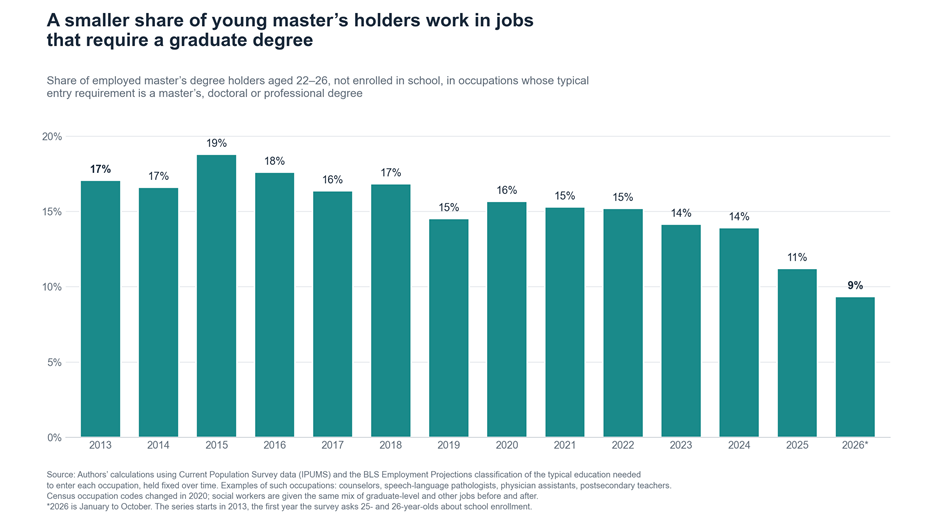
A smaller share of young master’s holders work in jobs that require the degree. Only one in ten is now in an occupation that typically requires a graduate degree, down from one in six.
Bachelor’s holders have been losing ground to associate’s holders too, but slowly, over six years. From 2003 through 2019, their unemployment, on the same two-year averages, was never above associate’s holders’. Since 2020 it has been above in all but two months. Master’s holders’ unemployment rose more than twice as much, most of it in two years.
So far the damage is at the start of careers: about three quarters of the rise in master’s unemployment comes from people entering or re-entering the labor force. At ages 27 to 34, master’s holders still have lower unemployment than bachelor’s or associate’s holders. If entry-level hiring stays this weak, we doubt that will last.
We see three explanations: more young master’s holders competing for the same jobs (1 million, up from 790,000 in 2019); slower entry-level hiring, which we think AI is part of; and a degree that tells employers less than it used to.
A master’s degree still pays, but the head start it buys is smaller and less certain than in 2019, and most of that change took two years. That should worry universities and the students thinking of enrolling.
Young master’s and bachelor’s holders are now more likely to be unemployed than associate’s holders
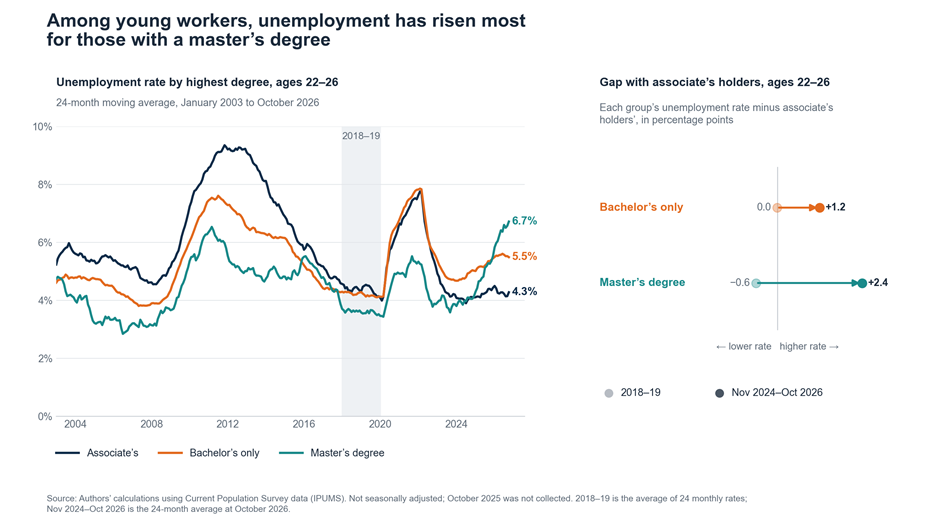
· Associate’s holders’ unemployment is back where it was before the pandemic. Bachelor’s holders’ is well above it. Master’s holders went from the lowest rate of the three groups to the highest.
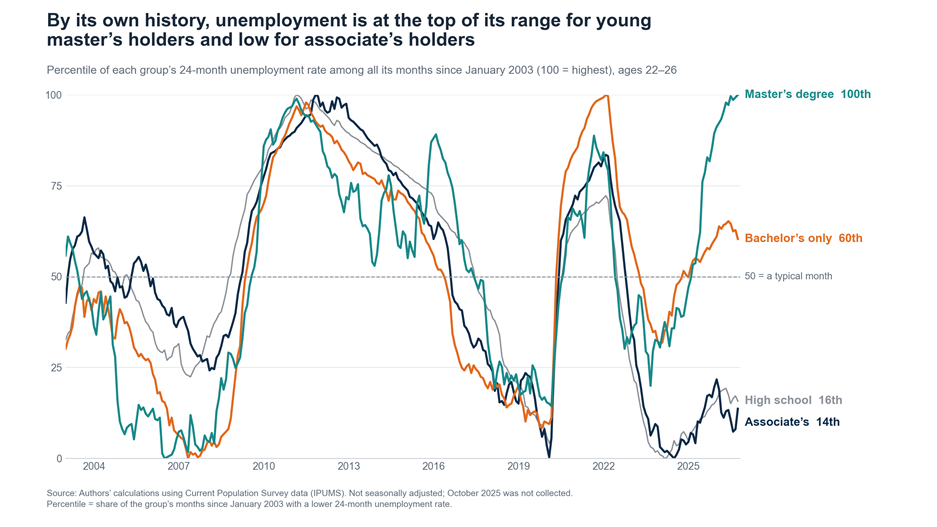
· By each group’s own history since 2003, which includes the Great Recession and the pandemic, master’s unemployment is at the top of its range. For associate’s holders and high school graduates, this is a good labor market by the same yardstick.
Master’s and bachelor’s degrees pay less of a premium than they did
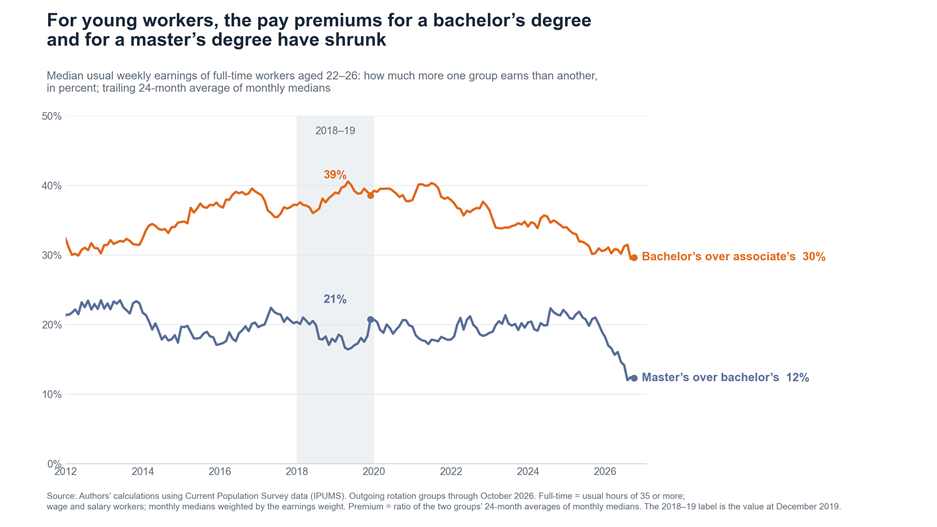
· The master’s premium has fallen the most. On the chart, the premium over a bachelor’s degree held steady until late 2025 and then dropped to its lowest level in data going back to 2012. It has also shrunk among 25-to-29-year-olds. The bachelor’s premium over an associate’s degree has been slipping more slowly, since 2021, and is at or near its lowest in the same data.
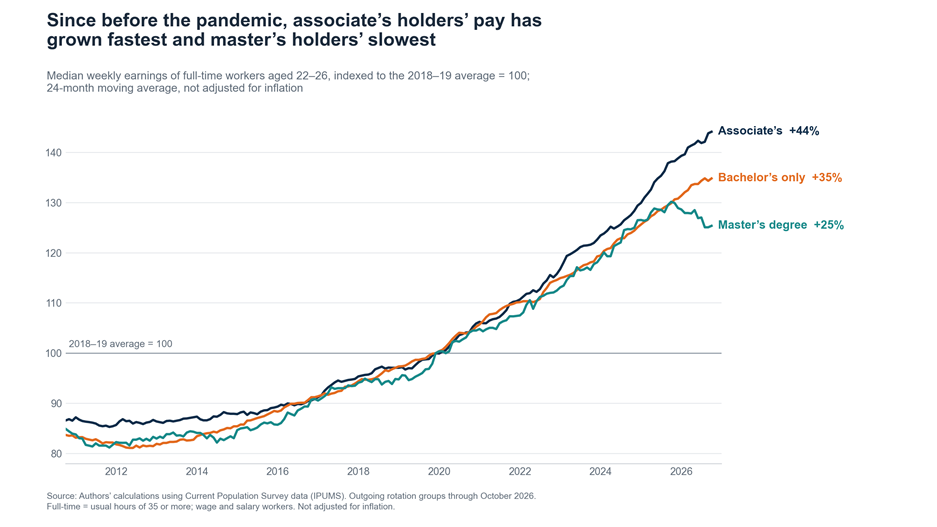
· The premiums shrank because associate’s holders’ pay grew fastest and master’s holders’ slowest, over the whole period and over the past two years. On the chart, master’s holders’ pay peaked in late 2025 and has fallen about 4% since. It had not fallen over a year at any time since 2014, and the only other drop this large in our data came right after the Great Recession.
What explains it
We don’t fully understand what happened in the past two years. The deterioration is so sharp and so sudden that none of the explanations below accounts for all of it. Here is what we can see so far.
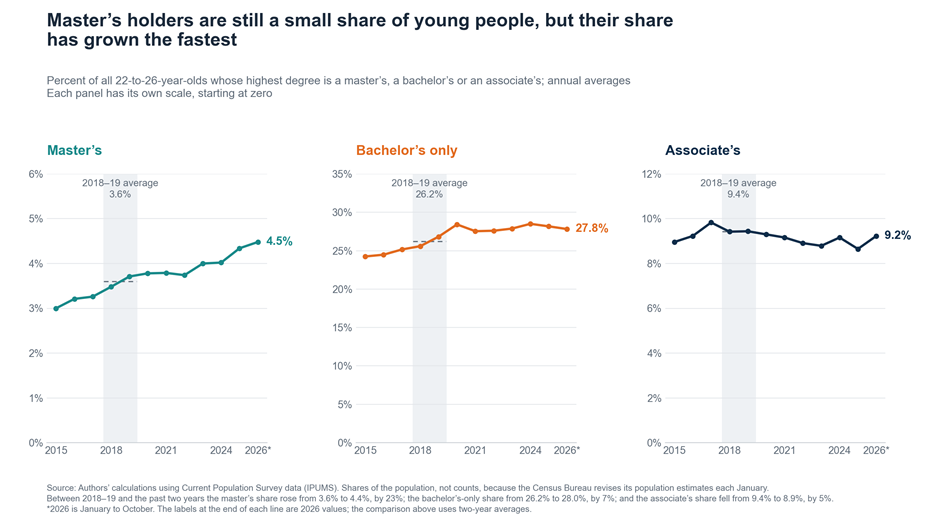
· First, there are many more of them, and their employment has grown only in jobs that do not need the degree. The number of 22-to-26-year-olds with a master’s degree was flat from 2019 to 2022, at about 790,000. It is now about 1 million, and it has grown more than twice as fast as the number with only a bachelor’s degree, while the number with an associate’s degree is about where it was in 2019.
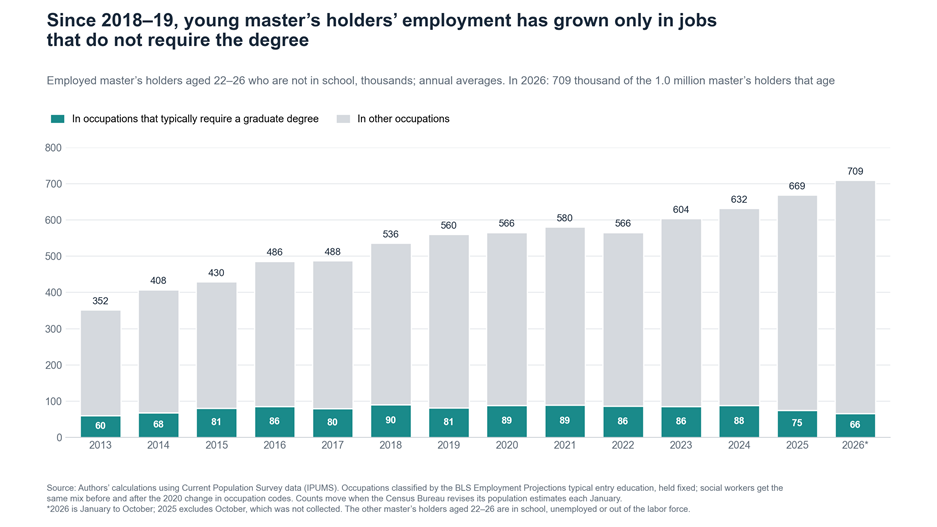
The number working in occupations that typically require a graduate degree has not grown. So the share in those occupations has fallen from about one in six in 2018–19 to about one in ten, with most of the drop in the past two years. All of the growth in employment went into jobs that do not require the degree.
· Second, the problem is getting hired. About three quarters of the rise in master’s holders’ unemployment comes from people entering or re-entering the labor force, and that part of their unemployment rate has risen as much as it did in the Great Recession. Among master’s holders, unemployed people who have never held a job have more than doubled as a share of the labor force. Employers want experience: our 2025 report found a rising share of openings asking for significant experience, and we think AI is part of the reason.
· Third, a master’s degree may tell employers less than it used to. In earlier work we showed that graduates of the most selective colleges have pulled back from graduate and professional school. Their enrollment in business school fell by more than a third from the mid-2000s, while less selective colleges held steady or rose. We think that makes some master’s degrees, the MBA among them, a weaker signal of ability than they used to be. That shift built up over many years, but it matters more when employers have many applicants for each entry-level job.
None of these explains why it happened so fast.
A master’s degree still pays off. Young master’s holders still earn well above bachelor’s holders, and among 27-to-34-year-olds most of the advantage is intact. But what has happened to young master’s holders in the past two years is unusually fast, and it is a warning sign for the universities that offer these degrees and for the students thinking of enrolling. For a 22-year-old weighing a master’s program, the early payoff is smaller and less certain than it was in 2019, and the job at the end of it is less likely to require the degree.
The programs have a direct stake. Under the 2025 budget law, a graduate program can lose access to federal student loans if its graduates, four years after finishing, earn less than young workers with only a bachelor’s degree in two years out of three. The faster the master’s premium shrinks, the more programs will be at risk.
To our knowledge, this is the first time these results have been shown, and we can’t yet fully explain them. Universities and students are making decisions now that depend on the answer, and the question needs much more research.
About the data
The figures come from the Current Population Survey (IPUMS) through October 2026, for people aged 22 to 26 unless stated. Degrees are the highest degree held; professional and doctoral degrees are not included. Unemployment and pay are 24-month moving averages. Pay is median weekly earnings of full-time workers, not adjusted for inflation. Jobs that require a graduate degree follow the BLS classification of typical entry education.