
Labor Matters: AI Will Take Its Jobs in the Next Recession.
The case for not worrying much about AI and jobs right now goes like this. Unemployment is low and a lot of AI jobs are being created. Most studies don't find a significant impact of AI on jobs. If AI were taking jobs we would see it in the data.
As I discussed in other articles, I discount these studies because I view them as very flawed. But that is not the point of this article.
In any case, the conclusion that there is little to worry about gets more and more traction in the media and on social media.
I've heard this argument before. It was the consensus view of manufacturing jobs in 1999 and 2000. Within ten years, after two recessions and the loss of a third of manufacturing jobs, it had become one of the biggest economic surprises in US history, and one that a big part of the country still has not recovered from.
We should refresh our memory of this episode, because it is highly relevant to the AI and jobs debate we are having right now. The thing to learn from it is that almost all of the job losses from automation and offshoring happened during and right after recessions, not during the boom that came before them.
During the 1990s the impact of offshoring and automation on manufacturing jobs was a hot topic, mostly because of fears about offshoring. Many people warned about it, but the aggregate numbers refused to cooperate. After the 1990-91 recession, manufacturing employment climbed to the peak of the 1990s expansion, 17.6 million in March 1998, and had slipped by only about 300,000 by the middle of 2000. The unemployment rate was 4 percent, the lowest in thirty years. The policy fight that year was over permanent normal trade relations with China, PNTR, the vote that cleared the way for China to join the WTO. After the growth of the 1990s, most people were not worried.
The Bureau of Labor Statistics published its 2000 to 2010 projections in December 2001. Manufacturing employment was "expected to increase by only 3 percent over the 2000-2010 period." The release said that "manufacturing will return to its 1990 employment level of 19.1 million." One of the worst predictions ever. It fell by a third. This forecast was in line with how people talked about the risk at the time.
What happened
Manufacturing employment fell from 17.3 million in 2000 to 11.5 million in 2010, a loss of 5.75 million jobs.
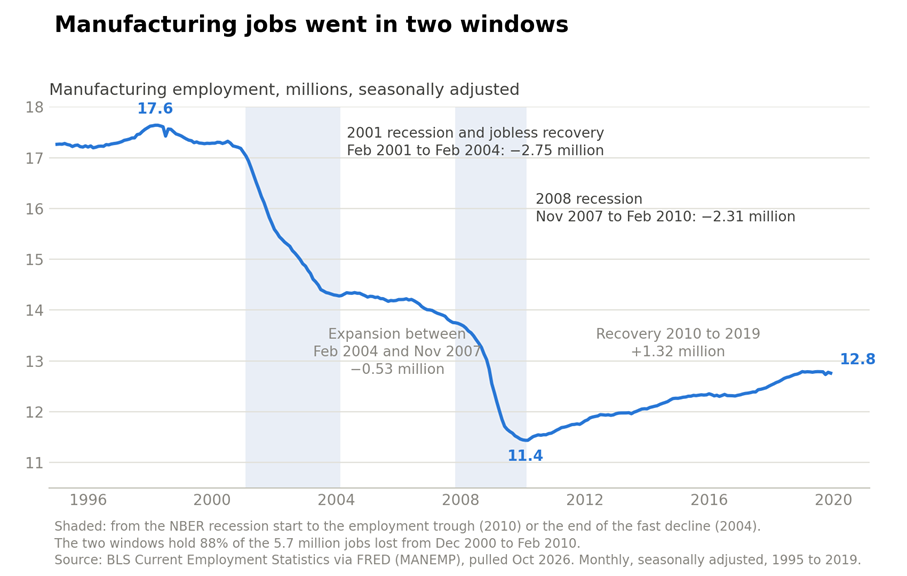
From February 2001 to February 2004, the recession and the jobless recovery that followed it, the sector lost 76,000 jobs a month. From November 2007 to February 2010 it lost 86,000 a month. In the expansion between, from 2004 to late 2007, it lost about 12,000 a month. Drawn as two windows, each running from the start of the recession to the point where the fast decline ended, those stretches hold 88 percent of the loss.
Nir Jaimovich and Henry Siu found the same pattern for all routine jobs, meaning work built on repeatable tasks, from assembly lines to back-office clerical work, not just factory jobs: "essentially all employment loss in routine occupations occurs in economic downturns," with 88 percent of the decline since 1990 inside the windows around recessions. Manufacturing accounts for only 37 percent of that loss. The rest is clerical and administrative work that was never shipped anywhere, and it disappeared on the same schedule. Trade was the bigger lever in manufacturing, but I don't think it matters much which lever firms pulled. The recessions were when the cutting got done.
The aggregate labor market did recover. The places didn't. David Autor, David Dorn and Gordon Hanson followed the commuting zones most exposed to Chinese imports and found no recovery in employment rates even in 2019, nine years after the shock plateaued. Most of the lost factory jobs showed up as people out of work, not as jobs elsewhere. Justin Pierce and Peter Schott found lasting increases in deaths from suicide, drugs and alcohol in the counties most exposed to PNTR, much larger than after ordinary downturns, and the same places realigned politically before 2016.
Why recessions
The timing is the finding. What follows is my reading of why. By 1999 there was a large stock of ways to make the same output with fewer American workers. Some of it was equipment and software bought during the 1990s investment boom. Some of it was the option to source from China and Mexico. Firms had the potential and mostly didn't use it to reduce labor costs, because sales were growing and profits were good. Why close a plant that is making money?
Then the recession came, and two things changed at once. First, profits fell and some firms were in survival mode. Second, firms had license to cut. A layoff that would have been a scandal in 1999 was expected in 2002.
Now
The big job losses haven't happened yet. They'll come in the next recession.
Firms have barely started. The gap between what the best models can do and what most firms actually use them for is enormous, and I expect it to keep growing. Closing that gap will be one of the most important forces shaping the US economy and labor market in the coming years and decades. That gap is a stock of labor-saving changes firms could make and haven't, the same kind of stock manufacturers were sitting on in 1999-2000. The absence of large AI job losses doesn't tell you much about how large that stock has become.
Conditions so far have been unusually forgiving. There has been no recession since ChatGPT's release. Growth has been solid, corporate profits are at a record share of GDP, and the layoff rate is about as low as it gets. AI is also creating jobs. Thousands of AI companies are founded every year, concentrated in tech hubs like the Bay Area, and existing firms are adding AI roles at a faster clip still. I estimate that 1.5 to 2 percent of knowledge workers now hold jobs that would not exist without AI. And that count excludes the physical buildout: the data centers, power plants, transmission lines, and chip fabs behind the AI boom are employing electricians, construction crews, engineers, and technicians in significant numbers.
There are also hints of what to come, the same kind manufacturing showed in 1998 to 2000. The white-collar group I've been tracking, finance, insurance, information and professional and business services, which I call FIIPB, peaked in April 2023 and has been falling since, the first decline outside a recession in decades. By September it was about 1.6 million jobs, or 4 percent, below its 2005 to 2019 trend.
By the next downturn, employers will have had years to learn where AI can substitute for labor. My prediction is that the next recession does to AI-exposed office jobs what 2001 did to manufacturing. The cuts will continue through the recovery, as they did in 2002 and 2003, and I don't expect many of those jobs to come back. That young college graduates are struggling even in today's favorable conditions is what worries me most.
The prevailing view that AI hasn't affected the labor market much is not a harmless analytical mistake. It tells policymakers, colleges and young workers there's no rush. Adjustments that could be made gradually now will be much harder to make in a recession. The time to prepare for that labor market is before it arrives.