
Labor Matters: Remote Work Has Plateaued. But not for Everyone.
National work-from-home rates have barely moved in two years. Federal workers, STEM occupations and young college graduates are another matter.
Mels de Zeeuw and Gad Levanon
Despite two years of return-to-office headlines, the national work-from-home numbers have barely moved. In the 12 months to August 2026, 22.3% of employed workers did at least some paid work from home, and 15.4% of all hours worked were done at home. Both are down 0.4 points from the year before and roughly flat over two years. The plateau hides three groups that moved a lot: federal workers, workers in STEM occupations, and young college graduates. The biggest pullback wasn't in the private sector, where the return-to-office headlines come from. It was among federal workers, whose office policy was set by a presidential memorandum.
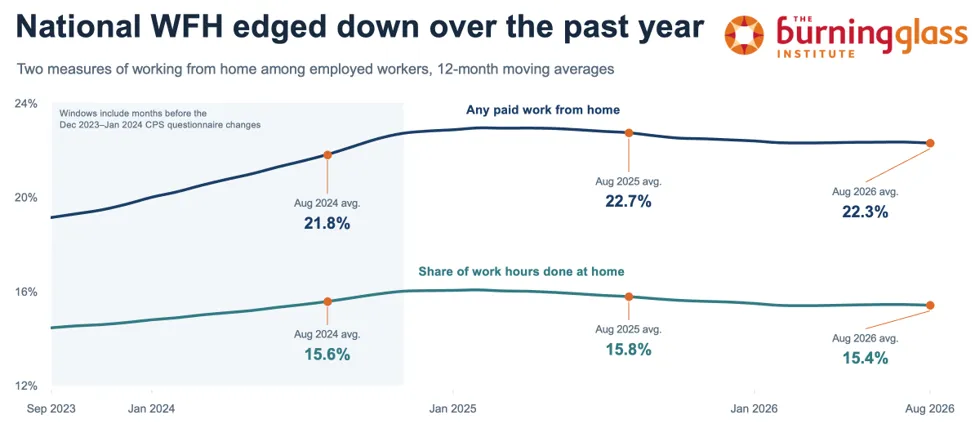
Source: Authors' calculations using Current Population Survey data
The sharpest break is in the federal workforce. Among federal workers in public administration, the share doing any paid work from home fell from 42.5% in January 2025 to 22.4% in August 2026, and their share of hours worked at home fell from 29.0% to 13.3%. State and local government workers show no such move. The timing and the contrast with state and local workers point to the January 2025 federal return-to-office directive.
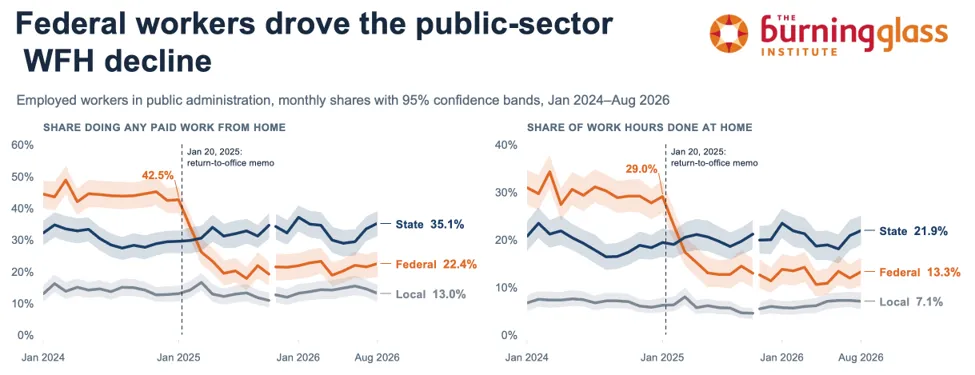
Source: Authors' calculations using Current Population Survey data. Monthly figures; October 2025 was not collected. Shaded bands are 95% confidence intervals (person-clustered bootstrap).
Unless noted, the changes below compare the 12 months to August 2026 with the 12 months to August 2024. Across employers, the retreat is concentrated in technical jobs. Computer and mathematical workers do more of their work from home than any other occupation group. Even so, their share of hours at home fell from 52% to 48%, 2.2 points of it in the latest year. Life, physical and social scientists fell a similar 4.3 points. Federal scientists account for much of that, down 14.4 points, but scientists at private employers also fell a significant 3.3 points, so it is not just the federal story again. Architecture and engineering fell 2.8 points and business and financial jobs 1.6. Management, legal, sales and office support roles saw no significant change.
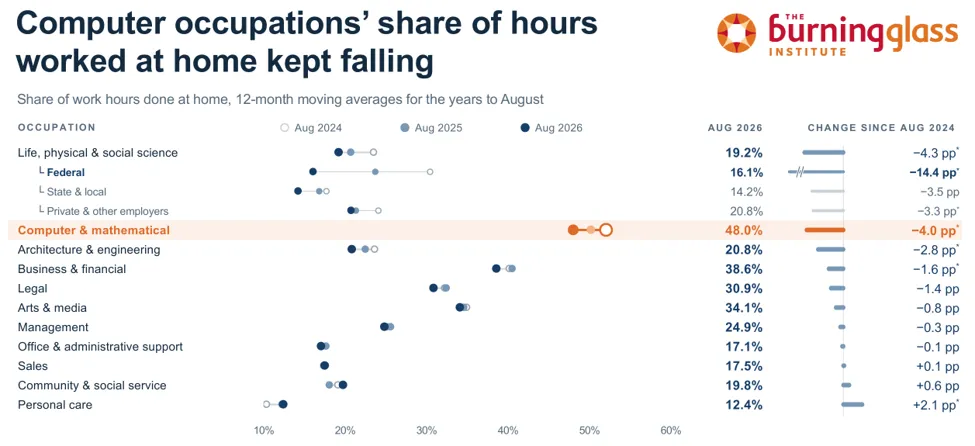
Source: Authors' calculations using Current Population Survey data. * Change since August 2024 significant at p<.05 (person-clustered bootstrap).
Put together, STEM occupations (computer, engineering and science jobs, federal scientists included) saw their share of hours worked at home fall from 39% to 35.5%, a 3.5-point drop. Among other professionals, a group that runs from managers, lawyers and business staff to teachers and healthcare practitioners, it slipped from 22.4% to 22%, not a significant change. STEM's lead narrowed from 16.6 to 13.5 points.
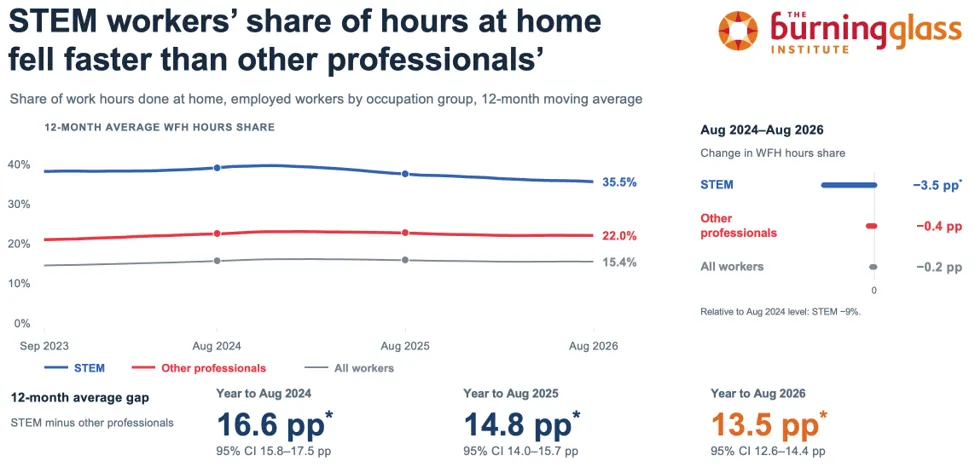
Source: Authors' calculations using Current Population Survey data. * p<.05 (person-clustered bootstrap). Bars: the change since August 2024; gap figures: the gap itself.
The return to office has been much more pronounced among young college graduates than among older ones. Among employed workers aged 22 to 24 whose highest degree is a bachelor's, the share of hours worked at home fell from 16.1% to 11.9%, a 4.2-point drop. It fell 2.6 points for those aged 25 to 34 and held steady for those 35 to 44. The gap between the two older groups went from 1.6 points to 4.7. On the broader measure, any paid work from home, the ordering is the same, and those 45 and over are unchanged. Remote work is becoming one more way the labor market treats young graduates differently from established professionals.

Source: Authors' calculations using Current Population Survey data. * Change since August 2024 significant at p<.05 (person-clustered bootstrap).
Why young graduates? Part of it is well understood. There is good evidence that junior workers seated near colleagues get more feedback and build skills faster, and young workers are themselves less keen on fully remote work. We want to add one hypothesis, which we leave for further research: leverage. Remote work is a concession employers make when they must compete for people, and young graduates are in the weakest position to ask for it. Their labor market has deteriorated sharply over the past two years. Unemployment among recent graduates has risen, hiring into entry-level professional jobs has stalled, and a new graduate weighing an offer has little room to negotiate over where the work gets done. Older workers with experience and a job in hand do. The same logic fits the other groups losing remote work: tech and entry-level professional labor markets have gone slack, while the groups keeping it, such as managers and lawyers, are the ones employers still struggle to hire. We can't prove it yet, but this is where we're leaning.
Remote work isn't going away. What has changed is who gets to do it. Federal workers lost it by directive, tech and science workers are seeing less and less of it, and young graduates are losing it fastest relative to their older colleagues. Among college-educated workers, remote work is increasingly stratified by career stage.
About the data: The figures are 12-month moving averages from the CPS basic monthly survey (IPUMS), covering employed workers who were at work. Figures for federal, state and local government workers cover the public administration industry and are monthly, so that the January 2025 directive can be seen. "Any work from home" counts paid work at home in the survey's reference week. The hours measure divides hours worked at home by total hours worked. Results are nearly identical for full-time workers only. October 2025 was not collected; it is interpolated in the 12-month averages and left blank in the monthly chart. The 12 months to August 2024 include months before the CPS changed its telework questions, dropping the pandemic-era introduction in December 2023 and moving the questions next to the hours question in January 2024. The changes raised measured work from home by about 1.6 points on the any-WFH measure and roughly half a point on hours, so the year to August 2024 is a slightly low baseline and the two-year declines are, if anything, understated. One-year changes are unaffected.