
Labor Matters: Job hugging is mostly a private white-collar thing
In brief: Everyone is talking about job hugging, but it is not a national mood. It is a private white-collar story. In finance, insurance, real estate, information, and professional and business services, the quits rate has fallen to the 13th percentile of its 25-year history, 28 percent below 2019. Everywhere else, quitting is close to normal, and in government, education and health it is running high. The reason is that FIIPB is the one part of the economy that has been losing jobs. People do not quit when there is nowhere to go.
"Job hugging" is the label that stuck to this labor market. Workers cling to the jobs they have, the quits rate is at a post-pandemic low, and in recent surveys more than half of workers call themselves huggers. The national numbers support the mood. But when I split the quits rate by industry, most of the hugging turns out to be happening in one part of the economy.
For every industry JOLTS publishes, I took the 12-month average of the quits rate and ranked it against that industry's own history since 2001, so that a high-turnover industry and a low-turnover one are each judged by their own standard. Then I combined the industries into three groups. FIIPB is finance, insurance, information, and professional and business services: the private white-collar economy I've been writing about all year. The second group is government and social services plus private education and health. The third is everything else.
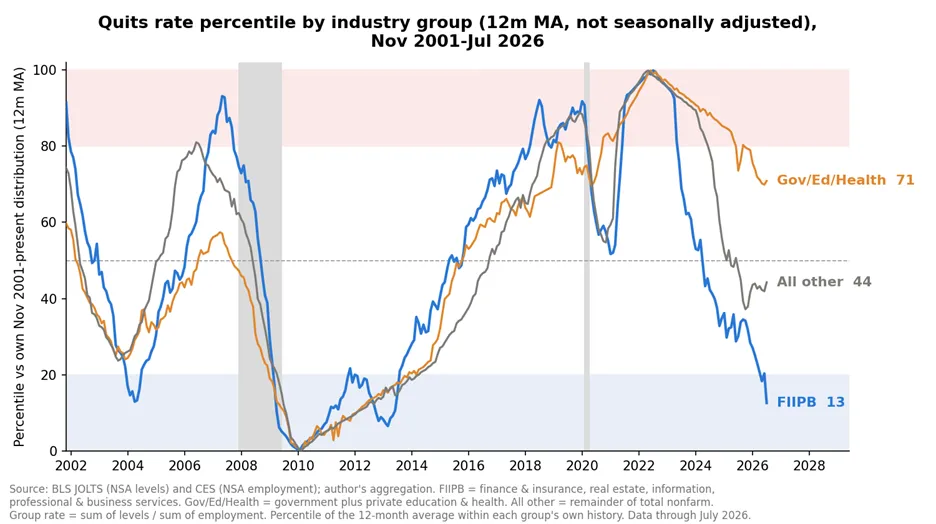
The Great Resignation was universal. All three groups hit the top of their range together in mid-2022. Since then, FIIPB has fallen almost in a straight line. Its quits rate is now at the 13th percentile of its own history, 1.8 percent against 2.5 percent in 2019, a 28 percent drop from what was already a high-turnover year. It hasn't been this low since 2013. Nobody else followed. The rest of the private economy sits at the 44th percentile, close to normal. Government, education and health are at the 71st, with a quits rate identical to 2019.
So why FIIPB? The most likely answer is that this is where the jobs stopped.
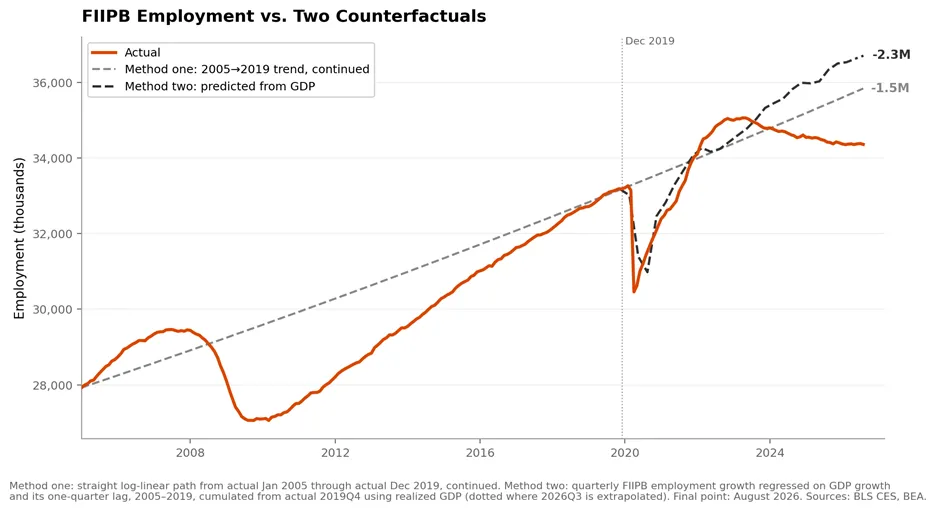
The second chart shows FIIPB employment against its pre-pandemic path. Employment peaked in early 2023 and has been falling since. It's now at least 1.5 million jobs short of where it would have been. In JOLTS terms, the sector's net hiring, hires minus separations, has flipped from a small positive in 2019 to a small negative today. The numbers are small in any single month, but the sign is the whole story. People quit when they have somewhere to go, and in a sector that's shedding jobs there's nowhere to go. The offers dried up. Fear reinforces it. A worker who moves gives up tenure, and in a shrinking sector the safest seat is the one you already hold.
The government, education and health group is the mirror image, and it confirms the logic. It's the one part of the economy still adding jobs at scale. Health care led employment growth from 2023 through 2025, and its hiring rate is at the 46th percentile, against 9 for FIIPB. Where the jobs are, people still move. The rule works in both directions: quits follow job growth.
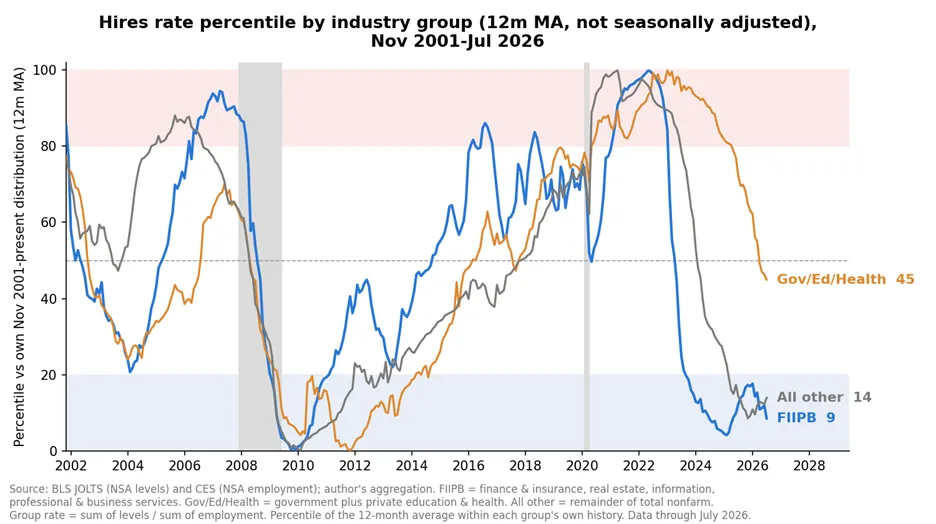
The third chart, hires, looks alarming, and I'd caution against reading too much into it. It mostly restates the quits chart. Most hiring is replacement hiring, and when nobody quits there are no seats to fill.

Layoffs, in the fourth chart, are the reason this doesn't feel like a recession. It isn't one. Layoffs are below their historical median everywhere: FIIPB at the 33rd percentile, government, education and health at the 17th, everyone else at the 15th. In 2001 to 2003, and again in 2008 to 2010, hires and quits this low came with layoffs at the top of their range. This time firms cut hiring and let attrition do the work. One caveat: FIIPB layoffs rose through 2025 and pulled away from the other two groups. The move is small, 1.63 percent of employment against 1.55 in 2019, but it's the only line here moving the wrong way, and it's the one to watch.
For companies, this is a good deal, at least for now. Turnover is expensive: every departure means a search, a hire, and months of training. In FIIPB the seats stay filled, recruiting budgets shrink, and there's little pressure to raise pay to keep people. For workers it's the reverse. A job switch is where most raises and promotions come from, and that route is closed.
Data note. BLS JOLTS, not seasonally adjusted, 12-month averages through July 2026, ranked within each series' own November 2001 to July 2026 history. Percentiles are ranks within a series, not comparisons of absolute rates across industries. Group rates are built from NSA levels over CES employment. Employment counterfactuals are from BLS CES and BEA; see the earlier Labor Matters on missing white-collar jobs for the method.