
Labor Matters: For young workers, the college advantage is breaking down
Back in the spring I wrote that unemployment among young college graduates was unusually high. We now have CPS data through July 2026, the first months to capture the class of 2026's job search, and the update strengthens the story.
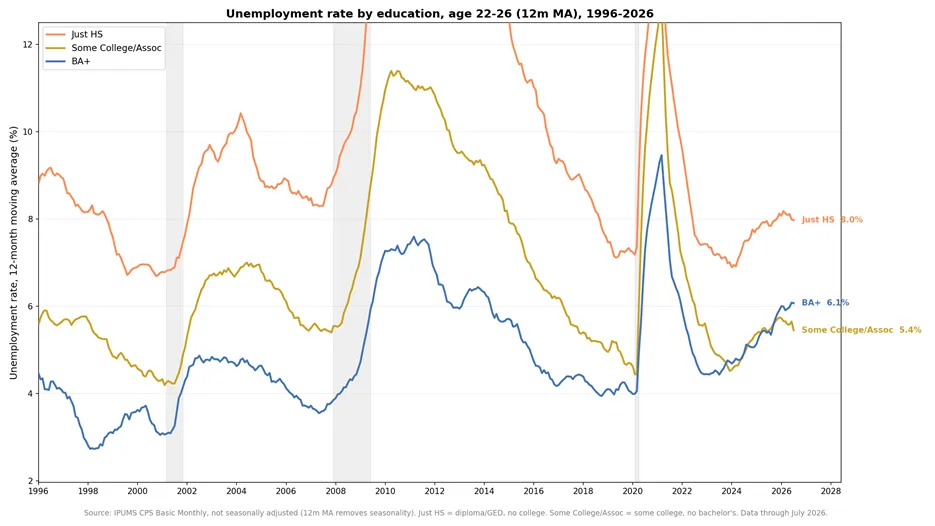
The first chart shows unemployment rates for a 5-year age group, 22 to 26 year olds, by education, smoothed as 12-month moving averages to remove seasonality. For thirty years these lines kept a stable order: more education, less unemployment. Part of that order has now inverted. Young workers with a bachelor's degree or more are at 6.1 percent, above the 5.4 percent for those with some college or an associate degree, and the once-enormous gap with high school graduates (8.0 percent) keeps shrinking.
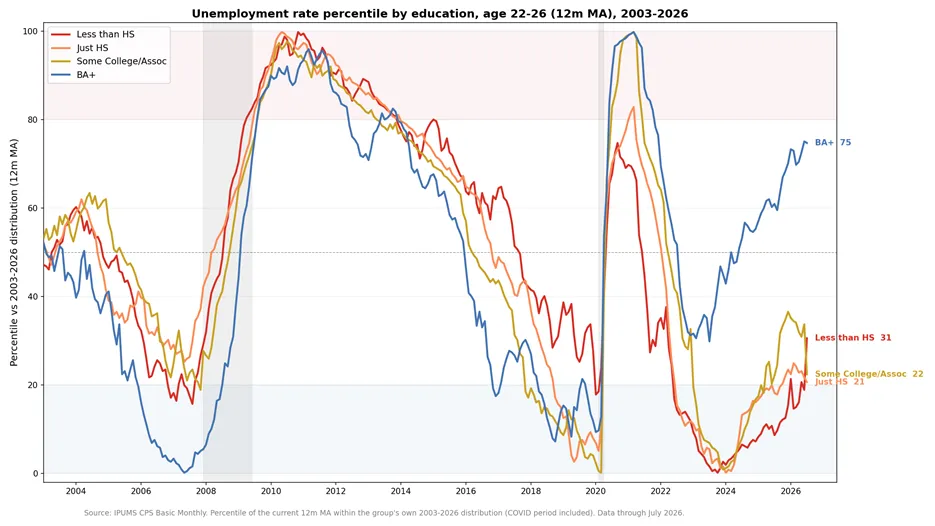
The second chart compares each group's current rate to its own unemployment-rate history since 2003, expressed as a percentile. Young BA+ workers sit at the 75th percentile of that history and are still climbing. Every other group sits near the bottom third of its distribution. For young people without a degree, this is a decent labor market by historical standards.
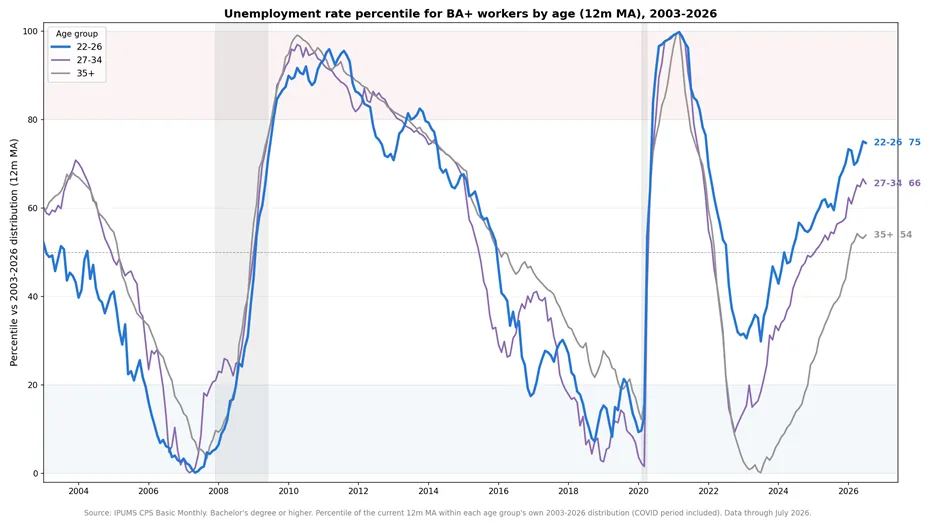
The third chart looks only at graduates and splits them by age. The deterioration follows the career ladder exactly. Graduates 22 to 26 are at the 75th percentile of their history, graduates 27 to 34 at the 66th, and graduates 35 and older at the 54th, right around normal. The problem is not college graduates in general. It's the bottom rungs of the white-collar career ladder.
Keep in mind that all of this is happening while the overall unemployment rate is 4.1 percent, low by any historical standard. This is not broad weakness. Layoffs remain rare; it's hiring that is depressed, and a low-hiring market is hardest on people trying to get in the door. You can see it in the flows: Handshake reports entry-level postings down 15 percent over the past year, with applications per posting up by more than a quarter.
These charts pose a sharp question: why is the deterioration hitting 22 to 26 year olds with a BA and not 22 to 26 year olds without one? Any explanation that blames youth in general, such as inexperience or the usual cyclical sensitivity of young workers, fails this test, because young non-graduates are doing fine. The causes have to run through the specific jobs graduates take, and I see two that do.
First, AI is likely part of the story. Entry-level knowledge work, such as drafting, coding, research, and basic analysis, is precisely what generative AI does best, while the jobs young non-graduates hold, in health care support, hospitality, construction, and the trades, involve hands and presence that AI can't replace yet. And whatever the mix of reasons behind it, the hiring freeze is concentrated in exactly the sectors that absorb new graduates: tech, consulting, and finance stopped hiring while in-person service sectors kept adding workers.
In its latest update, using ADP payroll records through June 2026, the Stanford "canaries in the coal mine" study finds employment of 22 to 25 year olds in AI-exposed occupations is now 19 percent below where it would be had it kept pace with less-exposed peers, a gap that operates through reduced hiring rather than layoffs and appears only where AI substitutes for human tasks.
Second, supply. The share of each cohort holding a bachelor's degree has been rising for decades, so every year more graduates compete for the professional entry jobs a degree is supposed to unlock, while young workers without degrees have grown scarcer, tightening the market they compete in. That trend is too gradual to explain a break in the last three years by itself. But it's the background condition that made the graduate market vulnerable: a long-building oversupply that the hiring freeze and AI turned from pressure into inversion.
The immigration crackdown has sharpened that scarcity of lower education workers: undocumented workers compete mostly in lower-education labor markets, so collapsing inflows and rising removals tighten exactly the jobs young non-graduates hold while leaving graduate labor markets untouched.
The weak situation of young college grads is happening in an economy where corporate profits are at record highs and employers are barely laying off anyone. History shows that major payroll cuts happen mostly during and after recessions. Imagine how bad this could get if the macro picture changes.