
Labor Matters: Once Again: The Story Is AI, Not Trump
Executive summary
There is some text here but focus on the charts!
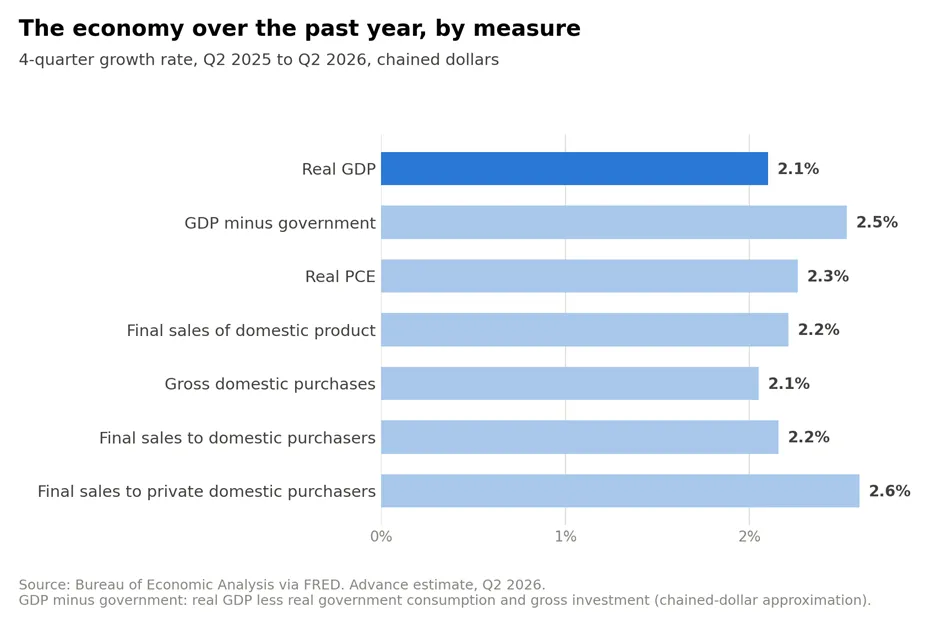
Second Quarter GDP numbers were published yesterday. The economy grew 1.5% in Q2 and 2.1% over the past year. Every broad measure of demand landed between 2.1% and 2.6%, and the private economy grew 2.5%. That's solid growth in a year of tariffs, the Iran war, federal cuts, and almost no job growth, with PCE inflation near 4% over the past year and eroding purchasing power.
· A year ago, many economists were very pessimistic about the US economy. They were watching Trump when the story was AI.
· AI capability keeps advancing, and companies, investors, and individuals are acting on it. AI's footprint in the economy, investment, capacity, and usage, will very likely keep growing for years.
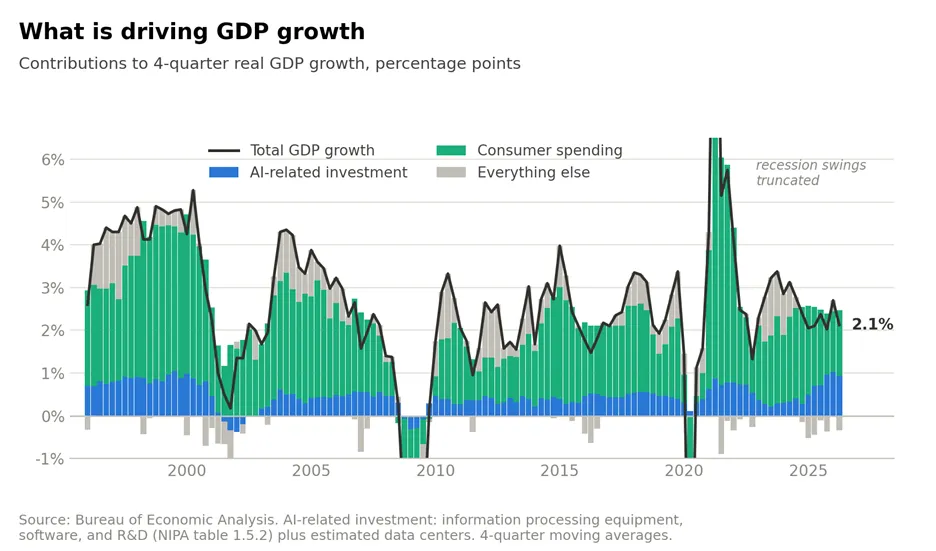
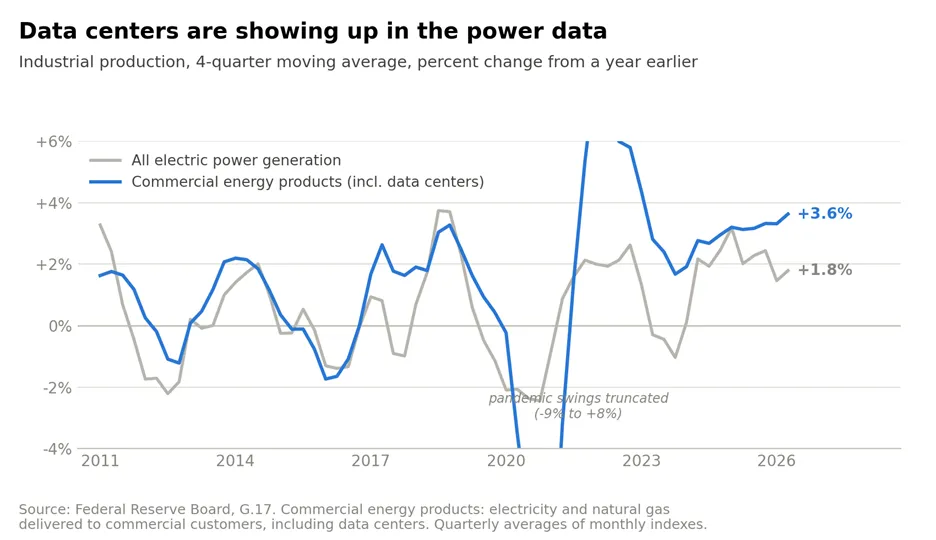
· Over the past year, AI-related investment contributed about 0.9 points to GDP growth, more than 40% of all growth and nearly the dot-com record. The buildout is visible well beyond the investment data: electricity delivered to commercial customers is growing two and a half times as fast as total generation, and advanced manufacturing is pulling away from the rest of the factory sector.
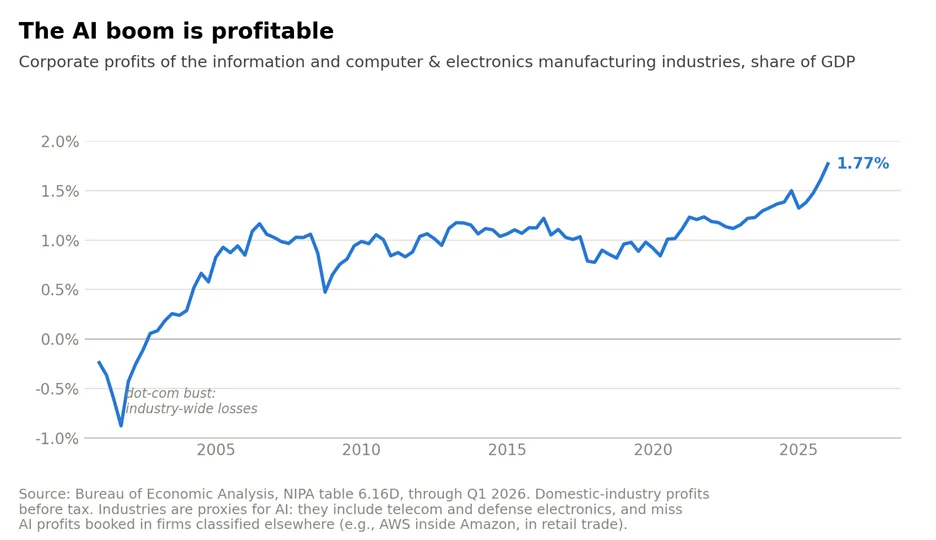
· Tech profits went through the roof, reaching a record 1.77% of GDP, and profits elsewhere grew solidly too, giving companies the cash to fund the next round of investment.
· Strong profits and optimism about AI's future drove stock prices sharply higher. Household net worth now sits near 600% of GDP, far above any historical norm.
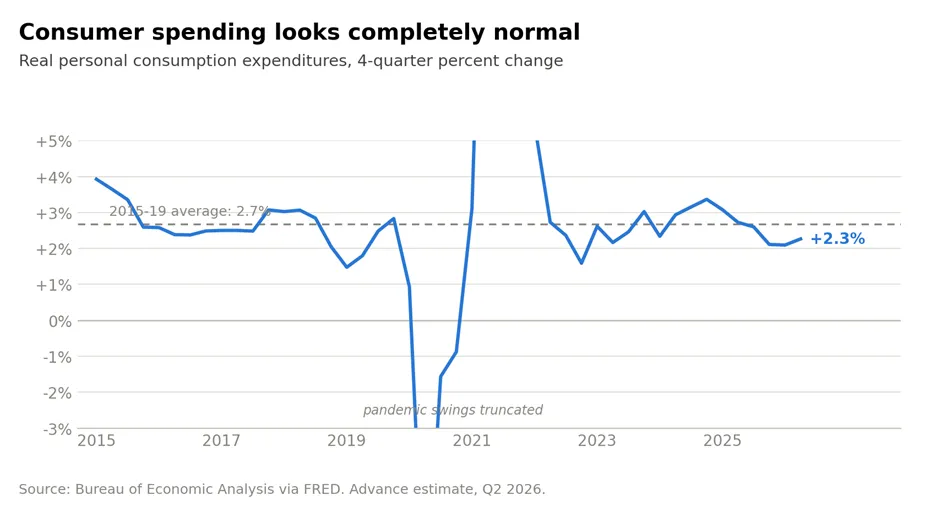
· That wealth, more than the labor market, is what's carrying the consumer. Spending grew a completely normal 2.3% and contributed about 1.5 points to GDP, despite almost no growth in jobs or real income.
· The main story: a historic economic transformation is underway, and companies, investors, and households know it. The past year proved that tariffs, a war, and federal cuts are too small to derail it.
Introduction
Yesterday's advance estimate showed the economy growing 1.5% in the second quarter, and 2.1% over the past four quarters. Now consider what the economy absorbed during that year: tariffs, the Iran war and its energy shock, federal workforce cuts, immigration restriction, almost no job growth, and historically weak consumer sentiment.
The chart below shows the past year on seven measures, each stripping out a different piece of the accounting noise. Final sales of domestic product removes inventory swings. Gross domestic purchases counts what Americans bought regardless of where it was made, removing trade. Final sales to domestic purchasers removes both. Final sales to private domestic purchasers also removes government, leaving the private-demand core. Every measure lands between 2.1% and 2.6%. Despite everything on that list, growth was solid, and the private economy, GDP minus government, grew 2.5%, faster than the total.
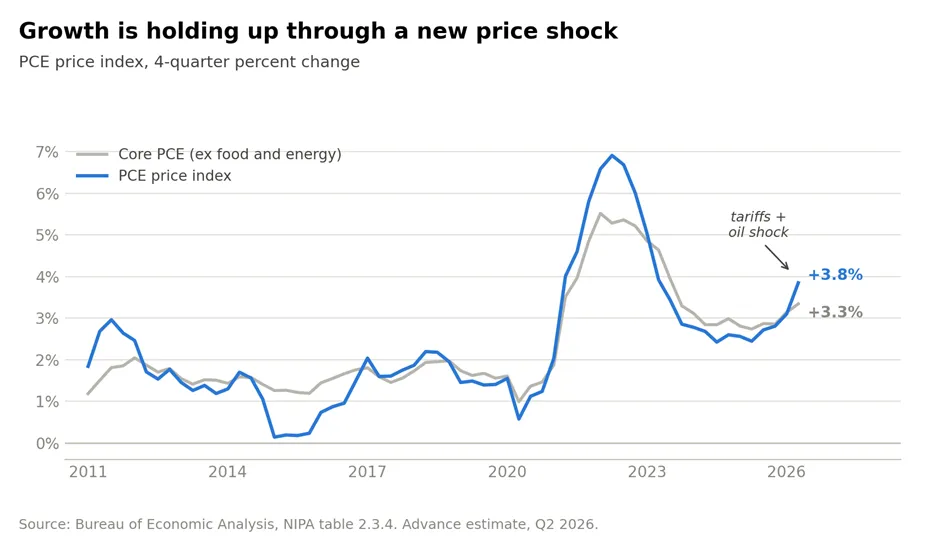
And that happened during a price shock. Tariffs are passing into goods prices and the Iran war pushed energy costs up sharply. PCE inflation is running near 4% over the past year and hit 5.1% annualized in Q2.
Two engines, nothing else
Decompose the past year's growth and the picture is stark. Consumers contributed about 1.5 points, AI-related investment about 0.9 points, and everything else combined, housing, other investment, trade, government, subtracted. Outside of these two engines, the economy has been shrinking for a year and a half.
The AI buildout
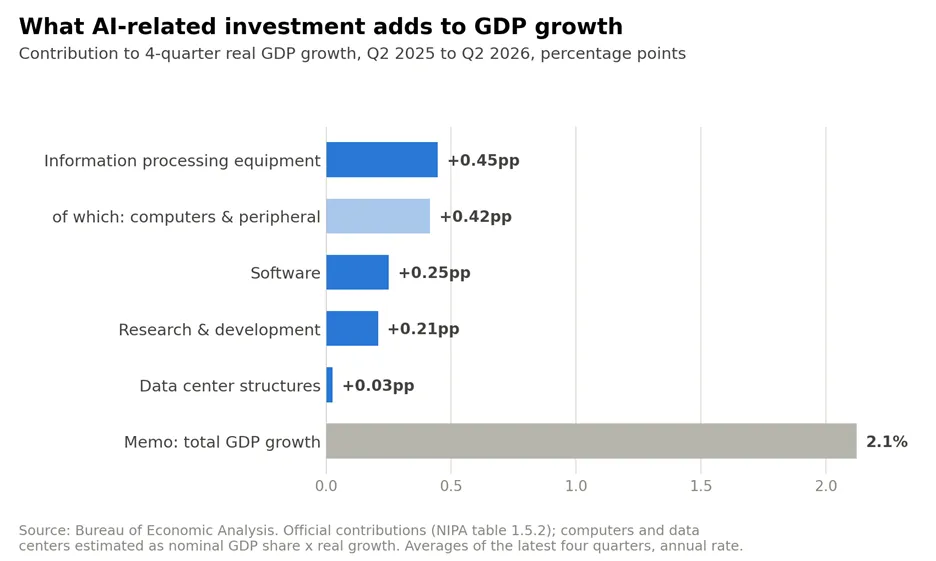
Every category where AI capex lives is growing at multiples of GDP. Investment in computers is up 44% over the past year. Data center construction is up 18%.
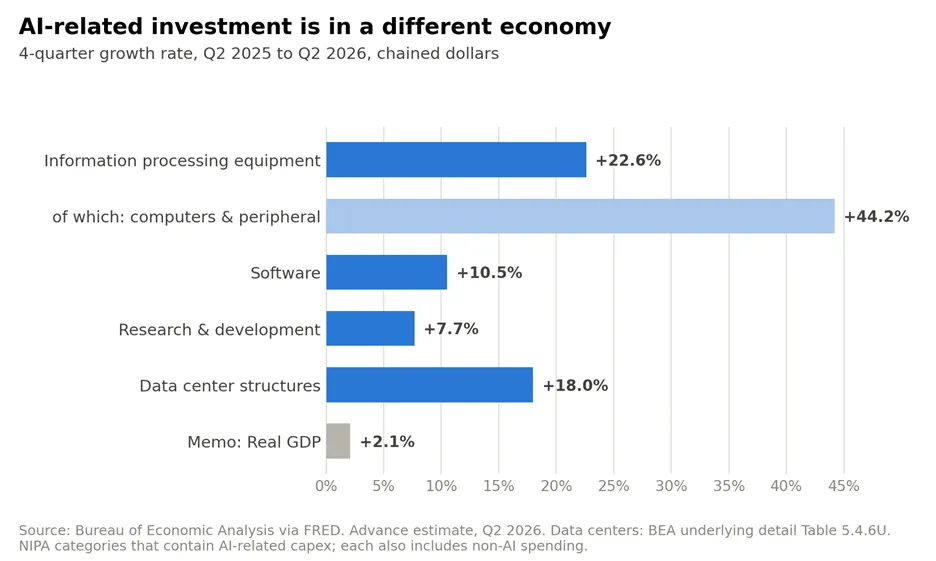
Add it up and investment in the categories most directly exposed to the AI buildout contributed 0.93 points of the past year's growth. Not every dollar in these categories is AI, so call 0.9 points an upper bound on direct attribution. But the acceleration is concentrated exactly where the buildout is occurring.
Only once in the modern data has this bucket carried the economy like this: 1999. The dot-com peak was 1.06 points. We're just below it and rising.
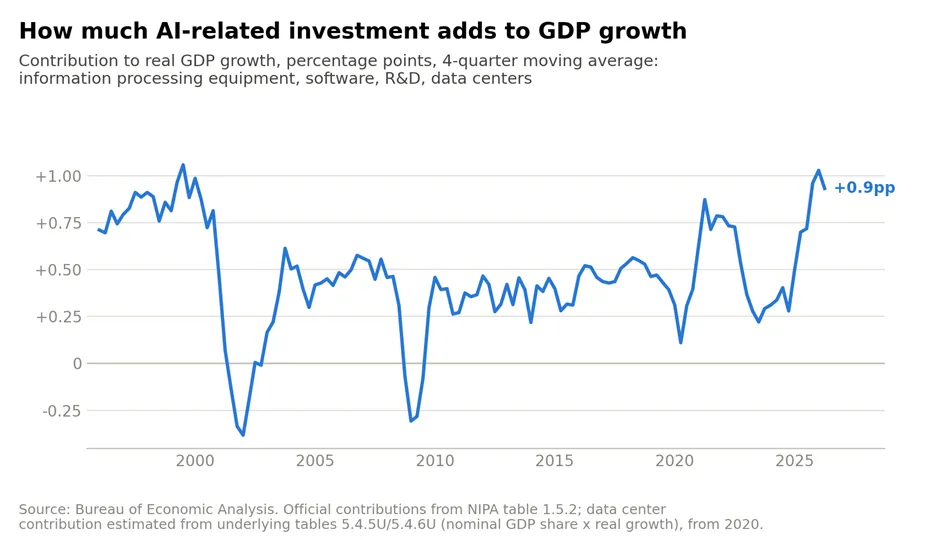
One honest caveat. These are gross figures. A lot of the hardware is imported, and imports subtract from GDP, so the gross figure overstates the domestic contribution. But subtracting the full import bill overcorrects. AI-related goods and services are also exported, mostly chips and hardware, plus foreign purchases of US AI services. And imports are valued at the port, while investment is valued installed in the rack: the freight, the margins, the installation work, the building itself, the software and the R&D are all domestic. The net domestic contribution is smaller than 0.9 points but solidly positive.
This is just the beginning
The buildout is not a one-year spree. AI capability keeps improving, and adoption is following: about half of American adults now use AI chatbots, a fifth of businesses deploy AI in production, and the federal government just opened its doors to enterprise AI. The spending plans are already on the books. In their own earnings guidance, the four largest cloud providers are planning roughly $725 billion of capital spending this year, 77% more than last, and reported revenue at the leading model companies is roughly tripling year over year. None of that guarantees the contribution to growth rises forever; investment adds to growth only while it keeps accelerating. But AI's footprint in the economy, investment, capacity, usage, is very likely to keep growing rapidly for years.
You can see it in the power lines
Electricity delivered to commercial customers, the category that includes data centers, is growing two and a half times as fast as total generation, and the gap opened exactly when the buildout started.
And in the factories
The buildout does not stop at the data center door. Much of what fills those buildings and powers them, the servers and chips, the cooling and electrical machinery, the battery and vehicle technology, comes out of exactly the factories that are pulling ahead.
US advanced manufacturing is booming, and almost no one predicted it. Since 2022, four subsectors, Chemicals, Machinery, Computer & Electronic Products, and Transportation Equipment, have driven essentially all of the net growth in US manufacturing, and they're still accelerating. They keep pulling away month after month while the rest of the sector sits flat. The divergence is consistent with the same investment boom, though AI is one of several forces lifting these sectors, alongside reshoring, defense demand, and pharma. It's advanced, knowledge-intensive production, it carries some of the largest multipliers of any sector, and it's the part that's surging.
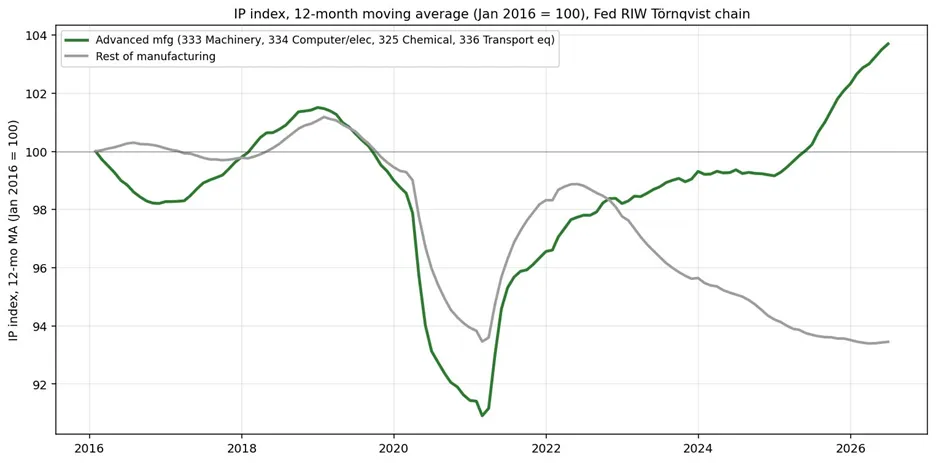
Methodology: Monthly seasonally adjusted IP indexes from the Federal Reserve. The two aggregate lines are Törnqvist chain indexes built from the Fed's published Relative Importance Weights, rebased to January 2016 = 100, shown as trailing 12-month moving averages.
The boom is profitable
Tech-industry profits reached 1.77% of GDP in the first quarter, a record, and nearly double their 2020 share. And it's not just tech: total corporate profits rose 12.8% over the year through Q1, and 9.6% excluding tech. Profits matter for this story three times over. They drive the stock prices behind the wealth effect that is carrying the consumer. They may partly reflect the efficiency gains AI is already delivering in the industries deploying it. And they let firms fund the next round of data centers and chips out of internal cash flow, making the buildout far less dependent on credit markets.
The consumer refuses to break
The chart below shows the four-quarter growth rate in consumer spending. At first glance, it doesn't look especially interesting. But then consider the headwinds consumers have faced over the past year, as economists have repeatedly highlighted: tariffs, uncertainty, historically low consumer sentiment, almost no job growth, almost no growth in real disposable income, and the Iran war.
And yet, look at the chart again. It looks completely normal. How come?
I don't have the full answer, but the wealth effect is certainly part of it. Household net worth used to fluctuate mostly between 325% and 400% of GDP. Since the mid-1990s, that relationship has broken upward. As of the first quarter, it sits near 600% of GDP, and it kept climbing this past year even as the labor market stalled. The climb is mostly equity gains, concentrated in the AI-adjacent stocks that record profits and AI optimism keep pushing higher.
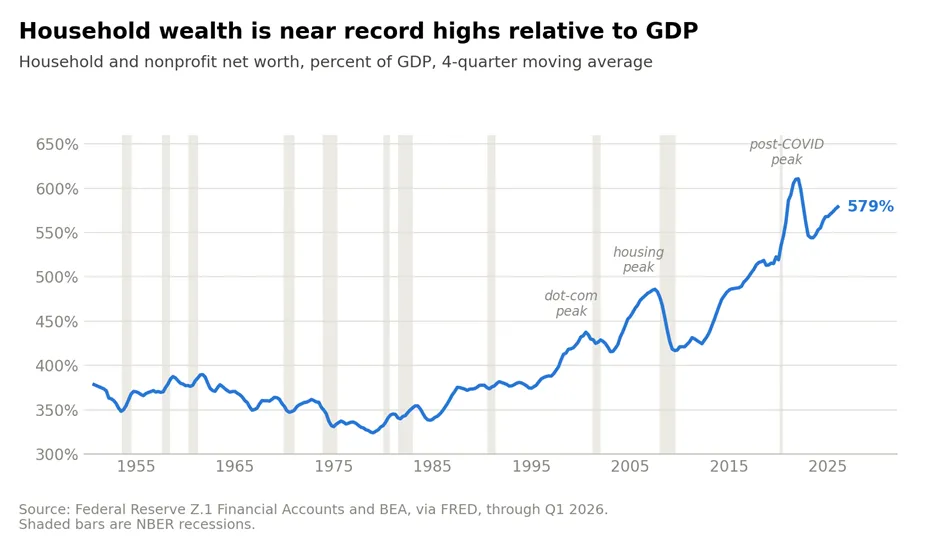
That matters because when households are sitting on that much wealth, and watching it grow, spending no longer depends only on current labor-market income. Asset gains, home equity, retirement balances, and balance-sheet strength can all support consumption even when income growth looks soft. And because there's typically a lag between wealth accumulation and spending, the gains of recent years are still feeding through now. One caveat: the wealth effect is concentrated among older, higher-income, asset-owning households.
The bottom line
The AI buildout is demanding more than the economy can currently supply, and the data show it on every front at once: record investment, visible power demand, an advanced manufacturing boom, record tech profits financing the next round, and equity wealth carrying the consumer. That set of forces absorbed tariffs, an oil shock, and a stalled labor market, and still delivered 2+% growth, with private demand growing almost 4% annualized in Q2. A year ago, the median forecast in the Philadelphia Fed's Survey of Professional Forecasters called for just 1.6% growth in 2026, and those shocks were supposed to produce a major slowdown if not a recession. The past year settled it: against a transformation this large, they were too small to derail it.
What is the message? The main story of the next 12 months is AI, not Trump.
Data: BEA advance estimate for Q2 2026 (July 30, 2026), BEA underlying detail tables, Federal Reserve G.17 and Z.1. Profits, net worth, and industry data through Q1 2026 where noted. Consensus forecast: Philadelphia Fed Survey of Professional Forecasters, August 2025. Hyperscaler capital spending: company earnings guidance.