
Labor Matters: Washington Was a Safe Place to Be a Young College Grad. Not Anymore.
For decades, the Washington region was one of the safest places in America to be a young college graduate. Recessions came and went, and the federal anchor held. In the Great Recession, unemployment among young graduates in DC, Maryland, and Virginia peaked at 4.9% while the national rate hit 5.7%. Through most of 2023, young grads in the region enjoyed roughly 2% unemployment, a full point below the rest of the country. That era ended abruptly.
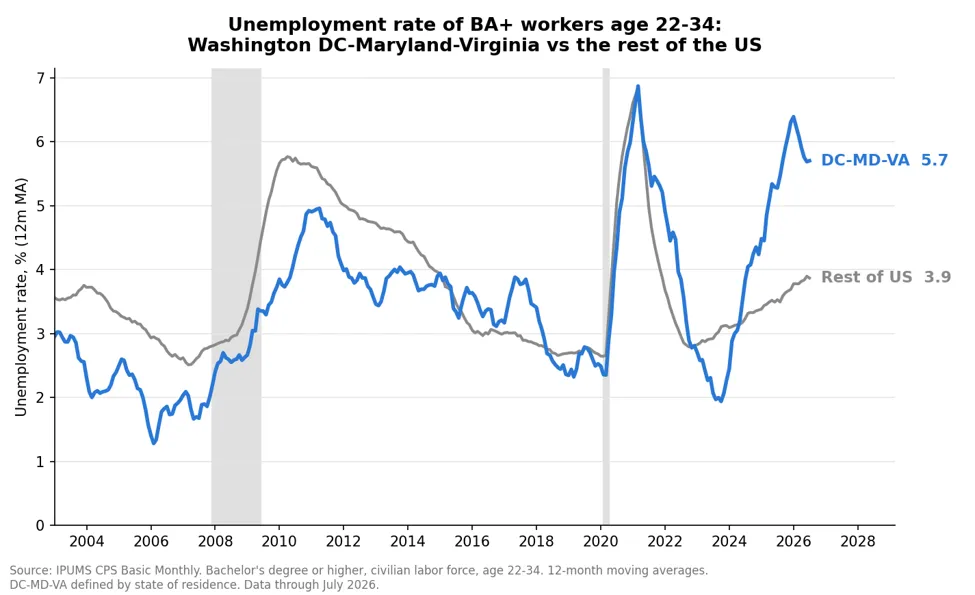
The lines crossed in 2024, and then the regional line went nearly vertical, peaking at 6.4% in early 2026 (way above the Great Recession peak!), before settling at 5.7% in July, against 3.9% in the rest of the country. Both series are 12-month averages for workers aged 22–34 with a bachelor's degree or more. Then, in the first weeks of 2025, the new administration began cutting: layoffs, buyouts, hiring freezes, and reductions in contractor and research spending.
I define the region as DC, Maryland, and Virginia combined, because many of the people working in the federal government live there. The comparisons below measure the change from a base period of January 2023 through December 2024, which ends three weeks before the first layoff announcements, to the most recent 12 months of data, August 2025 through July 2026.
Look at who got hit. If this were an ordinary regional slump, every group would suffer together, and by roughly as much as their national counterparts. That's not what happened. The region's young graduates entered the period at exactly the national rate for their group, 3.2%, and now stand nearly two points above it: 5.6% versus 3.8%. Older graduates went from below the national rate to above it. The gaps among workers without degrees moved far less.
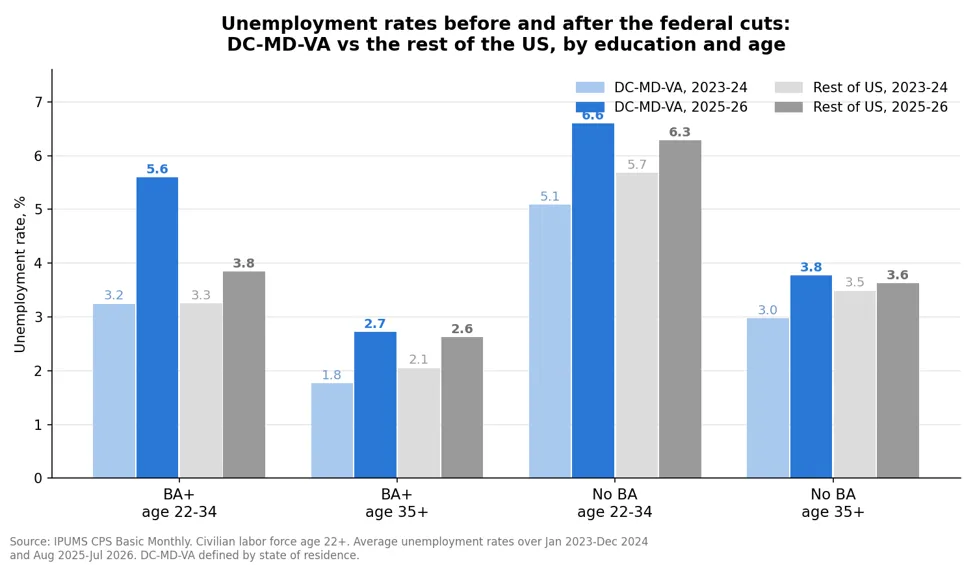
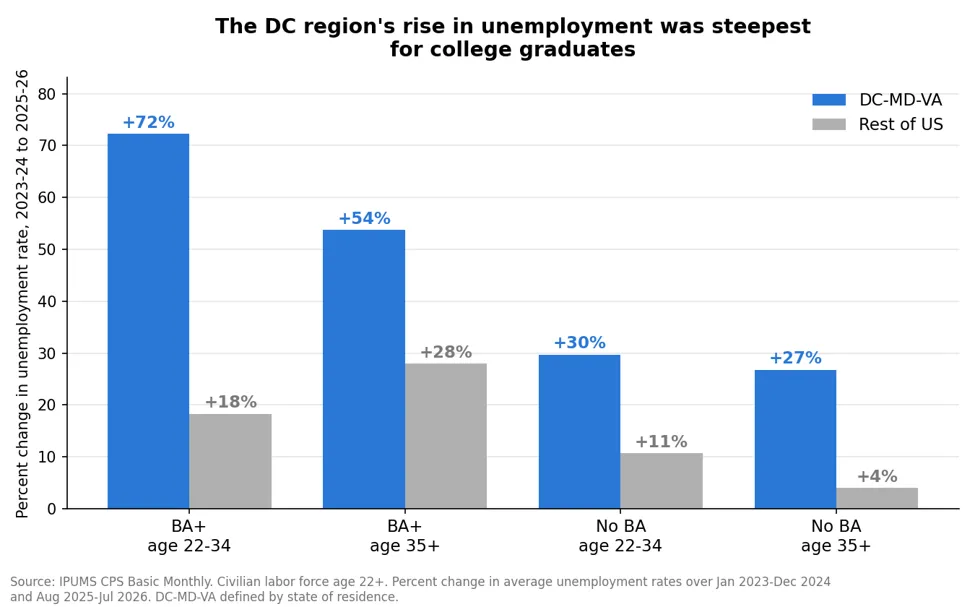
Because these groups start from very different baselines (young workers without degrees always have higher unemployment than mid-career professionals), percent changes are the cleaner comparison, and they show a clear education gradient. Unemployment rose 72% for the region's young graduates and 54% for older ones, against 18% and 28% for the same groups nationally. Workers without degrees saw increases of 27–30%, against 4–11% nationally.
That pattern fits the mechanics of federal personnel policy. Hiring freezes and probationary terminations closed the entry point, which in the federal ecosystem is degree-gated, so the heaviest damage fell on the young graduates who would have been the next hires. Buyouts and reductions in force fell on incumbents, in professional and support roles alike, which is why older workers show a meaningful excess too. The groups most exposed to federal employment deteriorated the most; the group least exposed, young workers without degrees, shows the weakest and shakiest result of the four.
It is worth noting the recent improvement in the 12-month averages, from 6.4% at the start of 2026 to 5.7% by July. That may be an early recovery. It may instead mean that some unemployed graduates gave up on the region and took their job search elsewhere, which lowers local unemployment without creating a single job. The CPS can't easily tell these apart, though migration data eventually will.
How does this end? Labor markets tend to find their way back to normal unemployment rates, and much of the adjustment here will come through migration: highly educated young people leaving the region for markets that are hiring. So regardless of whether the next administration reverses some of the cuts in federal employment, the 2025 shock will have long-term consequences. The young graduates who leave will build their careers, and their networks, somewhere else.