
Labor Matters: The Powell Fed: Five Years Above Target. And counting.
Here is a number that should define Jerome Powell's legacy: core PCE inflation—the Federal Reserve's own preferred measure, and the benchmark it explicitly chose as its north star—has been above the Fed's 2% target for nearly five years and counting. The most recent reading, for April 2026, came in at 3.3%—up from 3.2% in March, still accelerating. One and a third percentage points above target.
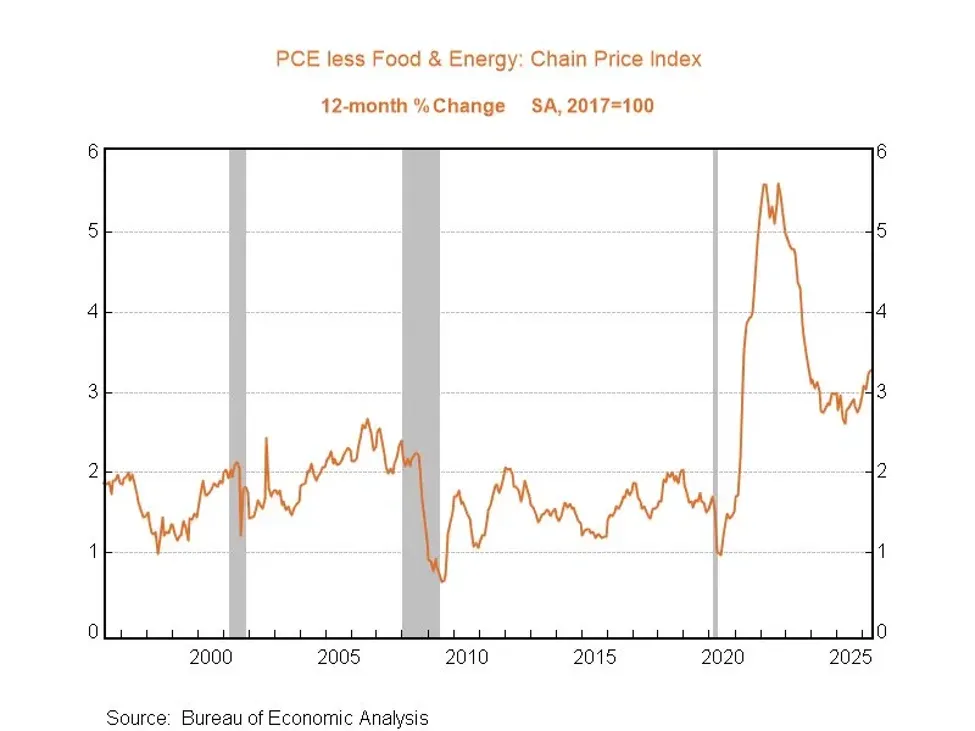
For a generation before the pandemic, core PCE sat mostly between 1.5% and 2.5%—if anything, below target more often than above. Then it exploded to 5.6%. The disinflation that followed was real and came faster than the Fed had feared—the clearest sign its credibility survived the shock. But it stopped short. Core PCE has spent two years stuck near 3%, and lately it is drifting back up. It never closed the last mile to 2%.
With Powell's chairmanship now ended, we can assess his record on the metric he chose for himself. At several critical junctures, the Powell Fed chose the more accommodative option: too slow to tighten in 2021–2022, too quick to ease in 2024–2025. That asymmetry is the story.
The First Error: Asleep at the Wheel
Inflation began accelerating in spring 2021. CPI hit 5% by May. The Fed's response? Nothing. Rates stayed at zero. Quantitative easing continued at $120 billion per month. The Fed was adding monetary stimulus while inflation ran at multi-decade highs.
The justification was “transitory”—a word Powell used repeatedly until finally retiring it in December 2021. By then the damage was done. The Fed did not begin raising rates until March 2022, starting with a timid 25 basis points. The fed funds rate did not hit 1% until May 2022, 9-12 months too late.
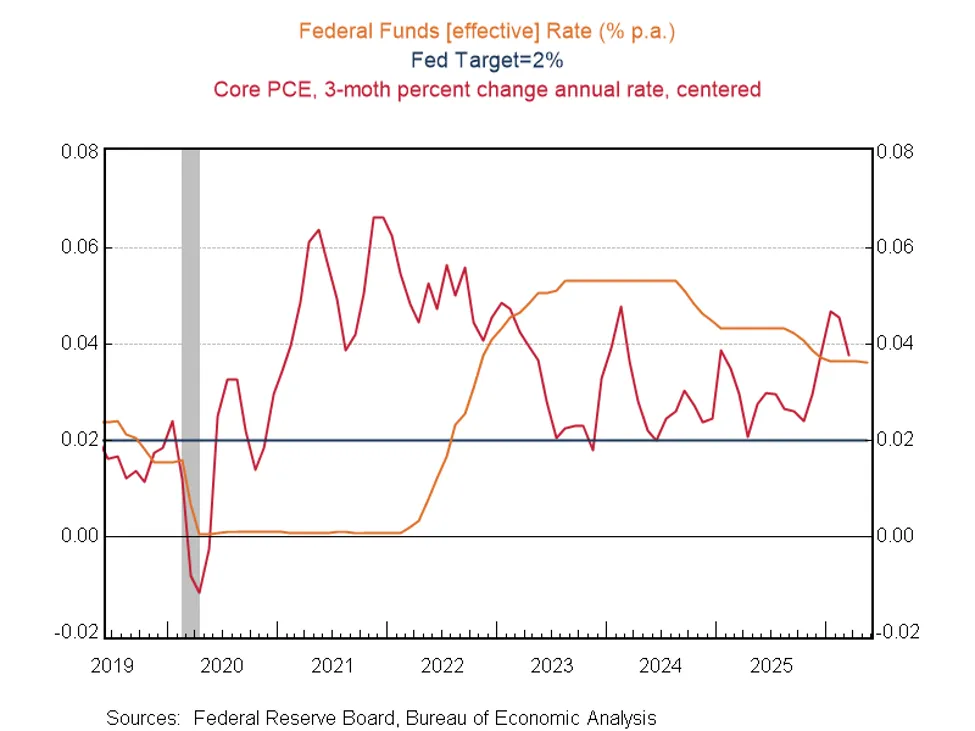
The Taylor Rule had been signaling the need for hikes since mid-2021. Labor markets were extremely tight by late 2021—quits at record highs, wages accelerating—yet the Fed sat at the zero bound. Housing prices surged nearly 19% in 2021, fueled by ultra-low mortgage rates the Fed was actively maintaining, embedding shelter inflation into CPI for years to come.
A History of Wishful Thinking
One chart captures the Fed's systematic bias better than any narrative. Track the Fed's Summary of Economic Projections for core PCE over time—its forecasts for 2022, 2023, 2024, 2025, 2026, 2027—and every single line slopes upward. For every single year, the initial projection was too low and had to be revised higher.
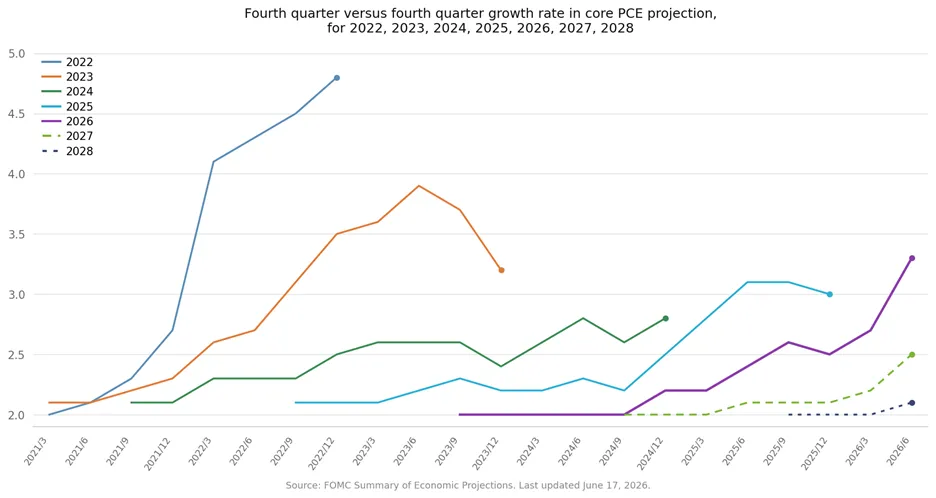
Fed median core PCE projections by forecast year, per meeting. Updated through June 17, 2026. Source: FOMC Summary of Economic Projections.
How to read this chart: each line represents the Fed's inflation forecast for a single calendar year—not the actual data. The horizontal axis shows when the forecast was made, meeting by meeting. A flat line would mean the Fed held its original call. An upward slope means it kept revising higher. Every single line slopes upward. The December value is very close to the actual realized inflation for that year, so the gap between where a line starts and where it ends in December is essentially the size of the miss.
This is not a one-time forecasting error. It is the same mistake repeated across five years and radically different economic conditions. The Fed has spent half a decade telling us inflation will return to 2% next year. It is always next year.
Forecasting is genuinely hard, and we should be honest about that. But the systematic direction of the errors is not random bad luck—it is bias.
The Second Error: Cutting Before the Job Was Done
If the first error is now nearly consensus, the second is more contested but may prove equally consequential. Between September 2024 and December 2025, the Fed cut rates by 175 basis points. It began with an aggressive 50-basis-point cut—a move that signaled urgency the economy did not warrant. GDP was growing above trend. Asset prices were at or near records. Inflation was above target.
The Fed's justification was a softening labor market: slowing payrolls, rising unemployment, and the Sahm Rule triggering. But there is strong reason to believe these signals were misread. For two reasons.
First, throughout 2024 and 2025, GDP growth remained robust while hiring slowed. The conventional interpretation—the economy is weakening—assumes that jobs and output move together. But what if they were decoupling?
Productivity gains allowed firms to produce more with fewer workers. If this interpretation is correct—and the macro data is increasingly consistent with it—then weak payroll growth alongside strong GDP is not a recession signal. It is a structural transformation. The Fed treated it as cyclical weakness demanding rate cuts.
The broader picture told the same story. Capital expenditure on AI infrastructure—data centers, chips, cloud computing, power generation—was surging at a pace comparable to the internet and shale buildouts of prior decades. Household net worth rose sharply on the back of technology stocks posting dramatic gains in revenue and profitability. You do not get a recession in that environment.
Second, the rise in the unemployment rate in 2023-2025 was only partly a result of the weakening in job growth. The massive immigration from the southern border was also an important factor. Many of the new immigrants stayed in the US and joined the labor force within several months.
The Fed did not distinguish a labor supply expansion from a weakening economy. The unemployment signal was distorted by a supply-side shock the Fed was late to detect.

The Fed, reading payroll and unemployment numbers through a cyclical lens, missed the structural transformation happening beneath the surface. The result: 175 basis points of cuts that may have been built on a fundamentally wrong model of the economy, adding monetary fuel that pushed the return to 2% further out of reach.
The Verdict
A fair assessment requires noting what Powell got right. His March 2020 crisis response was fast, decisive, and probably prevented a financial catastrophe. Once hiking began in 2022, the pace was aggressive and ultimately brought inflation down from its peak. He also navigated intense political pressure from two administrations: Trump repeatedly demanded rate cuts both in his first term and after returning to office in 2025, at times publicly calling for Powell's removal. Powell held his ground. That institutional independence mattered, and it deserves credit.
But on the Fed's own stated metric—the one the institution chose, reaffirmed, and built an entire framework around—his tenure was a failure. Five-plus years above target is not bad luck. It is the cumulative result of a systematic dovish bias that consistently chose accommodation over restraint and hope over data.
Part of the explanation is institutional. Powell was not an economist by training, and in moments of uncertainty he leaned heavily on the staff and the profession’s consensus. From 2021 through 2025, that consensus was repeatedly too optimistic on inflation.
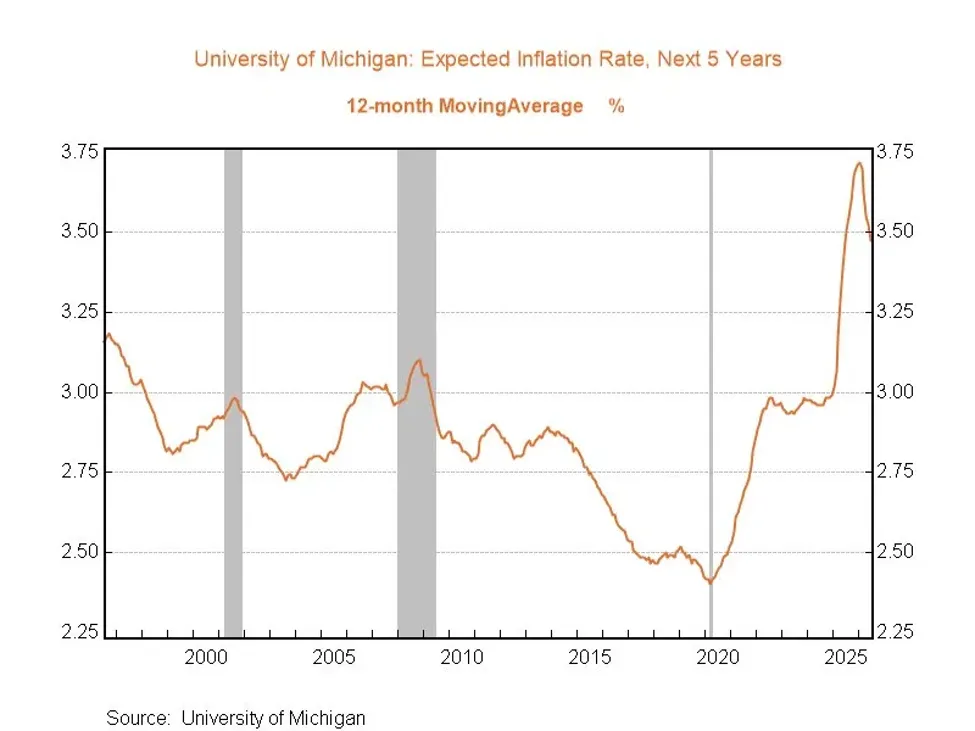
The consequences are visible. For decades the Fed worked to anchor inflation expectations. If people believe inflation will stay low, actual inflation is more likely to stay low. Unfortunately, households’ long-run inflation expectations have climbed to their highest in decades, recently near 3.5%—far above the range that held for a generation.
Kevin Warsh, now Chair, inherits an institution whose credibility on price stability has eroded. The 2% target increasingly looks like an aspiration rather than a commitment. Restoring it will require the willingness to be unpopular in the service of doing the job. That has always been the hardest part of being Fed Chair. For five years, it went undone.
The public was repeatedly told 2% was just around the corner.
It wasn’t. It still isn’t. And that is the Powell legacy.