
Labor Matters: The Economy’s Real Story Isn’t Trump. It’s AI.
he dominant narrative about the 2025 U.S. economy was wrong. While many fixated on political risks and recession warnings, the real story is the AI-driven growth surge. Massive investment in AI infrastructure and a booming “implementation economy” are driving demand before productivity gains even fully show up. Wealth effects and strong profit margins are reinforcing the cycle. Meanwhile, policy fears like tariffs proved less damaging than expected. With productivity already accelerating and multiple tailwinds in motion, strong growth isn’t the upside case—it’s the new baseline. The macro conversation needs to catch up to this reality.
New Data – New Narrative
After weeks of radio silence during the government shutdown, the data flow finally restarted—and we got a lot of releases in a short span. The numbers mattered, but the bigger lesson was conceptual: it is clear to me that a lot of the commentary over the past year has been anchored to the wrong storyline.
The dominant framing error was treating the U.S. economy as fundamentally weak and recession-prone—constantly one shock away from stalling. A better baseline is the opposite: above-average growth, because we’re in the early stages of a once-in-a-generation technological shift.
And this isn’t just a story about the future. A growing set of estimates—across economists, banks, and research groups—attribute a large share of U.S. GDP growth in 2025 to the AI buildup: data centers, chips, power infrastructure, and the software investment that comes with deploying AI at scale. Measured productivity has already accelerated, and more gains are likely to follow.
The Correct Narrative:
Generative AI raises the economy’s “speed limit” through multiple channels. Two of them can lift aggregate demand even before the broad productivity gains show up cleanly in the official statistics.
First: the AI investment boom. Scaling AI isn’t just about training frontier models—it’s about running AI everywhere. That requires massive spending on physical infrastructure: compute, storage, power, and cooling. Those outlays hit GDP directly through construction and equipment, and then spill into the next layer: grid upgrades, transformers and substations, backup power, fiber buildout, and a long construction and manufacturing supply chain.
Second: the AI implementation economy. Most firms don’t adopt AI by flipping a switch. They spend to make it work: cloud migration, data integration, cybersecurity and compliance, workflow redesign, training, and ongoing software and inference costs. In practice this looks like budgets moving toward cloud and data modernization, security, and the consultants and internal teams needed to rewire workflows—real demand for professional and IT services, even if headcount growth stays subdued.
A crucial but often overlooked driver of the AI buildup is the startup surge. Thousands of new AI-focused firms have launched in the past year, creating demand for compute, cloud services, data infrastructure, and engineering talent. That activity directly amplifies the investment cycle: more startups mean more funding, more spending on infrastructure, and faster deployment of AI into the real economy.
Then come the reinforcing loops—channels that make demand and growth more resilient.
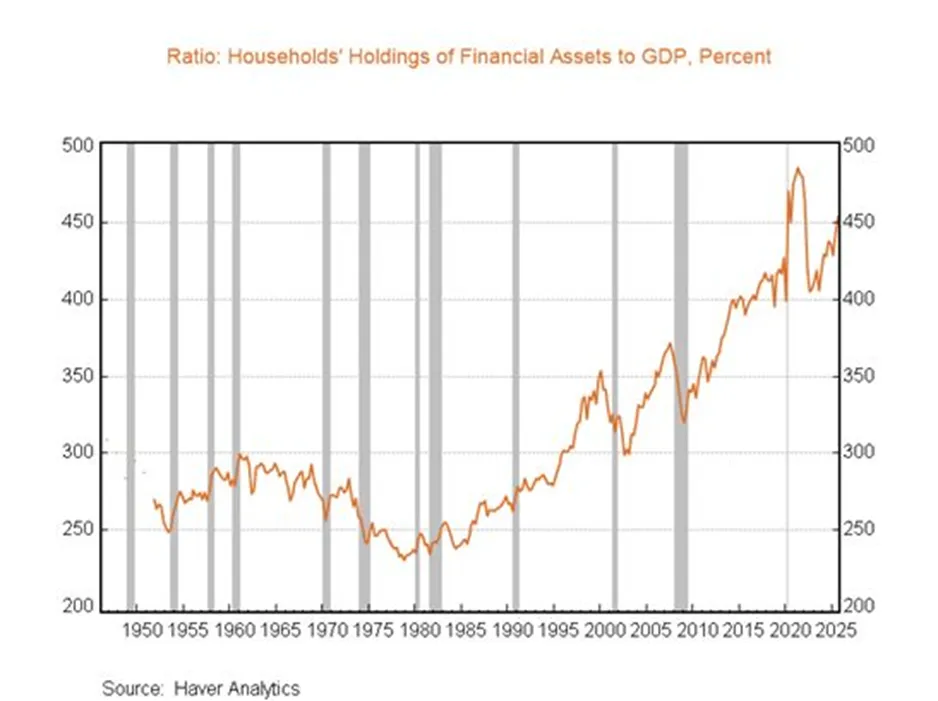
Start with the wealth effect, which is underweighted in public debate. U.S. households’ financial assets have risen from roughly 250–300% of GDP in earlier decades to around 450% today, driven heavily by equity wealth—and disproportionately by large tech firms that dominate major indexes and flow into millions of 401(k)s and IRAs. The mechanism isn’t that households sell stock to spend; it’s confidence and balance-sheet relief. When portfolios look healthier, people feel less need to over-save and more able to keep spending, even when wage growth cools or hiring slows. The tailwind is concentrated, but at the macro level it’s meaningful.
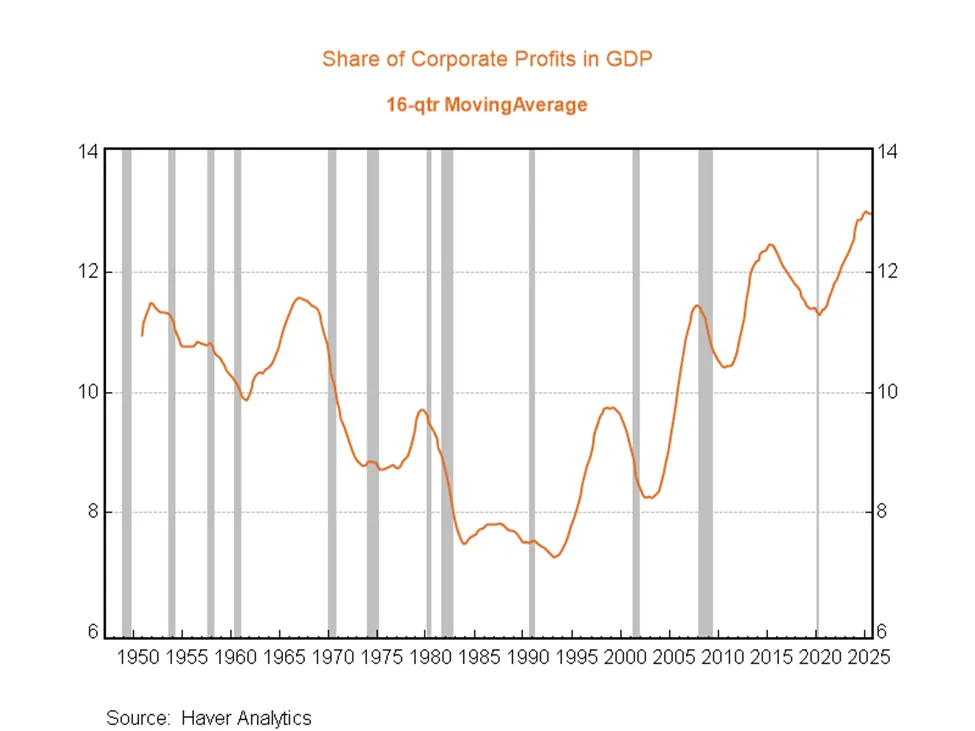
Then there’s the profit channel. In this cycle, the combination of strong top-line growth in AI-linked sectors, improving efficiency in many white-collar processes, and still-contained hiring in parts of the economy has supported margins. The share of profits in GDP is at an all-time high. And profits self-reinforce: they fund the next round of investment, they reduce reliance on external financing, and they make firms more willing to build capacity ahead of demand. That’s how an “efficiency” story turns into a growth story: better margins widen the set of projects that get greenlit.
Put it together and the conclusion is simple: in this environment, strong growth isn’t the upside case—it’s the baseline.
So why did so much of the 2025 conversation start from a weaker baseline? Because it started from politics—specifically, forecasts about how damaging Trump’s policies would be. Some of those impacts were real, but many were overestimated relative to the size of the AI tailwinds.
Take tariffs. The dominant fear was a straight chain: tariffs → higher inflation → weaker real incomes → slower consumption → softer GDP. That didn’t happen at scale. That doesn’t mean tariffs had zero price effects—it means the macro chain didn’t propagate the way the recession narrative required. Prices didn’t re-accelerate the way many projections implied, and consumption didn’t roll over.
The uncertainty channel was closer to reality: uncertainty spiked in April and May, firms hesitated, and some plans were paused. But it faded faster than expected—and once it did, activity re-accelerated.
Bottom line: Despite recession predictions in the spring and summer of 2025, GDP and Consumption growth rates in the second half of 2025 were strong. This is one of the biggest forecast misses in recent decades.
That’s the right synthesis: AI-driven investment and implementation have raised the baseline, and the policy shock ended up smaller and shorter-lived than the recession story required. Those dynamics are likely to continue—AI capex plus the implementation boom, reinforced by profits and household balance sheets.
Strong growth in 2026 shouldn’t be treated as a surprise. It’s the base case.