
Labor Matters: The Economic and Labor Market Outlook
After yesterday’s jobs report—with the annual benchmark revisions—it’s a good time to take stock and look ahead. The revisions reinforce the key point: unusually weak private-sector job growth began in 2024—before the current administration—so any narrative that pins the slowdown on politics has to explain why it started earlier. This outlook piece is very different from most of what’s out there, because most takes are missing the main story. The story isn’t Trump. It’s AI.
A lot of commentary still debates whether economic growth is weak or strong. Enough with this. The economy isn’t weak. Real growth is running roughly 2.5–3.5% at a time when population growth is close to zero. And it’s not hard to see why: we’re at the beginning of a once-in-a-generation (century?) technological improvement, and the build-up for this new world is a major positive shock to the economy. On top of that, huge wealth gains—driven by the valuation of tech companies—and record corporate profitability, supported by rapid productivity growth, provide a major boost to household and corporate spending.
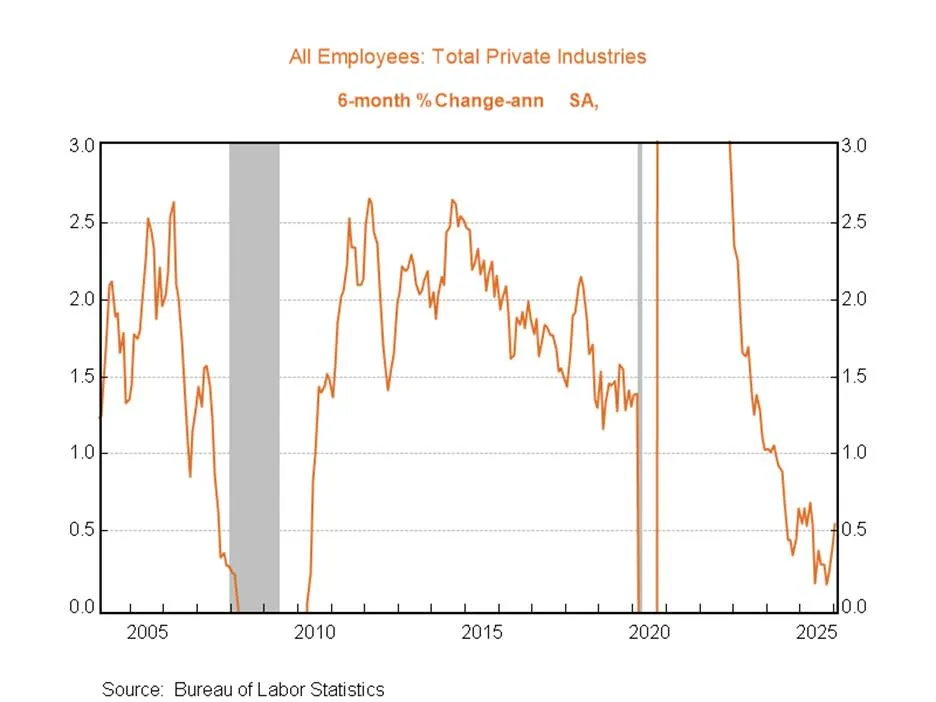
The puzzle—solid GDP alongside soft job growth—isn’t a mystery if you start from productivity: the economy can expand with fewer new hires when output per worker is rising, especially in the white-collar core.
My main narrative for the past year is simpler: the story isn’t Trump. It’s AI.
I don’t think AI is the only reason job growth has been this weak. But every passing month pushes me to give it a larger weight.
The alternative explanations are getting harder to sustain. The “reversing excessive hiring in 2021-2022” story was plausible a year or two ago, but it doesn’t explain why weakness keeps extending. And the “it’s just the Fed” story is also fading: rate hikes ended 2.5 years ago, yet hiring hasn’t snapped back.
Meanwhile, the evidence pointing toward AI keeps accumulating. Firms are increasingly explicit—earnings calls and layoff announcements now routinely cite AI and automation as part of the rationale. We’re also seeing the mechanism: not just job cuts, but anticipatory hiring reductions—teams freezing or slowing hiring because they expect AI tools (Claude Code and others like it) to absorb work that would have required additional headcount. That combination can produce weak payroll growth alongside still-solid output.
If AI and platformization are part of the story, the labor-market weakness shouldn’t be evenly distributed across industries—and it isn’t. The sector breakdown makes this visible in a way the headline number can’t.
Source: Bureau of Labor Statistics
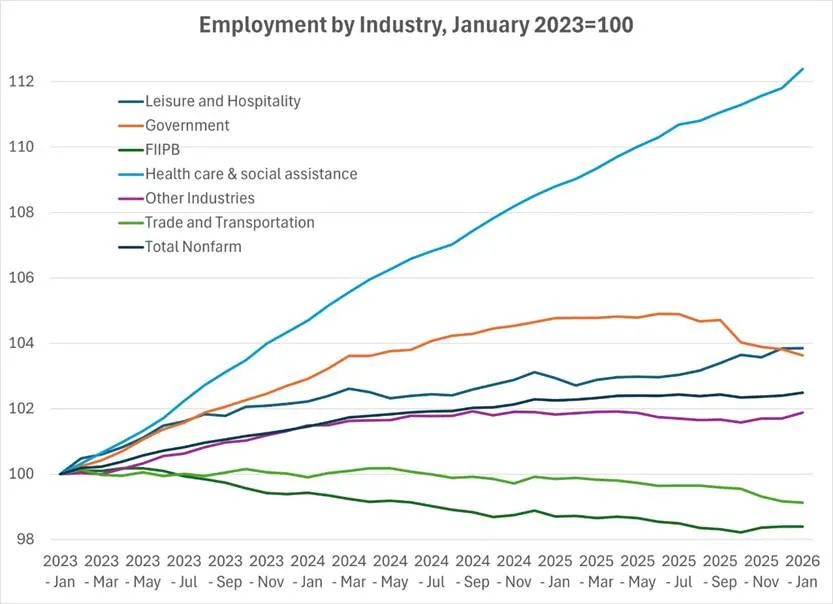
The chart above shows employment by industry groupings, indexed to Jan 2023 = 100. While total nonfarm employment was pretty flat through 2025, that “flat” is hiding a big sector rotation.
Who’s carrying the labor market? Health care & social assistance is doing the heavy lifting. It’s been the most consistent source of job growth since 2023, and it’s still accelerating. Leisure & hospitality—restaurants, hotels, entertainment—has also been adding jobs lately. Perhaps wealth-effect spending?
Who’s dragging it down FIIPB is shrinking. That’s Finance, Insurance, Information, and Professional & Business Services — basically the white-collar core: back office, professional services, tech/info, and a lot of the “coordination” work inside firms. Trade & transportation is also down.
Those two buckets are where you’d expect the most pressure from technology and platformization: e-commerce keeps taking share, automation of warehousing is scaling, workflows keep moving into a smaller number of scaled systems, and AI is starting to compress the amount of labor needed for a lot of routine knowledge work and coordination.
One more notable shift: government employment fell sharply in 2025 after rising earlier in the cycle.
Stepping back, this composition story is exactly why GDP can look fine while payrolls don’t. The capex wave in data centers, cloud, and automation is boosting measured output and activity, but it’s capital-intensive and doesn’t translate into broad-based hiring—another reason the economy can feel “stuck” in the topline jobs number while plenty is happening underneath.
The Unemployment Rate
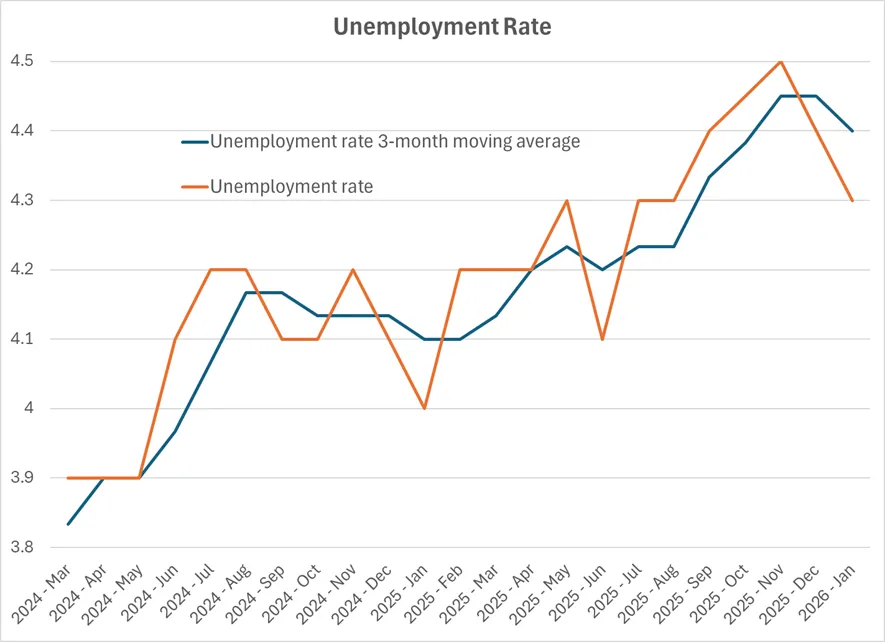
The chart below shows a clear rise in unemployment from June through November 2025 (orange line), enough that it looked like the start of a new uptrend (I’ve added an interpolated unemployment rate for October 2025 to fill in for missing data). But the last two readings pull back meaningfully, consistent with the idea that the mid-2025 jump was more of a temporary bulge than a new upward trend.
Source: Bureau of Labor Statistics
My read is that the increase was driven by three identifiable, largely one-off forces that are now fading. First, federal job cuts: federal employment has dropped sharply since early 2025, and when a large employer shrinks quickly it mechanically lifts unemployment—likely explaining roughly a third of the rise.
Second, private hiring slowed during the spring “tariff panic,” with private payrolls (outside health care) declining from April to October. But that phase has already passed, the panic is over, and hiring appears to have stabilized—at still an historically low rate.
Third, the January government shutdown likely added measurement noise through delayed hiring, temporary misclassification, and disrupted survey timing—effects that should be behind us and may even unwind.
Put together, the shocks look transitory. And the unemployment rate is unlikely to increase further in the near future despite the weak job growth.
How come? Immigration policy. Even with weak hiring, unemployment doesn’t have to rise if labor supply is tightening at the same time.
Southwest land border encounters (orange, left axis) collapse from very elevated levels in 2021–2023 to near-zero by 2025. At the same time, ICE book-ins to detention/arrests (blue, right axis) move the other way—rising gradually and then surging sharply under the new administration. Read together, it’s a stark picture: fewer new inflows showing up at the border, alongside a much more aggressive interior enforcement posture.
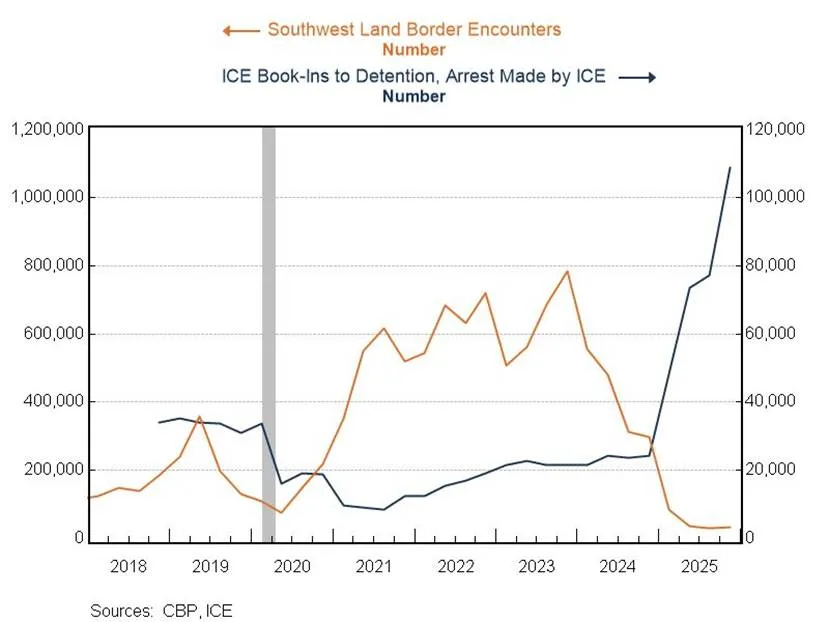
But perhaps the most consequential channels for the labor market are largely unmeasured here. We can’t directly plot how many undocumented immigrants voluntarily left the U.S., or how many stopped going to work because the perceived risk of enforcement rose.
All of these trends are moving meaningfully, and immigration policy is likely producing a major squeeze in labor supply. That would tighten the labor market disproportionately in occupations and geographies with high concentrations of undocumented workers, raising the odds of localized labor shortages and wage pressure even if the national unemployment rate looks stable.
While the overall unemployment rate barely increased between mid-2024 and January 2026, there were groups for which unemployment did rise more significantly. Young people—especially those with a college degree—did experience a more significant worsening of their labor market conditions. Here again I believe AI is playing a role because of its bigger ability to do the tasks currently done by new entrants in many office-based jobs. I’ll write more about this in a separate post.
In sum, I predict strong GDP to continue in 2026, but at the same time job growth is likely to remain weak—though not as weak as in the second half of 2025. In other words, productivity growth will remain strong.
One important caveat: even if the macro numbers look fine, it’s easy to see why many people feel bad about the economy. Weak job growth changes how the economy feels—fewer opportunities, less mobility, and more anxiety even for people who are employed. Layer on top of that the fear that AI will reshape (or eliminate) parts of their future career path, and the “K-economy” reality that some households are benefiting a lot from asset gains and strong demand while others are not, and you get a gap between solid GDP and sour sentiment that isn’t irrational—it’s lived experience.
I don’t expect the overall unemployment rate to change much, but I do expect the labor market conditions of new college grads to get even worse. On the other hand, the blue-collar labor shortage is likely to continue as demand for these workers continues to rise. AI is less likely to take these jobs in the coming years. At the same time, immigration policy will continue to squeeze labor supply for these occupations.