
Labor Matters: One jobs report, two stories
Today's jobs report carries a clear message: hiring has firmed up over the past few months after last year's soft patch. But the more important story isn't in the monthly payroll number at all. It's why the economy keeps growing at a solid pace while job growth stays historically weak — and the answer is AI.
The cyclical story: the scare has passed
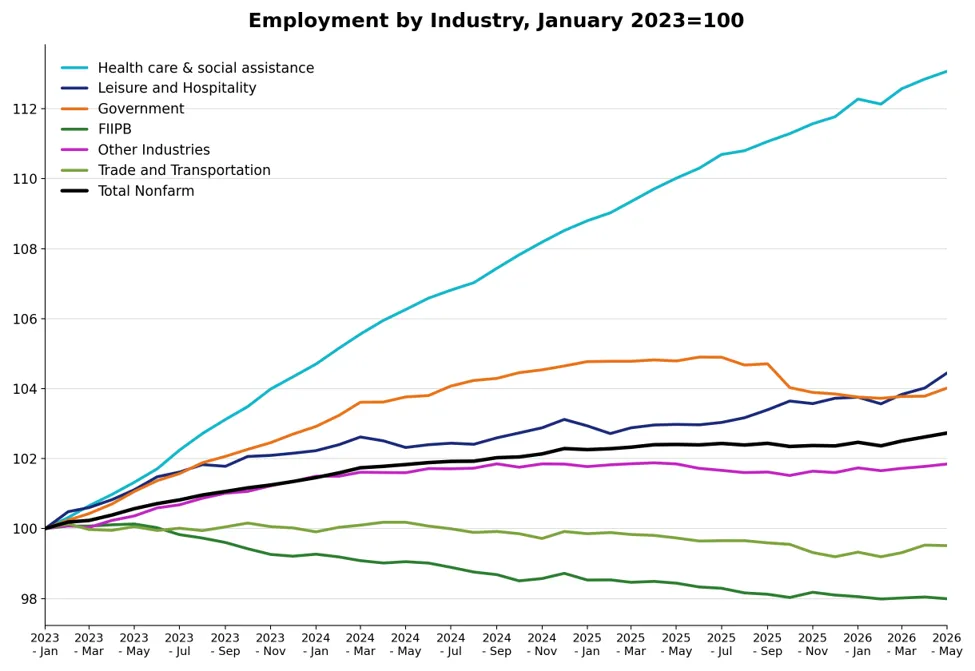
Rewind about twelve months. Around the "Liberation Day" tariff shock of April 2025, hiring genuinely softened. Momentum rolled toward zero, and recession fears spiked. For a moment it looked like the negative-shock narrative might finally be right.
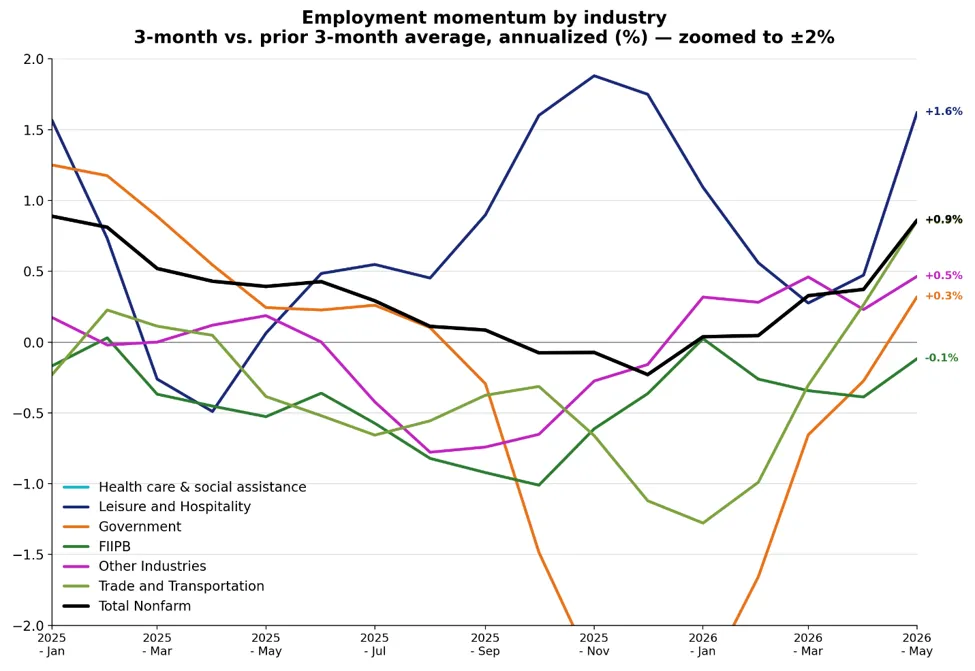
It wasn't. No recession materialized, none is in sight, and the economy is doing fine. As that realization sank in, hiring firmed back up. The turn is real, not a blip: total nonfarm momentum bottomed near zero in late 2025 and has snapped back to roughly +0.9% (three-month over prior three-month, annualized), with leisure & hospitality (+1.6%) and trade & transportation (+0.9%) leading the bounce. Even government is climbing off its trough as the federal drawdown passes.
How AI is actually carrying the economy
Here's what most commentary misses. Economists spent the past year cataloguing headwinds — tariffs, immigration restriction, federal layoffs, war with Iran, general uncertainty. Every one is real. And yet the economy shrugged them off. Why?
Because we are in the middle of a once-in-a-century technological boom, and it is showing up in the hard data now — not someday. Start with investment. Spending on data centers, chips, cloud infrastructure, software, networking, and the power to run it all is surging: investment in R&D, software, and information-processing equipment just contributed about 1.5 percentage points to GDP in a single quarter — the highest reading in 65 years of data, above even the dot-com peak.
That capex adds to GDP directly, today. Then it multiplies. The infrastructure buildout pulls in construction, heavy equipment, transmission, and cooling far beyond the tech sector itself. Suppliers' revenue becomes workers' income and the next round of investment. Fat margins in AI-exposed industries fund still more capex and buybacks. Soaring tech valuations have added trillions to household wealth, pulling consumer spending forward even as hiring slowed. Each channel reinforces the others, so the initial boost gets amplified through the whole economy.
Add it up and AI is contributing well north of the overall growth rate of GDP. The policy headwinds are real. The AI tailwind is just bigger.
Why weak hiring isn't weakness
This is also why the jobs and GDP numbers seem to disagree. Output keeps rising while employment grows slowly because productivity is accelerating in exactly the sectors most exposed to digital tools and AI — finance, insurance, information, professional and business services, retail, advanced manufacturing. In those industries the old link between output and headcount has broken: firms produce more with the same or fewer workers. That's not a soft labor market; it's a productive one.
Don't expect the old normal
So enjoy the cyclical rebound, but don't expect job growth to return to the comfortable >1%-a-year of past expansions. Strong productivity is keeping FIIPB and a few other tech-exposed industries in outright negative territory — a structural shift, not a passing phase.
The headwinds will keep making headlines. But the main story of the next year is AI, not Trump.