
Labor Matters: Is Manufacturing Productivity Finally Turning a Corner?
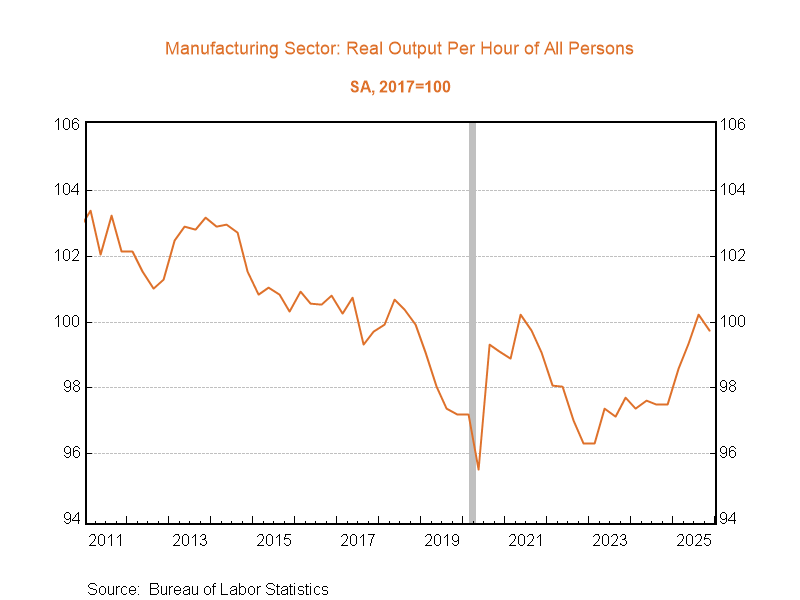
Manufacturing productivity has been one of the most disappointing macroeconomic stories of the past decade. After surging out of the Great Recession, output per hour in U.S. manufacturing flatlined for nearly ten years. But 2025 may mark an inflection point. The BLS recently reported that manufacturing productivity in the second half of 2025 was 2.6% higher than in the second half of 2024.
The question is: what’s behind it, and is it real?
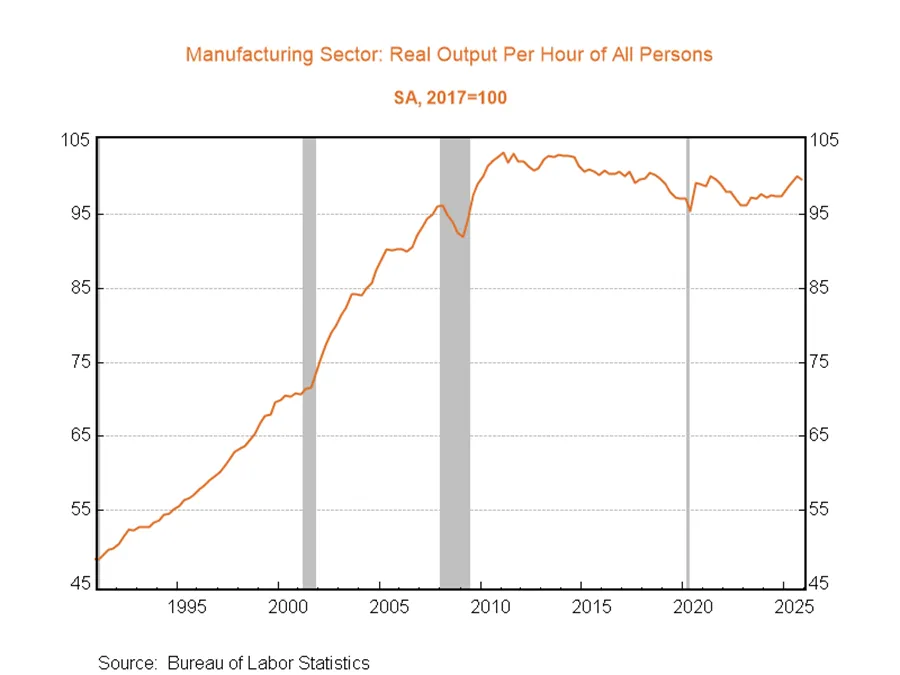
The arc of manufacturing productivity
The chart above tells a clear story in three acts. First, a couple of decades of rapid productivity growth ending around 2011. Then came the lost decade — from 2012 through 2019, manufacturing productivity barely moved, hovering around 100–103 while the rest of the economy grew. The pandemic added volatility but no lasting gains. By late 2022, productivity had actually fallen below its 2017 level.
Then something shifted. Starting in early 2025, the index began climbing — reaching 100.2 by Q3 2025 before a partial giveback in Q4.
Building a proxy to look under the hood
The BLS publishes timely productivity for manufacturing as a whole, but not for the 21 three-digit NAICS subsectors within it. To understand which industries are driving the 2025 pickup, we need to build our own measure.
Our approach: divide the Federal Reserve’s Industrial Production indices (which track real output at the sub-industry level) by aggregate hours worked from BLS employment data. This gives us a gross-output-per-hour proxy for 18 detailed manufacturing industries.
How well does it track the official series? Remarkably well.
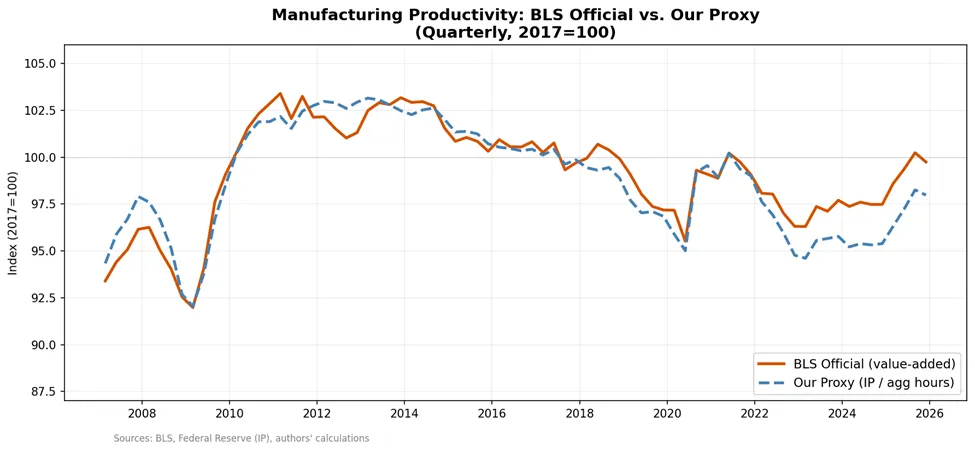
The proxy (dashed blue) captures the same turning points, the same lost decade, and the same 2025 upturn. The two series diverge somewhat in levels — our proxy uses gross output while BLS uses value-added — but the direction and timing align closely. This gives us confidence that the proxy is reliable enough to decompose what’s happening at the industry level.
Is the 2025 pickup broad-based?
This is the key question. A productivity increase driven by one or two industries is less durable than one shared across manufacturing. To answer it, we constructed a diffusion index: the share of industries with positive year-over-year productivity growth in any given month.
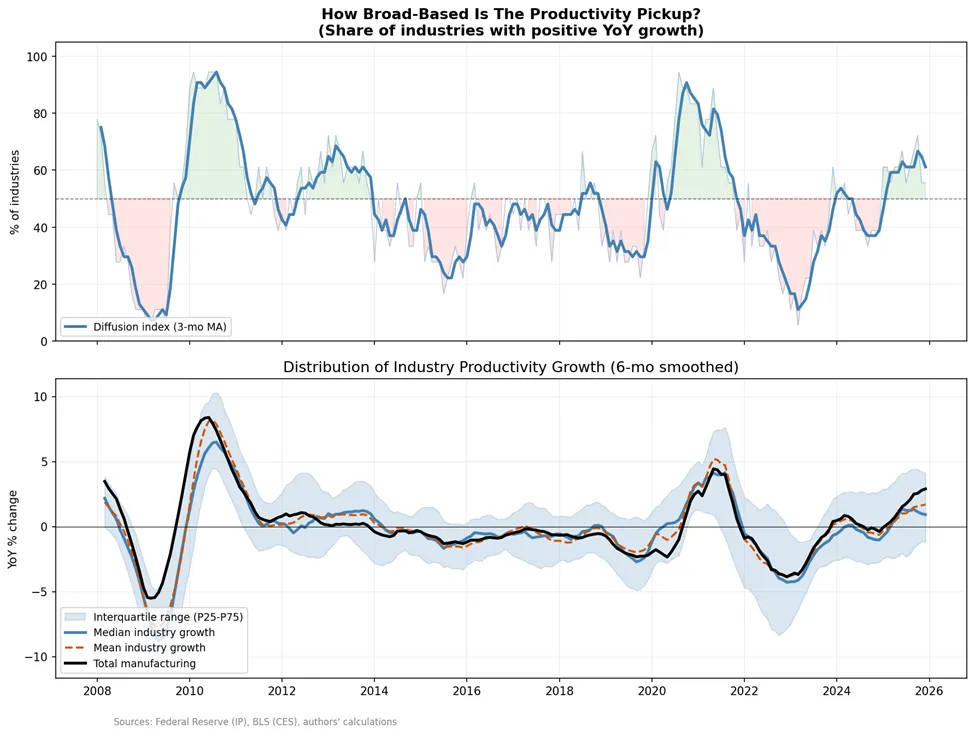
The top panel tells a striking story. The diffusion index bottomed at 33% in September 2024 — only 6 of 18 industries were seeing any productivity improvement at all. By mid-2025, it had climbed to 67%, and reached 72% by October. The bottom panel shows that the median industry’s productivity growth flipped from –1% to +1% — not just the mean being pulled by outliers.
This is genuinely broad-based.
What’s driving this?
I don’t know. More research is needed.
For example, is the decline in manufacturing employment concentrated among production workers, as it was in the decades before 2012? Or is it more concentrated in office jobs that are more exposed to AI? We will have to wait for more granular 2025 employment data to come out.
In any case, the weight of the evidence suggests that something real is happening. The overall growth rate of manufacturing labor productivity has increased significantly. It is broad-based.
Manufacturing productivity’s lost decade may finally be ending.