
Labor Matters: How Close Is WFH to Its New Normal?
Executive Summary
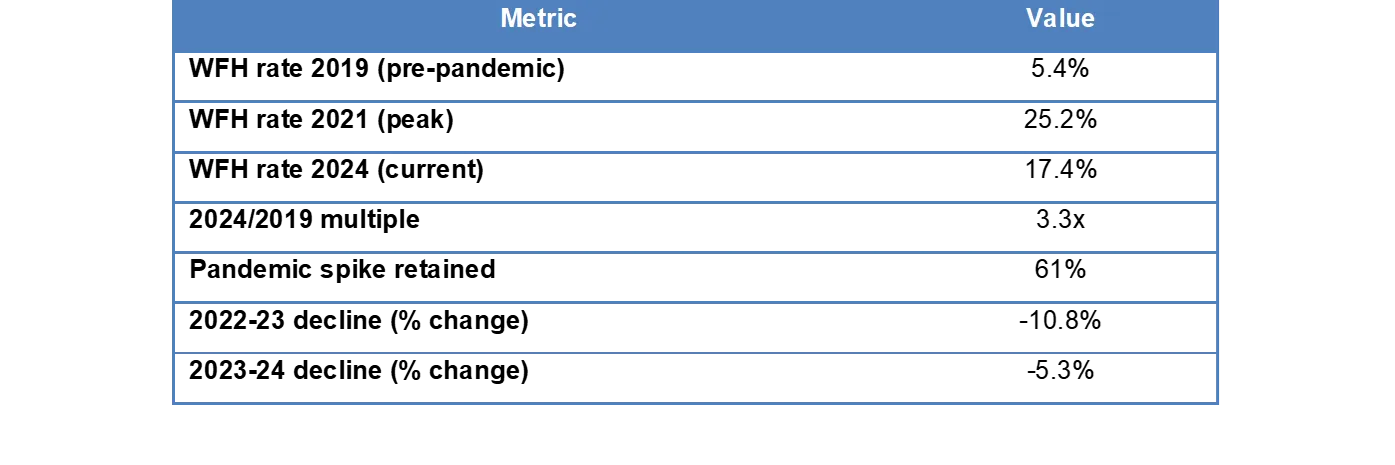
Work from home is still declining among professional and office workers, but the decline slowed sharply in 2024, suggesting that the post-pandemic retreat is moving closer to stabilization than to full reversal. Using the 2024 American Community Survey, this report finds that the share of these workers who primarily work from home rose from 5.4% in 2019 to 25.2% at its 2021 peak, then fell to 17.4% in 2024. Even after several years of return-to-office pressure, remote work remains more than three times its pre-pandemic level, with 61% of the pandemic-era increase still intact.
The slowdown is broad but uneven. Some high-WFH occupations and industries, especially computer and mathematical occupations and the Information sector, continue to move back toward the office. Others, including healthcare, real estate, education, and construction, appear much closer to a new equilibrium. The result is not convergence to a single norm, but a more uneven hybrid landscape across the economy.
The report’s most important structural finding is about gender and parenthood. After controlling for occupation, industry, education, geography, and other characteristics, women are more likely than comparable men to work from home, and the difference is especially large for mothers of young children. Women with a child under age 3 are 7.7 percentage points more likely to work from home than otherwise similar men without children, making motherhood the strongest demographic predictor of remote work in the model. This suggests that remote work has become an important mechanism supporting labor force attachment for many highly educated mothers.
The bottom line is that the U.S. is far from returning to its pre-pandemic remote-work baseline. Instead, the evidence points to a much higher, uneven, and still-evolving equilibrium in which remote work remains structurally important for some sectors, regions, and demographic groups.
I. Introduction
The pandemic brought about one of the most profound shifts in U.S. labor market history. Its most lasting legacy may be the rise of work from home (WFH). At the height of the pandemic in 2020-2021, remote work became the norm for a significant portion of the workforce. Since then, there has been a gradual return to the office, but the question of where this transition ends has remained open.
The release of the 2024 American Community Survey (ACS) data provides the first real opportunity to answer a critical question: has the WFH decline plateaued, or is it still falling? The ACS, with its large sample size and commuting question, remains the gold standard for tracking remote work prevalence across demographics, occupations, industries, and regions.
The ACS asks respondents how they "usually" commuted to work in the past week, and classifies anyone who answers "worked from home" as a remote worker. This captures people who primarily work from home, not occasional or hybrid remote workers — making it a more conservative measure than surveys that track any remote work on a given day.
This analysis focuses on professional and office occupations (2-digit SOC codes 11-29, 41, and 43), the segment of the workforce where WFH is most prevalent and where the policy debate over return-to-office mandates is most intense. Throughout, we use percent change in the WFH rate (rather than percentage point change) to measure trends, avoiding a bias that would make high-WFH occupations appear to be declining faster simply because they have more room to fall.
II. The Big Picture: Deceleration, Not Plateau
Among professional and office workers, the average share primarily working from home rose from 5.4% in 2019 to 25.2% at its 2021 peak, before declining to 17.4% in 2024. That 2024 level represents 3.3x the pre-pandemic rate, and workers have retained roughly 61% of the pandemic-era spike.
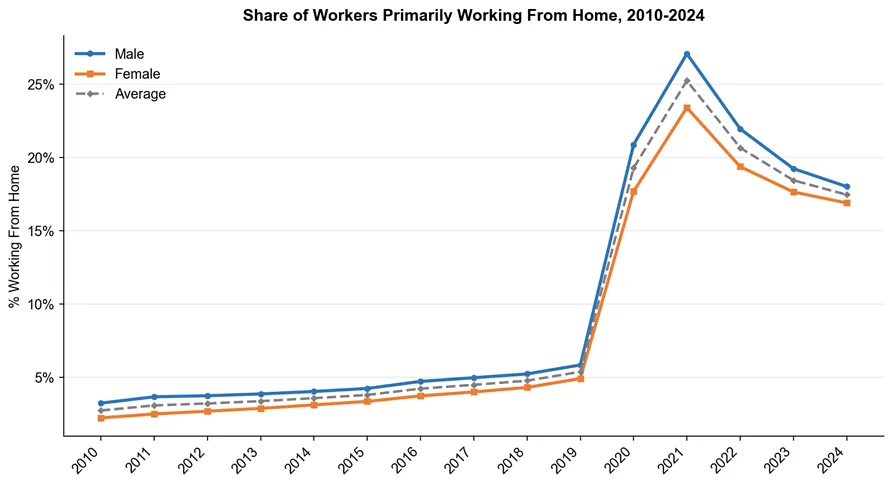
Source: American Community Survey, limited sample (SOC 11-29, 41, 43)
The critical finding is not the level but the trajectory. The WFH rate declined -10.8% from 2022 to 2023, but only -5.3% from 2023 to 2024. The rate of decline has roughly halved in a single year. At this pace of deceleration, the decline approaches zero by 2026-2027.
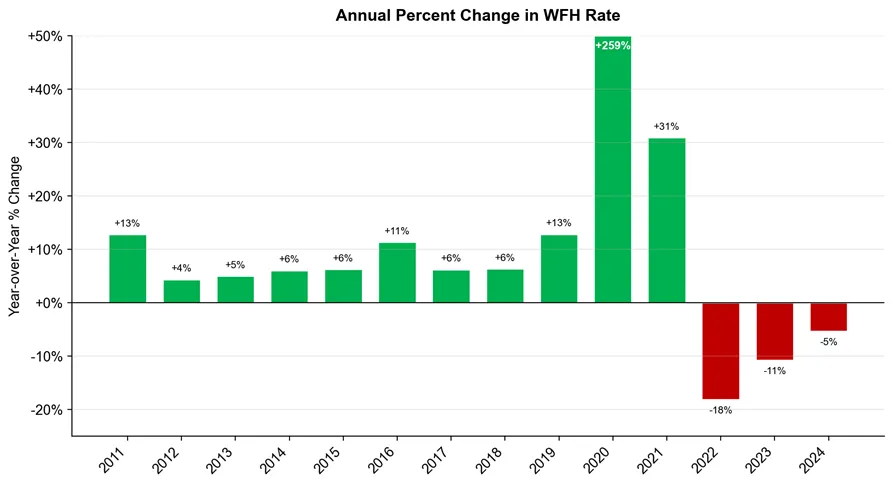
Annual percent change in average WFH rate (limited sample). The 2020 bar is truncated; the actual value was +259%.
Table 1: Key Metrics Summary
We deliberately use percent change rather than percentage point change throughout this analysis. A 3 percentage point drop means something very different for an occupation at 40% WFH (a 7.5% decline) versus one at 8% (a 37.5% decline). Percent change puts all groups on a comparable footing.
III. Which Groups Are Still Declining?
Occupations
Classifying each occupation by its 2023-24 percent change yields a mixed picture. Most occupations are still declining, but at a slower pace than the prior year.
Table 2: Occupation Decline Dashboard
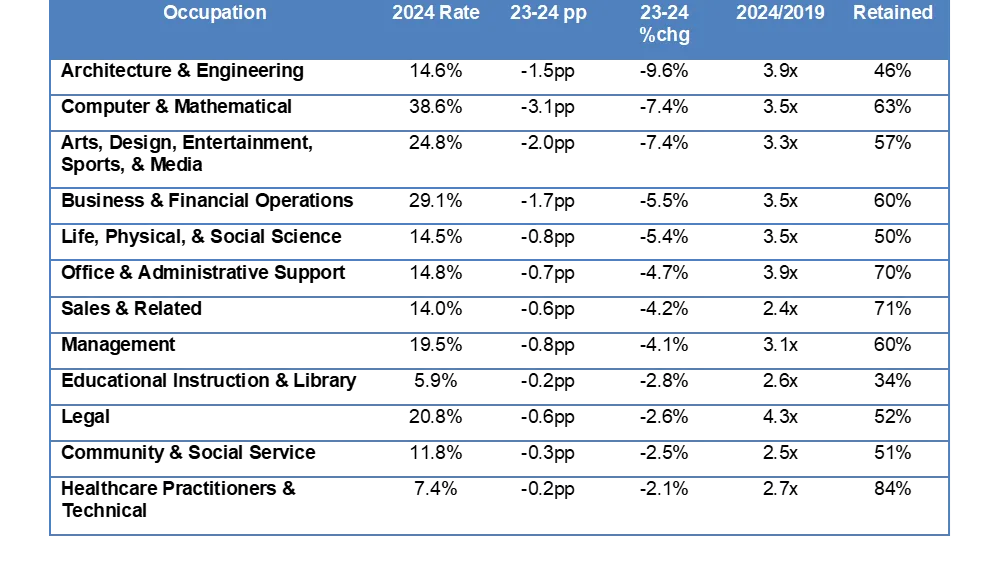
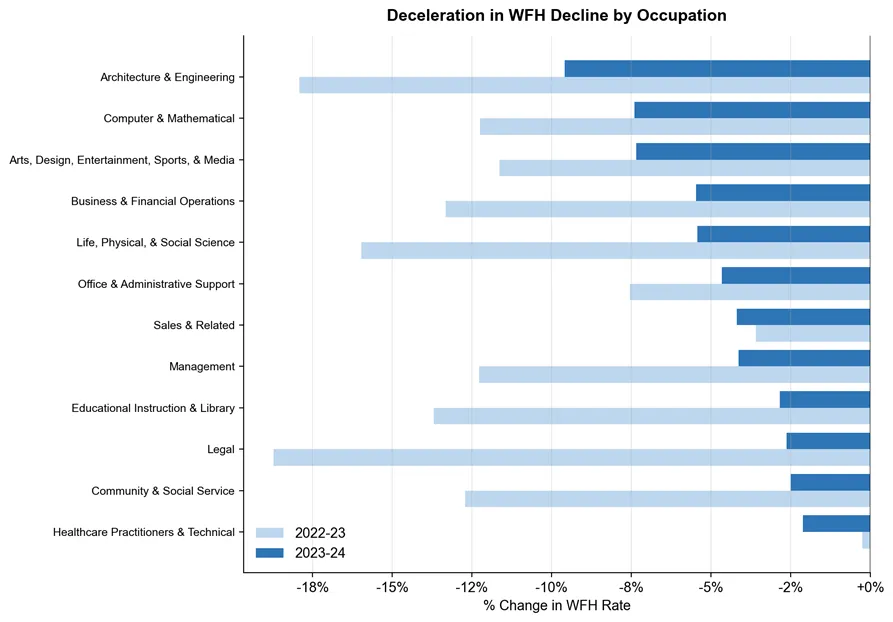
Percent change in WFH rate by occupation: 2022-23 vs 2023-24
Computer and Mathematical occupations and Arts/Design/Media remain the steepest proportional decliners, both still falling around 7% per year. But context matters: Computer/Math workers are still at 38.6% WFH, retaining 63% of their pandemic spike. These occupations are declining from extraordinary peaks, not reverting to pre-pandemic norms.
At the other end, Healthcare Practitioners and Education are barely moving. Education is notable: it gave back the most of any occupation (retaining only 34% of its spike), but the decline has essentially stopped, suggesting it has found its new equilibrium.
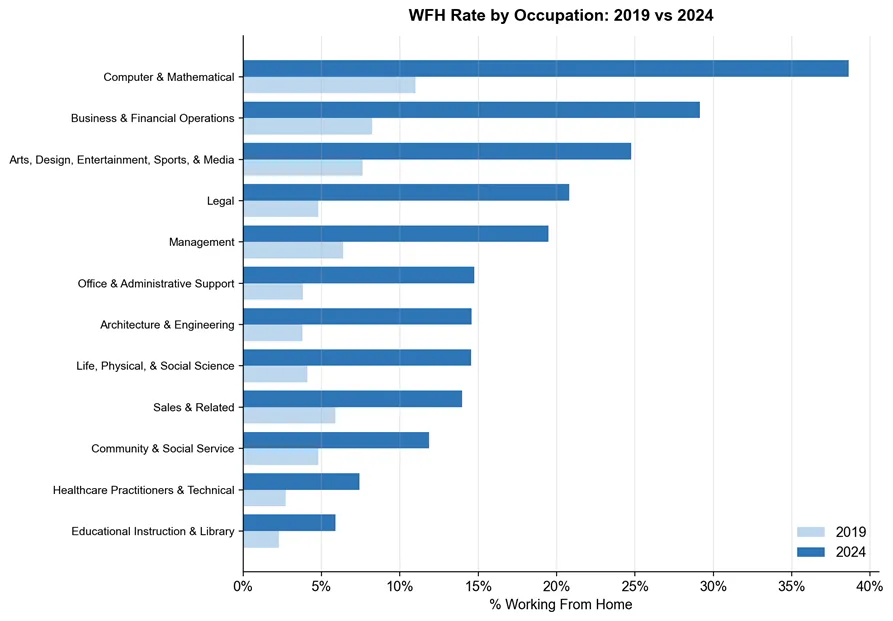
WFH rate by occupation: 2019 vs 2024
Industries
Table 3: Industry Decline Dashboard
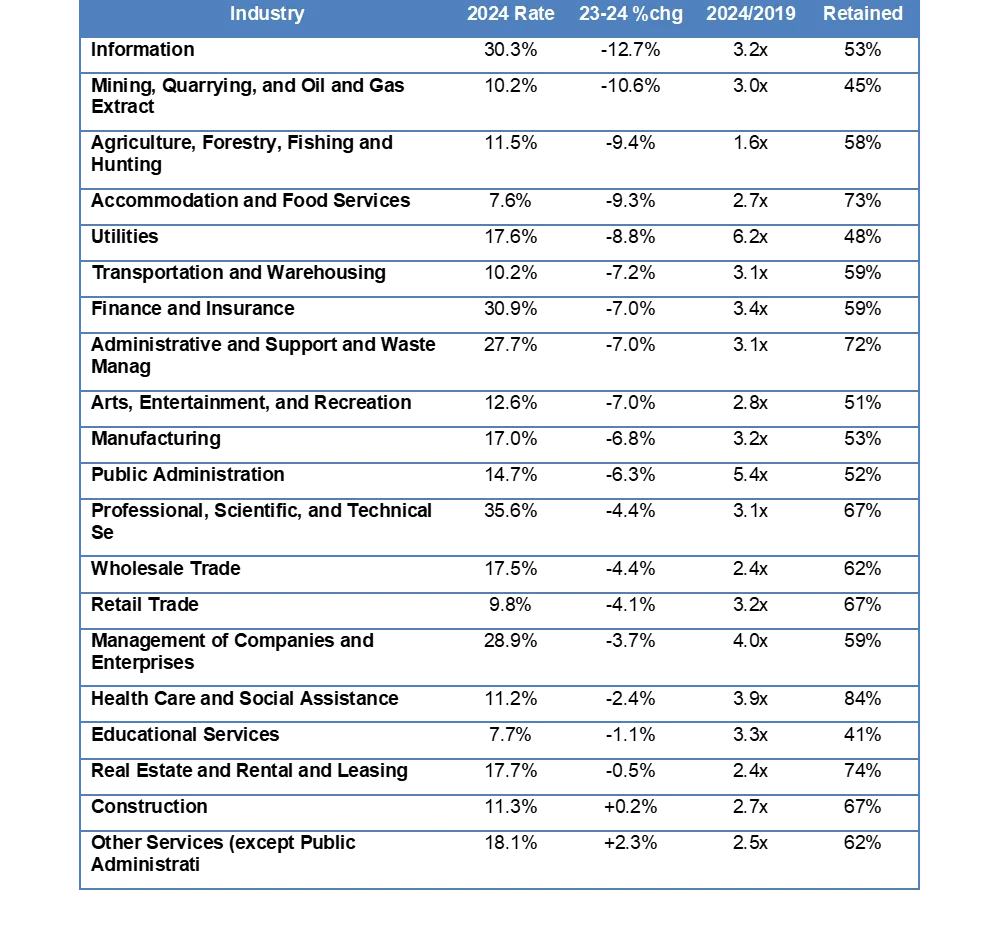
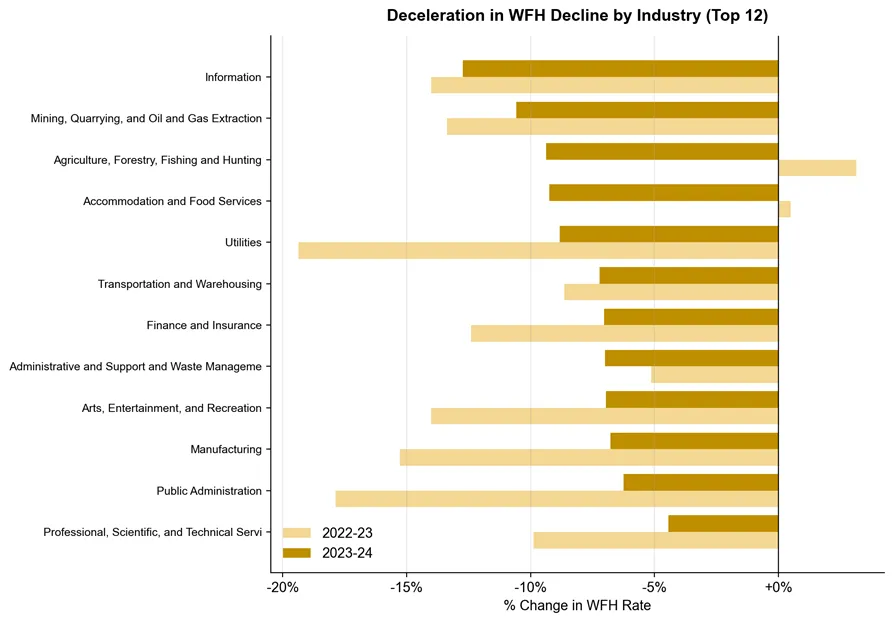
Percent change in WFH rate by industry: 2022-23 vs 2023-24
The Information sector stands out as the most persistent decliner at -12.7% per year, with little sign of deceleration. This likely reflects aggressive return-to-office policies among major technology and media companies. Construction, Educational Services, Health Care, and Real Estate have essentially plateaued.
IV. Regional Convergence
During the pandemic, the Northeast and Pacific regions saw an exceptionally high share of remote work, largely driven by stricter isolation measures. Since then, these regions have experienced a more pronounced shift back to in-office work compared to other areas. The result is convergence: the spread between the highest and lowest WFH divisions peaked at 15.1 percentage points in 2021 and has compressed to 7.0 percentage points in 2024.
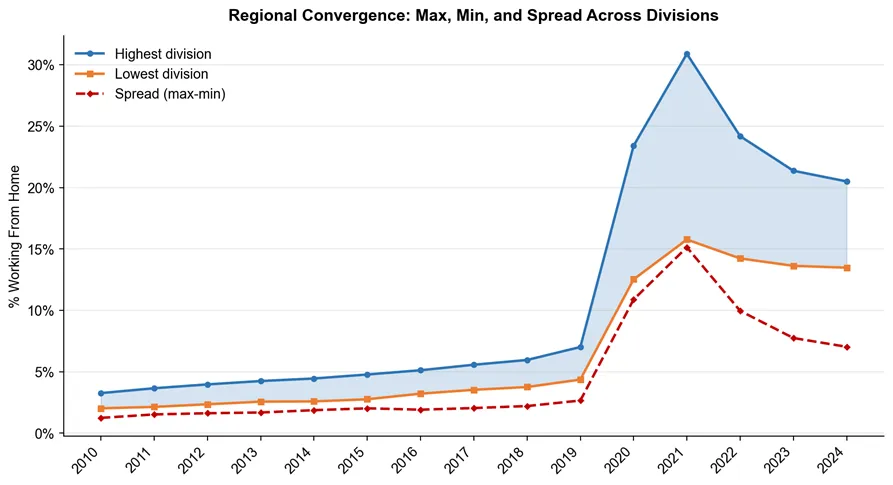
Regional WFH spread over time: max, min, and gap across Census divisions
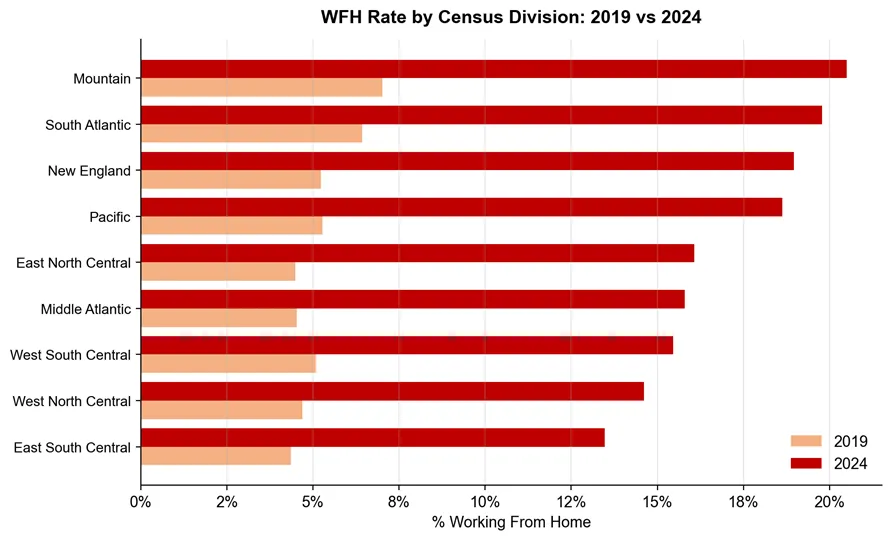
WFH rate by Census division: 2019 vs 2024
The state-level regression map below shows WFH odds ratios from a 2024 model that controls for demographics, industry, and occupation. The variation across states remains substantial even after these controls, suggesting that local culture and pandemic-era norms continue to shape remote work habits.
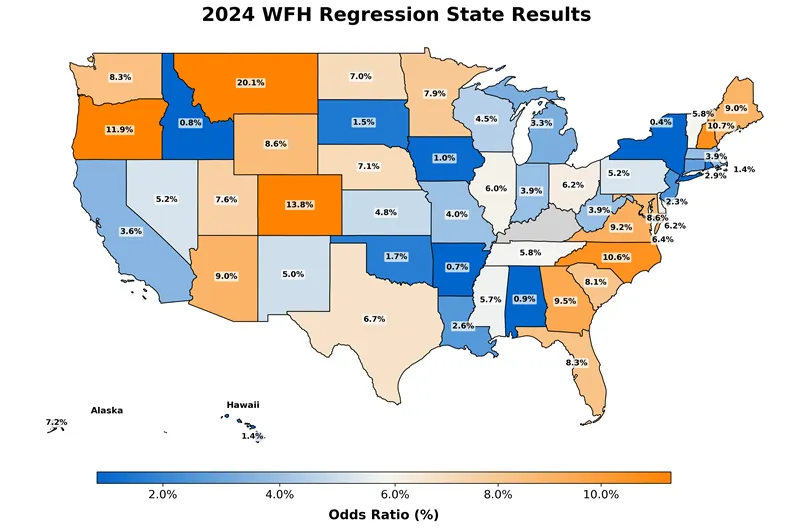
State-level WFH regression odds ratios, 2024 ACS (adjusted for demographics, industry, occupation)
V. The Gender Story: Who Is Working From Home and Why
A look at the raw data reveals that men in professional occupations have had higher WFH rates than women throughout the entire time series. The gap was about -0.9 percentage points (Female minus Male) in 2019, widened to -3.7pp in 2021 as WFH surged, and has since narrowed to -1.1pp in 2024. At face value, this suggests that men are simply more likely to work from home.
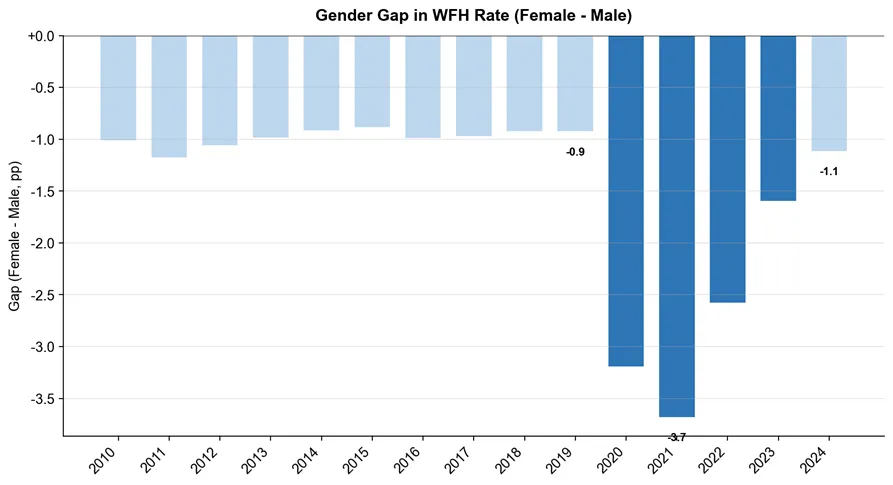
Gender gap in WFH rate (Female - Male, pp). Negative values indicate higher male rates.
But this raw comparison is misleading. Men are disproportionately concentrated in high-WFH occupations like Computer/Math and Management. Once we control for occupation, industry, education, and other demographics in a regression framework, the picture reverses: women are actually more likely to work from home than comparable men. This distinction between the raw gap and the conditional gap is critical for understanding what is really driving WFH patterns, and it motivates the analysis in the next section.
The pace of decline also differs by gender. Male WFH rates fell 6.4% from 2023 to 2024, while female rates fell only 4.2%. Women are closer to stabilization than men, suggesting that the factors pulling women toward WFH are more durable.
VI. The Motherhood Effect
What is driving this gender divergence? To isolate the role of parenthood, we estimated OLS regressions predicting WFH status in the 2024 ACS, controlling for state, industry, occupation, education, age, race/ethnicity, veteran status, internet access, disability status, and multi-generational household status. Each regression uses a different measure of parental status interacted with gender as the key variable of interest.
The results are striking. Women with young children are substantially more likely to work from home, even after accounting for their occupation, industry, and all other observables. The effect is largest for women with a child under age 3: they are 7.7 percentage points more likely to work from home than otherwise-similar men without children. This is the single strongest demographic predictor of WFH in the model.
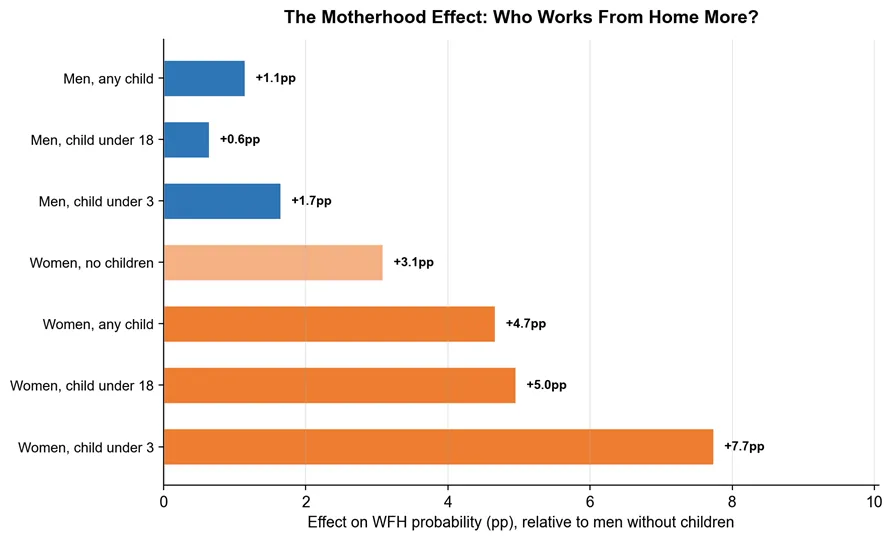
OLS regression coefficients: effect on WFH probability relative to men without children. Controls: state, occupation, industry, education, age, race, and other demographics.
Several patterns emerge. First, the motherhood premium is large and concentrated among women: women with any child are 4.7 percentage points more likely to WFH, versus only 1.1pp for men with children. Second, the effect is strongest for women with very young children (under 3), suggesting that WFH has become a critical tool for managing the demands of early childcare. Third, even women without children are 3.1pp more likely to WFH than comparable men, indicating a baseline gender gap that exists independent of parenthood.
These findings have important implications. WFH is not merely a lifestyle preference; for many working mothers, it is an enabler of labor force participation. Return-to-office mandates that do not account for this reality may disproportionately affect women with young children, potentially pushing some out of the workforce entirely.
VII. The Future of WFH
The data reveals an interesting tension at the heart of the WFH debate. The occupations most suited to remote work -- technology, finance, legal, business operations -- are also the ones where employers have pushed hardest for return-to-office. Computer/Math occupations are still declining 7% per year even though they peaked at 55% WFH. Information-sector firms are driving the steepest industry-level declines.
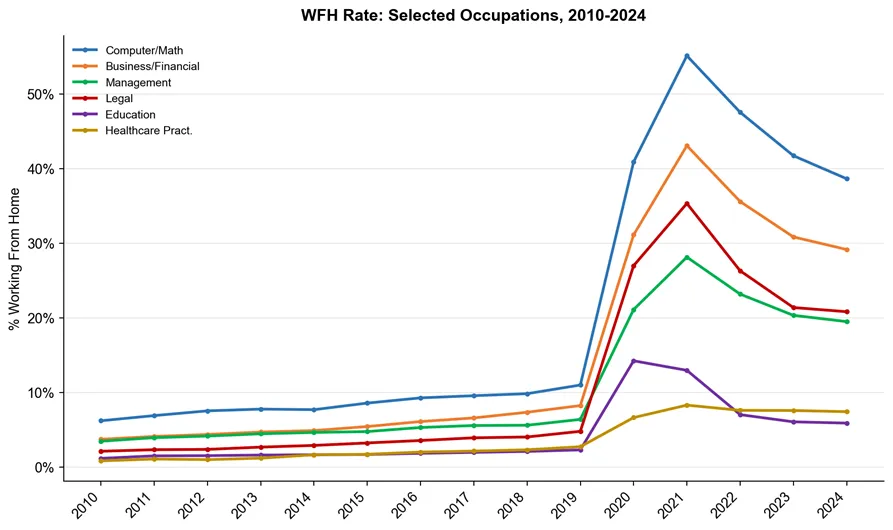
WFH rate over time for selected occupations (limited sample)
This pattern is consistent with the competitive dynamics hypothesis. Ambitious, career-driven individuals are more likely to forgo WFH in pursuit of visibility, mentorship, and advancement. Organizations that attract these individuals tend to outperform, creating a reinforcing cycle: in-office norms become a marker of high-performance culture, particularly in elite consulting, investment banking, and high-end product development.
But the motherhood effect introduces a complication. Firms competing for top talent also need to attract women, who increasingly rely on WFH flexibility. The regression results show that women with young children are nearly 8 percentage points more likely to work from home, even controlling for occupation and industry. A blanket return-to-office mandate risks losing this talent.
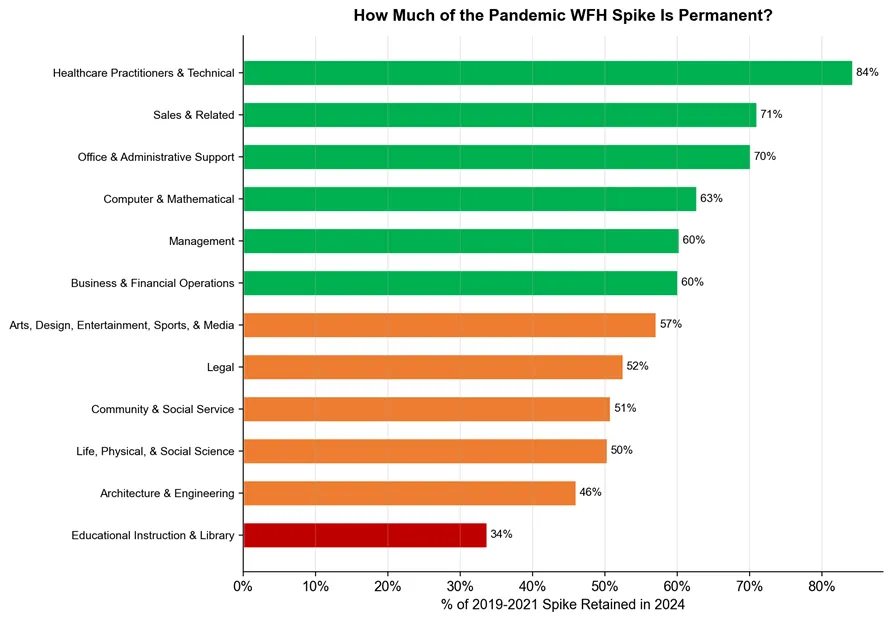
Pandemic spike retention by occupation: share of 2019-2021 WFH gain retained in 2024
The retention data reveals which occupations have found their new equilibrium. Healthcare Practitioners have retained 84% of their pandemic spike -- WFH is now structural in that field. Sales and Office/Admin roles have retained about 70%. Even in the occupations giving back the most (Education at 34%, Architecture/Engineering at 46%), the decline has slowed to near-zero rates of change.
Looking ahead, the evidence points toward stabilization at roughly 15-17% for professional and office workers by 2026-2027, approximately 3x pre-pandemic levels. This will not be uniform: competitive, high-prestige industries will settle at lower WFH rates than average, while sectors with less intense talent competition will retain more flexibility. The gender gap will persist, driven by the structural role of WFH in enabling working mothers. And regional variation, though narrowing, will continue to reflect local norms shaped by pandemic-era experience.
Remote work is not going away. But neither is the return to the office. The new normal is a hybrid equilibrium, unevenly distributed across occupations, industries, regions, and genders, gradually stabilizing three to four years after the pandemic upended American work.
Read All Labor Matters Issues & Subscribe on LinkedIn