
Labor Matters: Did AI Add "Basically Zero" to the Economy? BS.
A Goldman Sachs finding went viral this week: AI investment contributed "basically zero" to U.S. GDP growth in 2025. The Washington Post's Shira Ovide wrote it up, social media ran with it, and suddenly everyone had confirmation that AI is all hype and no substance.
I couldn't find the actual Goldman report, but from what I can gather, the core argument goes like this: yes, tech companies spent hundreds of billions on AI infrastructure last year, but most of that money went to imported equipment—semiconductors fabricated in Taiwan, memory chips from South Korea, servers assembled in Asia. In GDP accounting, investment spending gets recorded as a positive, but the corresponding imports get subtracted. They roughly cancel out. Therefore, "basically zero."
As a narrow accounting statement about imported hardware, this is correct. As a characterization of AI's contribution to economic growth, the version of this analysis that went viral—and that's now shaping the conversation—is wildly misleading. Whether Goldman addressed the following points in their full report or not, the narrative that took hold ignores them entirely.
Start with the physical buildout. You cannot import a building. Data center construction starts have surged across the country:
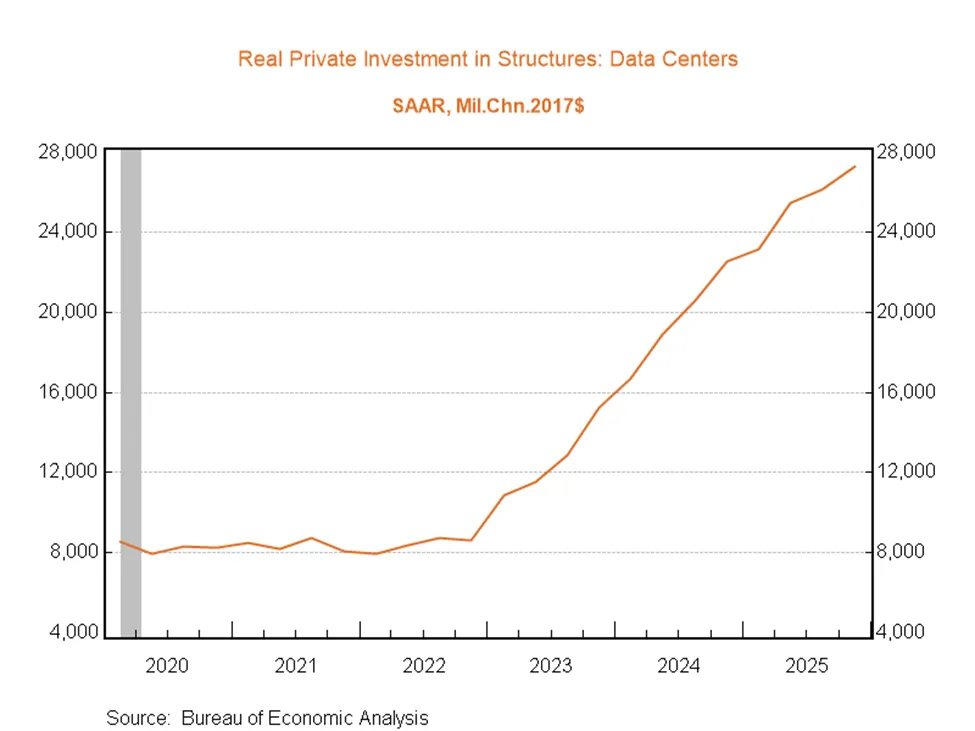
And data centers are just the beginning. The AI buildout is pulling massive investment into power generation, grid upgrades, electrical substations, fiber optic networks, and cooling systems. This is long-cycle domestic investment in structures and infrastructure that will take years to complete. The workers pouring that concrete and pulling that fiber are not in Taiwan.
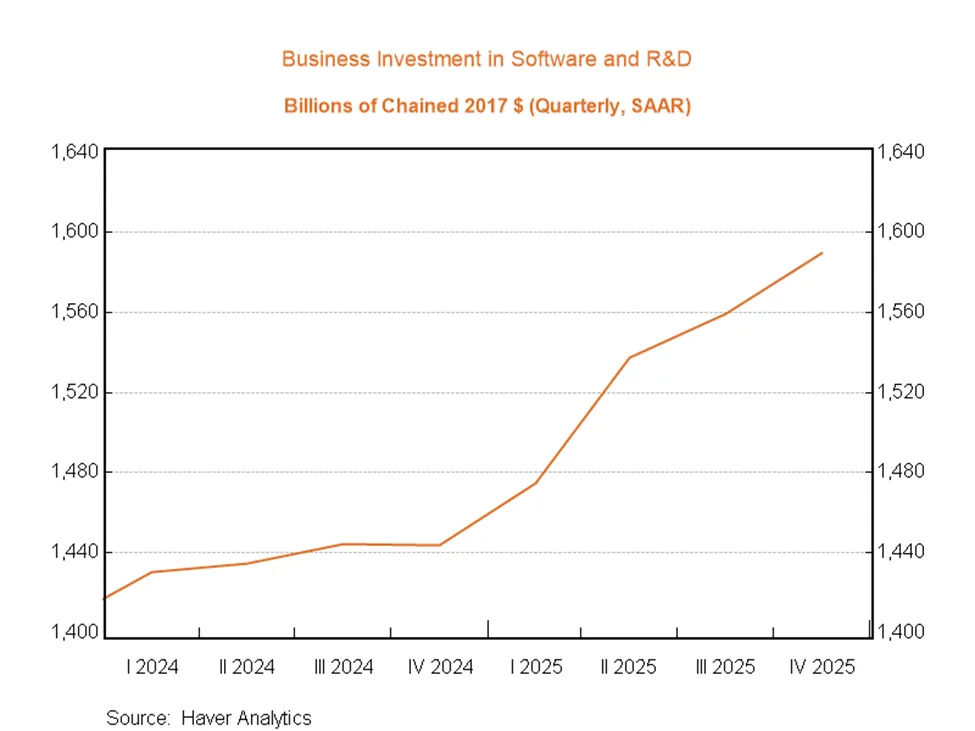
Then there's software and R&D—possibly the most important channel and the most overlooked. Investment in software and R&D rose dramatically in 2025, driven in large part by AI-related spending. Building models, developing applications, fine-tuning systems, creating internal tools—this is overwhelmingly domestic, labor-intensive work. U.S. workers writing code, U.S. researchers doing R&D. If the analysis narrowly focused on the hardware channel, it missed what is a much larger story.
The import story also has a mirror image that cuts the other way. Nvidia designs chips in the U.S. and captures enormous margins on sales to the entire world. When a European or Asian company Nvidia chip, Nvidia's revenue, employee compensation, and profits are U.S. GDP. Same for AMD, Broadcom, and the entire cloud layer—AWS, Azure, and GCP selling AI compute services globally. If you're going to net out imports from domestic investment, you have to count what's flowing back in through exports. You can't run the accounting in one direction only.
Then there are the second-order effects that don't show up in any investment line item. The AI-driven run-up in tech valuations has added trillions of dollars in household wealth in recent years. The wealth effect on consumption is real and well-documented. Corporate profits have been booming, partly because firms are producing more output with fewer workers—which is what productivity growth looks like when it actually arrives. None of this registers in an analysis that asks only whether imported GPUs added to GDP.
And all of this spending multiplies through the economy. Construction workers in data center corridors spend their wages locally. Engineers at AI companies buy homes and cars. Cloud revenue funds downstream hiring. Utility investment creates its own supply chains. The initial burst of AI-related spending generates additional rounds of income and consumption well beyond the direct investment—and well beyond what a narrow equipment import calculation can capture.
The fact that the "basically zero" framing spread so fast is itself instructive. There is a large and eager audience for the idea that AI is a bubble, that the spending is wasteful, that nothing real is happening. When a Goldman Sachs headline confirms that prior, people stop asking whether the analysis actually supports the conclusion.
It doesn't.
Read All Labor Matters Issues & Subscribe on LinkedIn