
Labor Matters: A Productivity Regime Shift in the White-Collar Core
The U.S. economy continues to expand even as job growth has weakened sharply—an apparent contradiction that reflects structurally stronger productivity growth in the white-collar core, rather than broad economic fragility.
New GDP-by-industry data indicate that Finance, Insurance, Information, and Professional & Business Services (FIIPB)—more than 40% of U.S. GDP—has diverged from its long-standing pattern of pairing output gains with rising employment. Since 2022, FIIPB real GDP has continued to climb while employment has flattened or declined, pushing a proxy for output per employee sharply higher and placing FIIPB on a distinctly stronger productivity trajectory than in the pre-pandemic decade. The acceleration appears concentrated in FIIPB, not widespread across the private sector.
This points to a potential shift toward an economy that can sustain solid growth with subdued job growth. The labor-market implications are most visible at the entry level: FIIPB has historically been a major on-ramp for college graduates, and a durable slowdown in incremental hiring would help explain why early-career job markets can feel weak even when GDP remains firm. If this “FIIPB decoupling” persists, hiring may not “snap back” simply because growth continues.
The Contradiction
The economy continues to expand at a solid pace. Yet job growth has been barely positive. At the same time, for many new college graduates finding entry-level work is unusually difficult.
There is a conventional and wrong explanation: the economy is weaker than it appears, and hiring is simply reflecting that weakness.
But there is a second interpretation that points in the opposite direction. Output may be rising because productivity growth has strengthened—allowing firms to produce more without adding much labor. And the answer matters. If the recent productivity surge is largely temporary, weak job growth may fade as those factors unwind. If it is durable, however, the labor market may be shifting into a regime in which GDP can remain firm even while hiring stays soft.
To explore this possibility, I turned to a new release of real GDP by industry from the Bureau of Economic Analysis (BEA) for 2025:Q3. When paired with industry employment data from the Bureau of Labor Statistics (BLS), it provides a useful and early high-level way to identify where output is rising without commensurate increases in headcount. This is not a perfect productivity measure—employees are not hours, and the BEA and BLS industry definitions do not align precisely—but as a directional indicator it can be informative. The reason to examine it now is straightforward: the apparent acceleration in productivity is not evenly distributed across the economy.
Where is output rising without hiring?
A natural place to look is Finance, Insurance, Information, and Professional & Business Services—FIIPB (banks and insurers, the information/software-media sector, and major white-collar service industries such as consulting, accounting, legal services, and corporate back-office functions). These industries form the white-collar core of the modern economy and together account for more than 40% of U.S. GDP. They are also unusually exposed to process standardization and technology-driven efficiency gains, including workflow redesign and, increasingly, AI-enabled automation.
If there is a meaningful shift in how AI is being generated in the U.S. economy, FIIPB is one of the first places it should be visible.
A clear break from the pre-2022 pattern
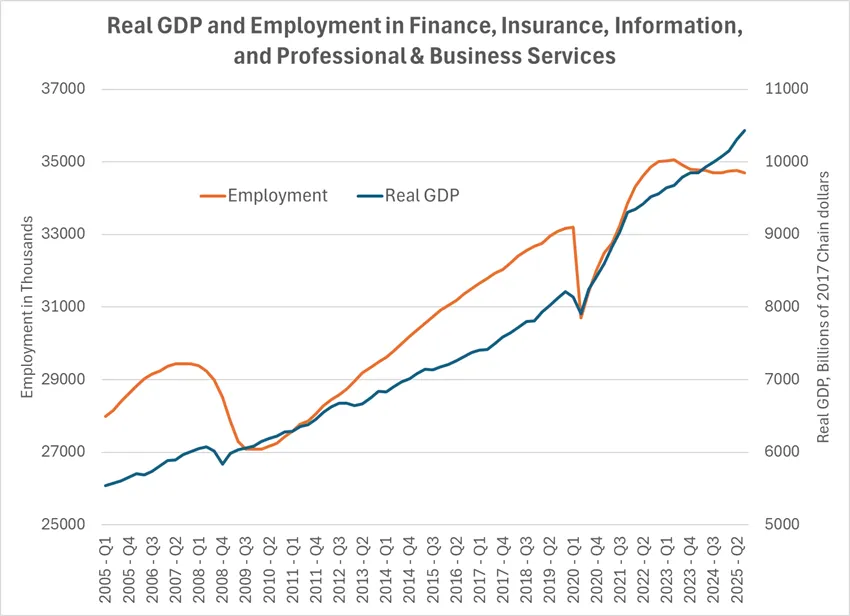
The first chart highlights the key change. For decades (even before the chart starts) through the early 2020s, FIIPB behaved like a structural growth engine: outside recessions, employment trended steadily upward, with only cyclical interruptions during downturns. For decades, growth in this sector was closely tied to hiring.
Sources: Bureau of Labor Statistics and Bureau of Economic Analysis
That history is what makes the post-2022 pattern so notable. After 2022, FIIPB employment peaks and then edges down, even as real GDP continues to rise—and, in parts of the period, accelerates. The implication is that FIIPB is producing more output with fewer employees. That is a clear departure from the long-running “grow = hire” relationship, and it is not typical for a broad, high-wage services block outside a recession.
This shift—FIIPB’s output-hiring decoupling—appears to be one of the defining features of the recent data.
The decoupling is visible in growth rates
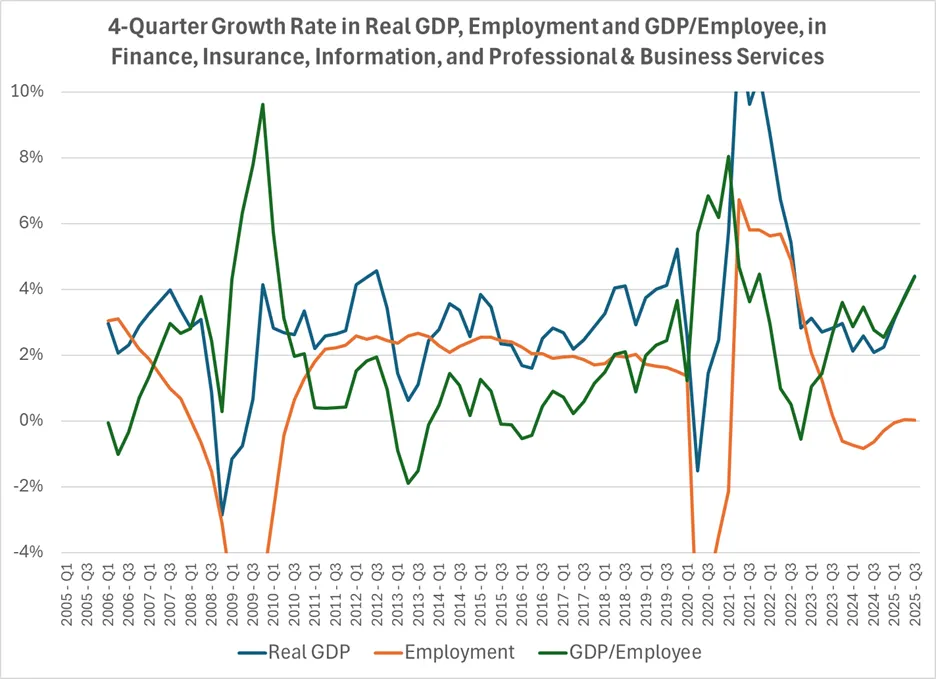
A second chart reinforces the point using four-quarter growth rates. It tracks year-over-year growth in FIIPB real GDP, FIIPB employment, and a proxy for real GDP per employee.
Sources: Bureau of Labor Statistics and Bureau of Economic Analysis
Since 2022, FIIPB real GDP growth has remained solid while employment growth has essentially stalled. The gap between output growth and employment growth shows up as an acceleration in GDP per employee.
The macro relevance is straightforward. FIIPB is large enough to matter for the aggregate labor market. When a sector that accounts for more than 40% of GDP stops hiring the way it historically has, overall job growth can weaken even if output growth remains firm.
Concentrated productivity, not economy-wide acceleration
The next question is whether this represents a broad-based productivity acceleration across the economy or a concentrated shift within a specific cluster of industries.
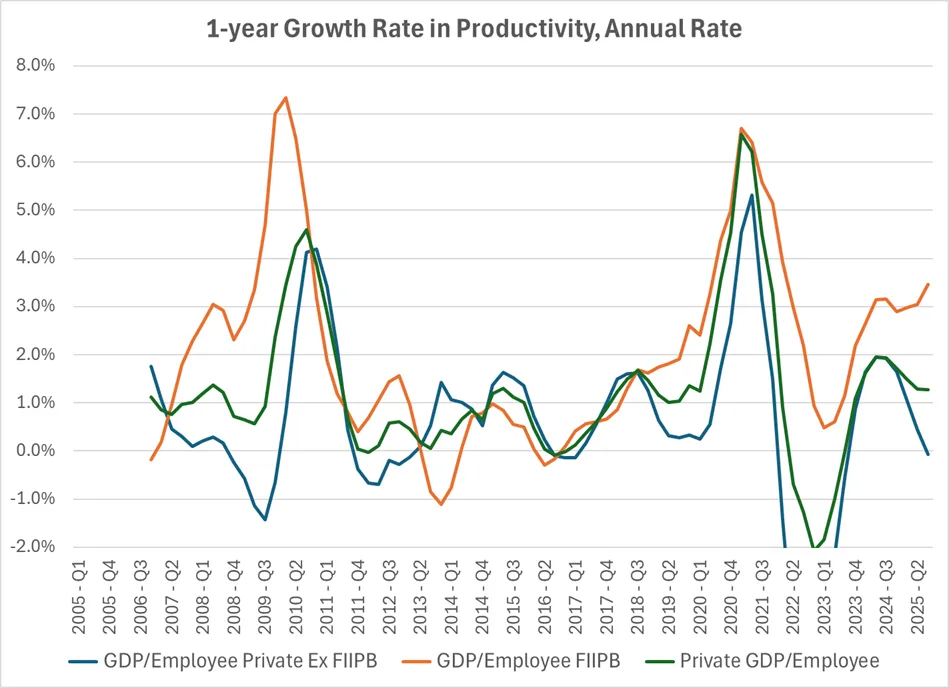
I compare FIIPB with the rest of the private sector using the same GDP-per-employee proxy. On a one-year basis (the past 4-quarters versus the previous 4quarters), FIIPB stands out for a clear step-up in post-2022 productivity growth relative to other private industries.
Sources: Bureau of Labor Statistics and Bureau of Economic Analysis
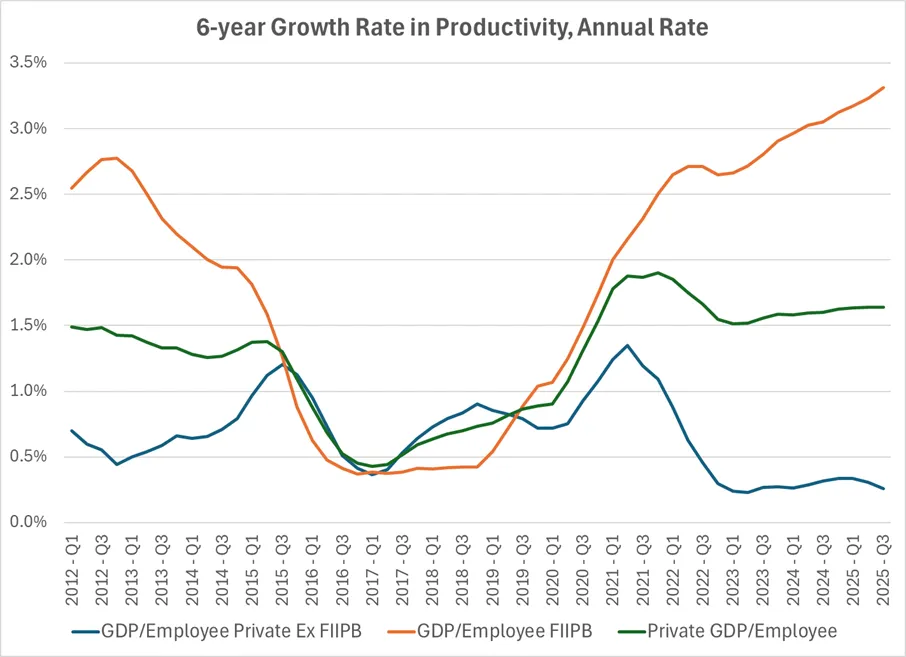
A longer-run view is even more telling. Smoothing out short-term volatility by looking at six-year productivity growth rates (the past 4-quarters versus the 4-quarters 6 years ago), FIIPB rises to a distinctly higher plateau and continues to climb, while productivity growth in the rest of the private sector looks comparatively stable.
Sources: Bureau of Labor Statistics and Bureau of Economic Analysis
The pattern therefore does not resemble an economy-wide productivity breakout. Instead, it suggests that recent productivity gains are becoming more concentrated in a narrow slice of the economy—and that FIIPB is the center of that acceleration.
What the data can—and cannot—establish
This approach does not identify a single mechanism. GDP per employee can rise for multiple reasons. The point is not to attribute the change to AI based on one dataset.
But the sector mix and timing do narrow the plausible explanations. FIIPB contains a high share of scalable, process-driven activity—document handling, customer support and back-office operations, compliance and risk workflows, routine reporting and analysis, sales enablement, and HR and recruiting processes—areas where standardization and automation can raise output per worker without requiring additional headcount. AI-enabled automation is therefore a plausible contributor, even if the data cannot isolate its specific role.
Regardless of attribution, the empirical result remains: FIIPB is producing more without hiring more, and the output-to-employment relationship has shifted relative to its pre-2022 history.
Implications for the labor market, especially entry-level hiring
This helps clarify today’s labor-market puzzle. If much of the economy’s output growth is generated in sectors that do not require incremental labor, job growth can remain weak even in an expanding economy.
The implications may be especially important for new college graduates. FIIPB has historically served as a major “on-ramp” for college-educated workers, supporting a wide range of entry-level pathways—analyst and coordinator roles, junior recruiting and client-service positions, operations and compliance support, marketing support, and other early-career roles that typically expand when the economy expands. If FIIPB growth no longer translates into steady net hiring, those pathways narrow, making the entry-level market more difficult even when GDP remains solid.
Bottom line
This is an early read rather than a definitive study, but the signal in the data is difficult to dismiss. The latest BEA GDP-by-industry release, when paired with BLS employment, suggests that recent productivity gains in the U.S. are not broadly distributed. Instead, they appear to be accelerating and concentrated in FIIPB, one of the economy’s largest and most important clusters, and historically one of its key white-collar hiring engines.
If this FIIPB decoupling persists, it would imply that hiring may not “snap back” in the familiar way simply because growth continues. The economy may be moving toward a regime in which output remains resilient while job creation—particularly along key white-collar entry paths—stays softer than past relationships would have predicted.