Labor Matters: I Think Technology Is Already Displacing Workers
Job growth has been weak for almost two years. There are two ways to read this. One is that the economy is simply soft — that demand has cooled, hiring has slowed, and the labor market will recover when conditions improve. The other is that we are witnessing an acceleration in productivity growth driven largely by technology, and that much of the weakness in employment is structural, not cyclical. The distinction matters enormously. If the weakness is cyclical, it will self-correct. If it is structural, it will not — and waiting for a rebound that is not coming means failing to prepare for what is already underway.
Let me try to narrow what the debate is actually about.
Everyone would agree that technology-driven displacement of office work is nothing new. Word processors eliminated typists. ATMs and online banking reduced teller headcount. E-commerce has been steadily displacing retail sales jobs for two decades. Newspaper publishers have been shedding positions since the mid-2000s. I think most people would also agree that technology contributed to the elimination of office jobs in every year, including the past three. And I think most would agree that even if generative AI had never arrived, other technologies — robotic process automation, cloud platforms, improved analytics — would have continued to lower employment in certain office related jobs over this period.
What there is no agreement about is whether technology accelerated the elimination of jobs in the past three years. Did the rate of displacement increase? Did labor productivity growth — the amount of output produced per worker — shift to a higher gear?
I cannot answer this definitively. But I can show you what the industry-level employment data looks like, and you can judge for yourself.
Using the Bureau of Labor Statistics Current Employment Statistics survey, we identified 49 industries where employment has declined or plateaued since late 2022. Together, these industries employed 15.2 million workers at the end of 2022 — roughly 10% of total nonfarm payrolls. By February 2026, they had shed nearly one million positions, a 6.4% contraction sustained over 38 months with no sign of stabilizing.
If these declines were cyclical or temporary, we would expect to see signs of recovery — employment stabilizing or beginning to return toward pre-2023 or even pre-2020 trends. We do not. Across most of these 49 industries, the decline has been nearly uninterrupted in the past couple of years. When you scroll through the charts at the end of this piece, look for a bottom, an inflection, any sign that these industries are finding a floor. You will not find one.
The timing coincides with the commercial deployment of generative AI and its rapid enterprise adoption. But more than timing, the tasks being displaced map precisely onto what commercially deployed AI systems now perform in production. Chatbots and AI voice agents handle customer inquiries — Klarna deployed an AI assistant that took over 75% of its customer chats; Salesforce reduced its customer support headcount from 9,000 to 5,000 using AI agents. AI coding assistants allow developers to generate boilerplate and write tests — Salesforce announced it would hire zero software engineers in 2025 after AI boosted engineering productivity by 30%; Microsoft held headcount flat at 228,000 while cutting 15,000 positions. Large language models draft documents, marketing copy, and research summaries. Image generators enable non-designers to produce professional visuals. AI automates underwriting, fraud detection, and claims adjudication — full AI adoption among U.S. insurers jumped from 8% to 34% in a single year. AI-powered sourcing tools screen resumes and match candidates, automating the core workflow of staffing firms.
These are not hypothetical capabilities. They are systems operating at scale, performing the exact tasks these industries employ people to do.
Not all of the job losses come from AI directly performing human work. Some result from broad CEO directives to reduce headcount in anticipation of AI-driven productivity gains, whether or not those gains have fully materialized. Benioff, Nadella, Jassy, McMillon — a growing list of CEOs have publicly linked workforce freezes and reductions to AI strategy. Some of these cuts are anticipatory. Some reflect genuine productivity improvement. The distinction matters less than the aggregate effect on the people who held those jobs.
And some of the displacement is indirect. The shift to online shopping reduces demand for in-store staff. Automated payroll platforms bring functions in-house that were previously outsourced. AI-powered self-service tools reduce back-office support needs across every industry they touch. Generative AI did not push these industries off a cliff. It removed the floor.
I cannot isolate AI’s causal contribution from these charts. In every one of these 49 industries, there are non-technology factors at work. But the pattern — persistent decline across unrelated sectors, concentrated in tasks that technology now performs, synchronized at the moment of generative AI’s commercial availability, and present in industries where output continues to grow — is more consistent with an acceleration in technology-driven displacement than with any cyclical explanation.
What would change my mind? If these industries begin rehiring strongly while AI adoption continues. If output weakens alongside employment rather than diverging from it. If the occupations shrinking fastest within these industries turn out not to be the ones most exposed to AI. Any of these would weaken the case. So far, none has materialized.
Below are the employment charts for all 49 industries. Scroll through all of them. Notice how many show the same shape: a trend that was stable or slowly declining, then steepened after late 2022. Notice that these are not related industries — they span call centers, software, insurance, publishing, marketing, staffing, banking, and printing. Ask yourself what single force connects them all. Then draw your own conclusions.
If this is what is happening, the cost of getting the diagnosis wrong is high. If policymakers and corporate leaders treat this as a cyclical soft patch, they will underinvest in retraining and career pathway redesign. They will ignore the erosion of entry-level positions that have traditionally served as training grounds for the next generation of professionals. They will wait for a hiring rebound that is not coming in these industries. The share of the economy experiencing technology-driven contraction is growing, and the workers affected deserve an honest reckoning with what the data actually show.
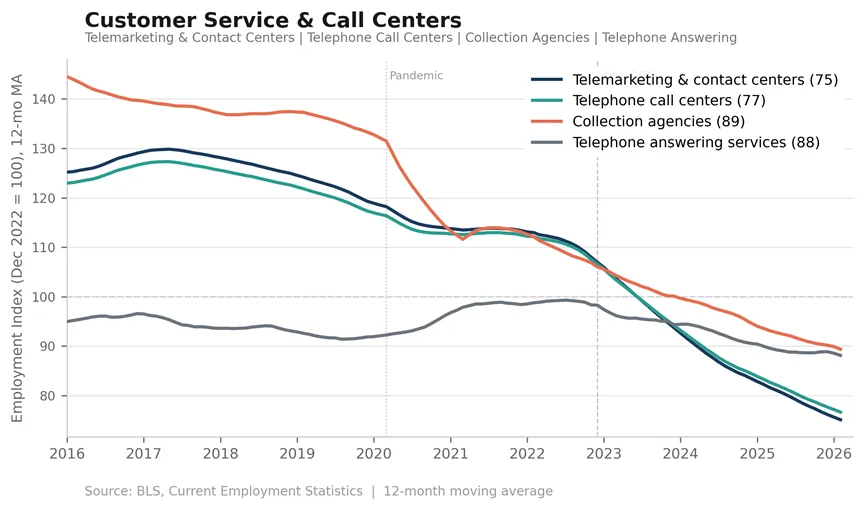
Customer Service & Call Centers: Down 25-27% since December 2022. Call center employment was already declining at 2-3% per year. After late 2022, it collapsed to over 10% — the sharpest acceleration of any sector in this report.
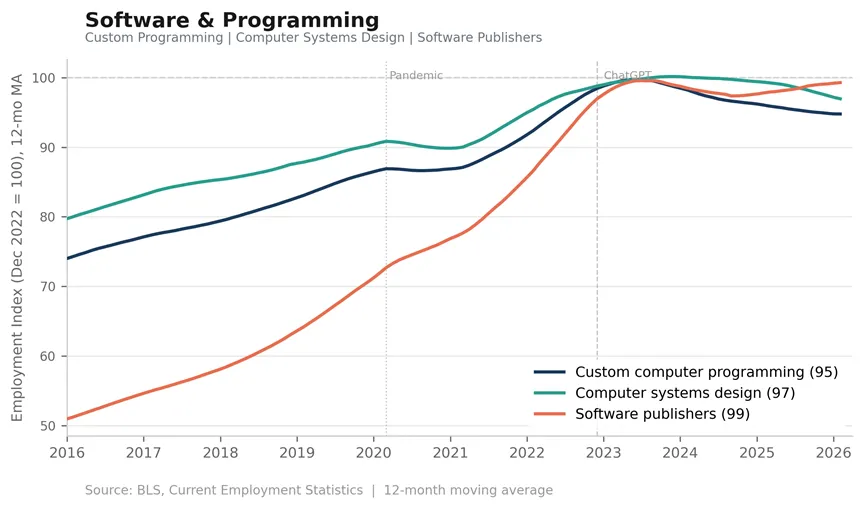
Software & Programming: After a decade of 3-5% annual employment growth, software publishing flatlined. Custom programming and systems design are shedding headcount while industry revenue continues to grow — the clearest example of the productivity scissor: output up, employment down.
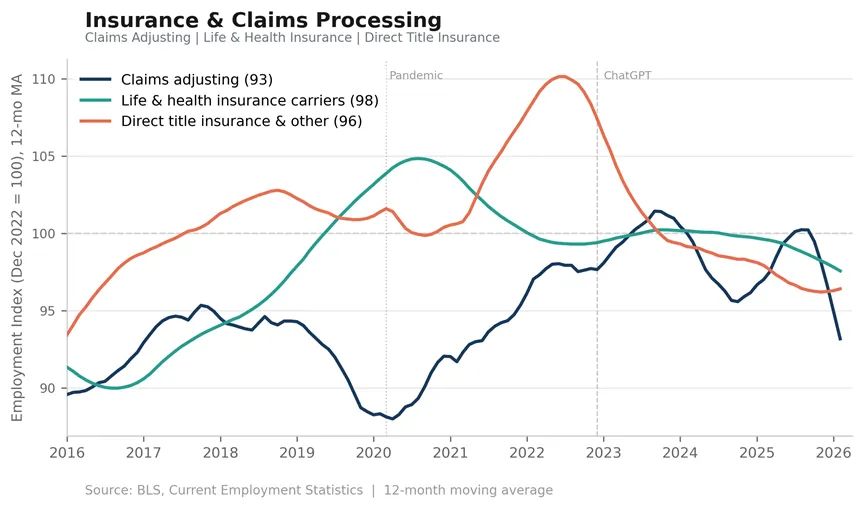
Insurance & Claims Processing: Claims adjusting down 17% — one of the steepest declines in the data. AI triages claims, estimates damages from photos, detects fraud, and auto-adjudicates straightforward cases. The tasks being eliminated are well-defined, the tools are deployed at scale, and the decline is too rapid for cyclical factors alone.
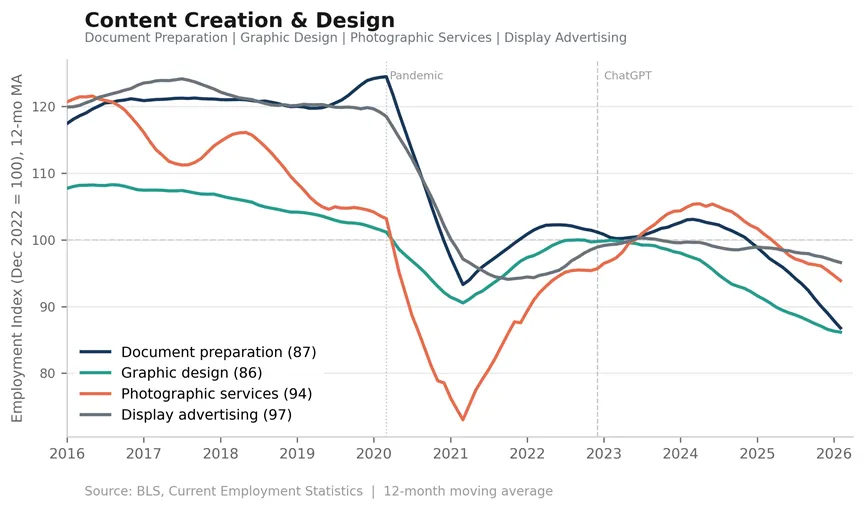
Content Creation & Design: Document prep down 18%, graphic design down 13%. These occupations are defined by the tasks AI now performs in production — drafting documents, generating images, producing layouts. When the core task is automatable, the employment effect is direct.
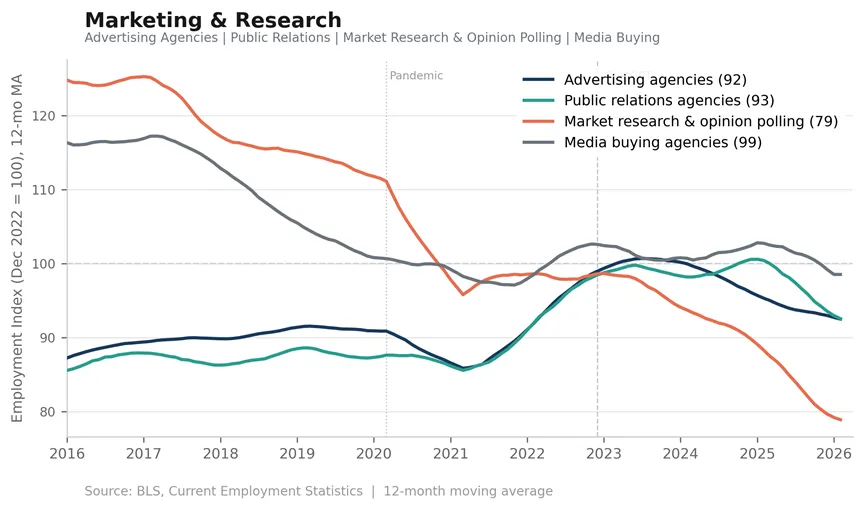
Marketing & Research: AI generates ad copy, synthesizes focus groups, and produces insight reports that previously required teams of analysts. Market research and public opinion polling down 13%.
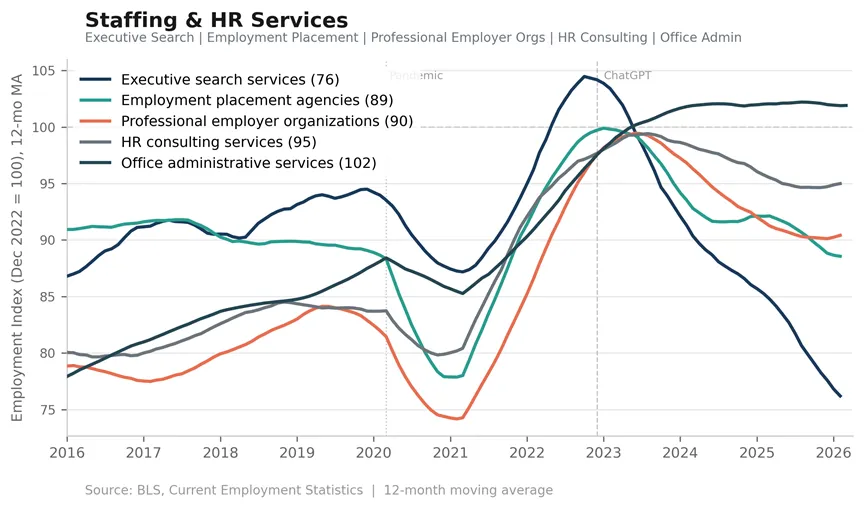
Staffing & HR Services: Executive search down 26%, employment placement down 13%. AI screens resumes, matches candidates, and conducts initial assessments — automating the core workflow of placement firms.
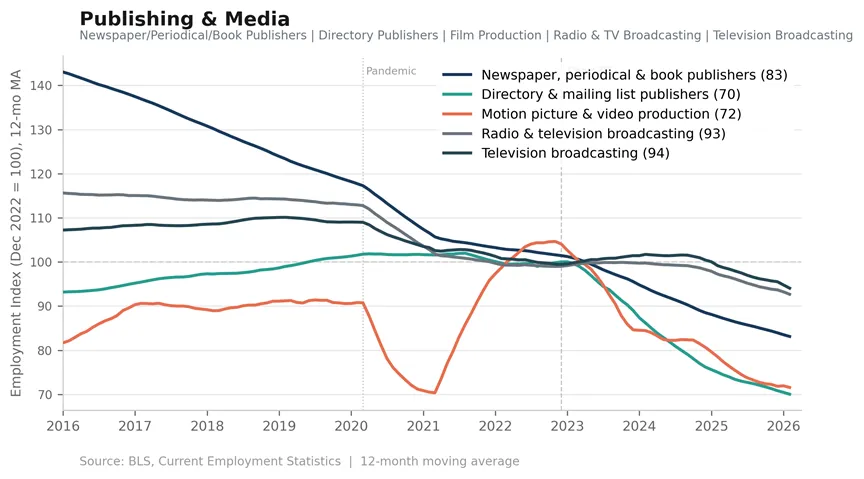
Publishing & Media: These industries were already declining — newspaper publishers have shed jobs for two decades. What changed after 2022 is the rate. In publishing, the annual rate of job loss roughly doubled. AI did not initiate this decline. It appears to have removed the floor.
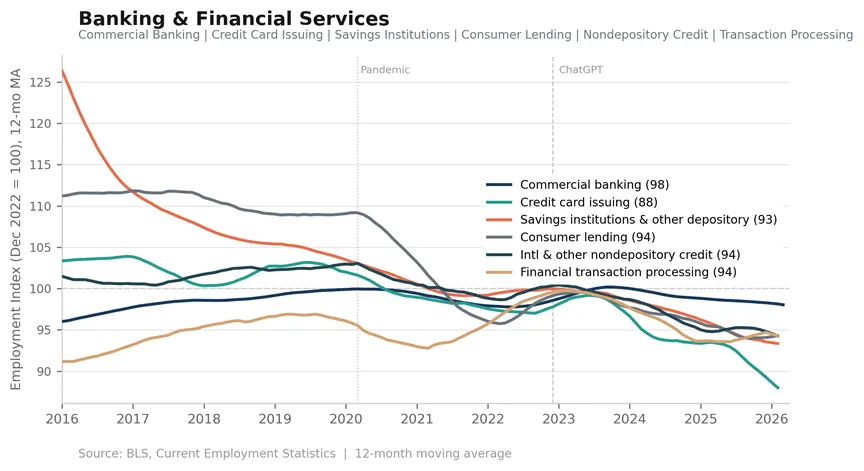
Banking & Financial Services: Branch closures and back-office automation predate generative AI. But the post-2022 acceleration in job losses — across commercial banking, credit cards, savings institutions, and transaction processing — suggests newer AI tools are adding to a long-running trajectory.
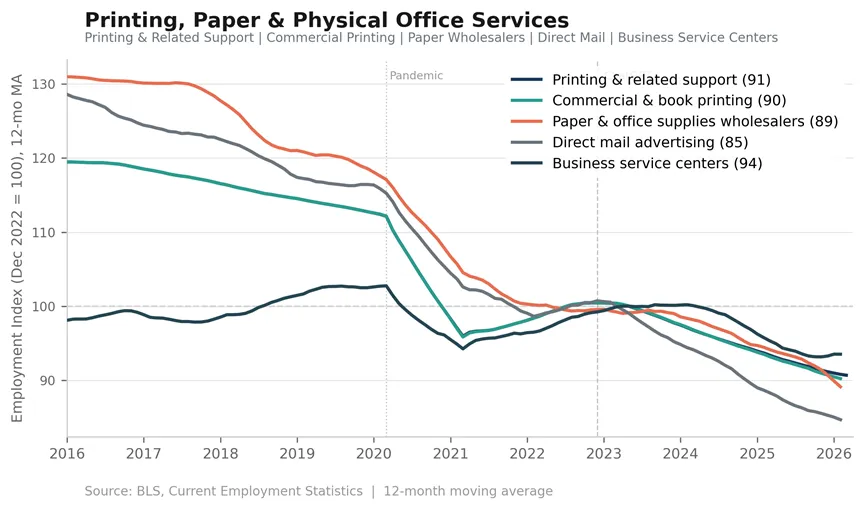
Printing, Paper & Physical Office Services: In structural decline for over a decade. AI-generated digital content and hyper-personalized digital marketing further reduce demand for print. In printing, a decline running at 1-2% per year accelerated to nearly 5% after 2022.
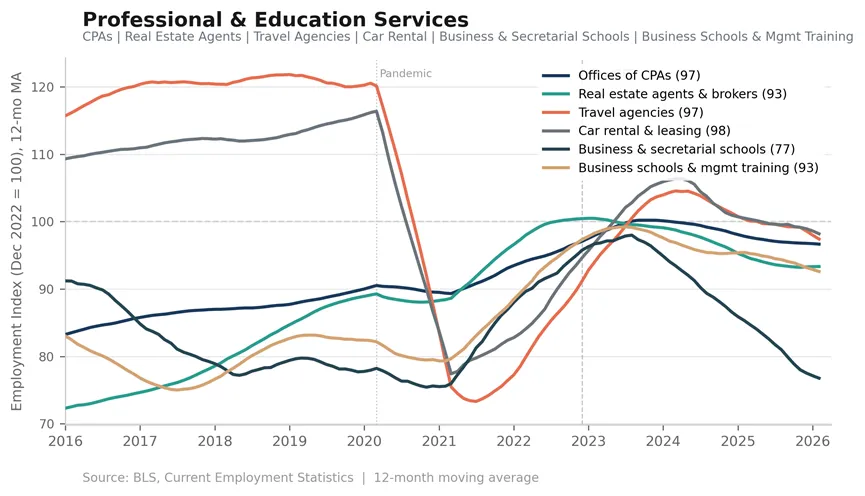
Professional & Education Services: CPAs, real estate, travel, and training schools — all with well-documented non-AI disruption histories. But each shows post-2022 weakness consistent with technology adding to pre-existing pressure.
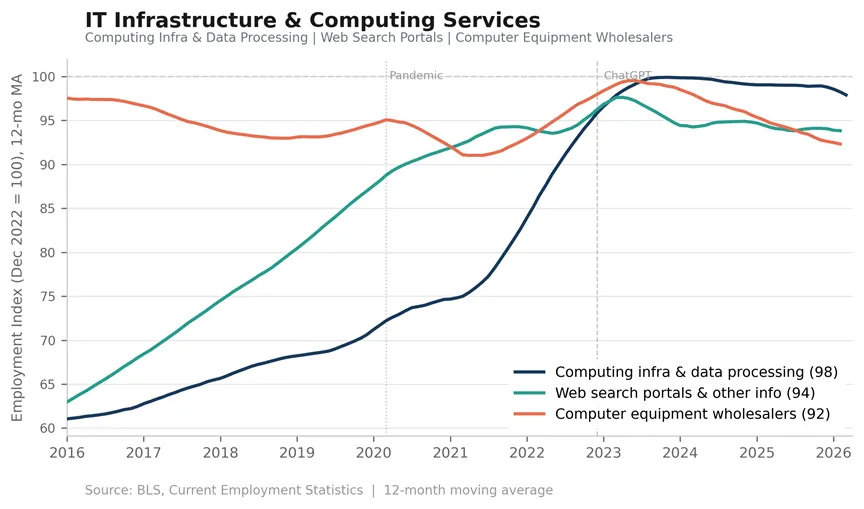
IT Infrastructure & Computing Services: AI optimizes server provisioning and cloud operations, reducing operations staff per unit of computing. Hard to separate from the broader cloud migration and infrastructure consolidation cycle.
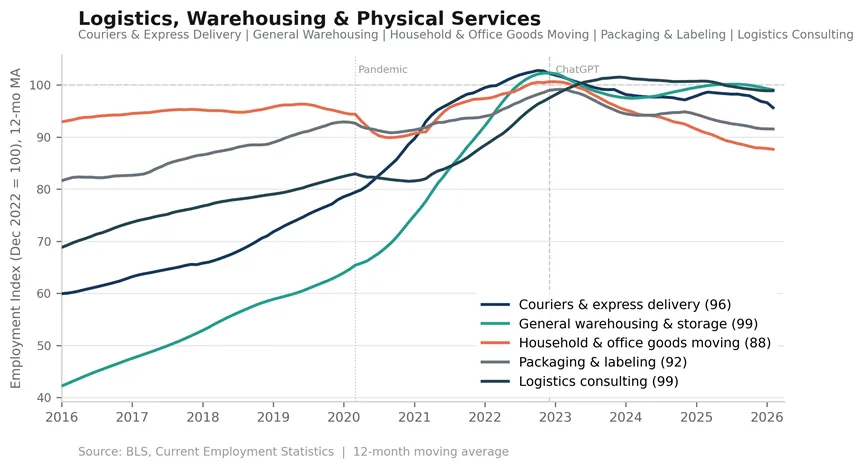
Logistics, Warehousing & Physical Services: E-commerce shifts, fuel costs, and post-pandemic normalization are likely the primary drivers. AI-optimized routing and warehouse robotics are contributing factors.