
Economics & Reason: When, Not If
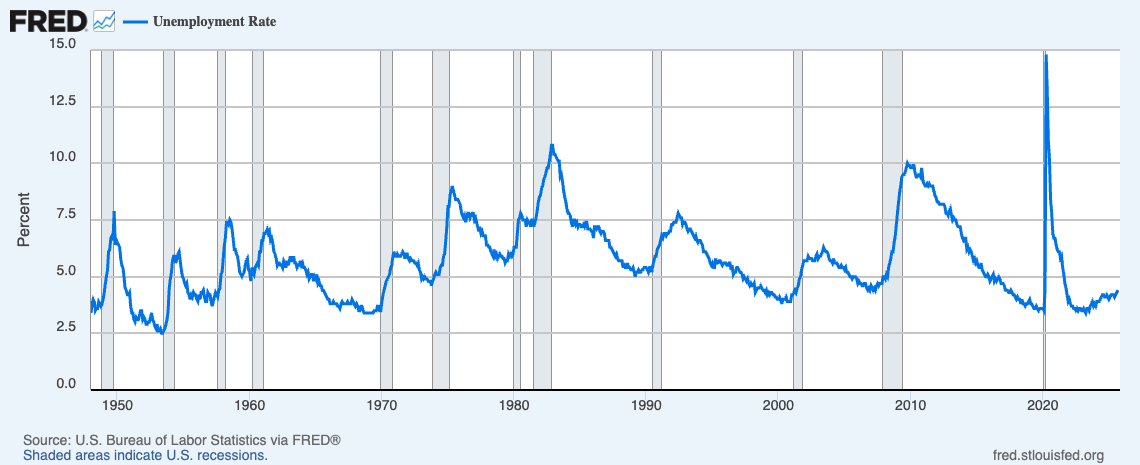
This one chart should say it all. Recessions are a part of economic life. There would not be booms without busts, and despite the great effort to eliminate recessions, they happen. There is quite a bit to be written about the relative success of economic policymakers at reducing the length and depth of recessions in recent years, but the Federal Reserve cannot ward of the economic effects of something like the Covid Pandemic Recession in 2020. Nor was that recession predictable in nearly any way shape or form before the fact.
Other recessions, may have been more predictable than 2020, but few did – the Great Recession had major, long-term effects on financial markets, yet only a few analysts saw or predicted the stresses caused by new financial instruments that caused the financial crisis. Similarly, few were willing to accept that company prices had come out of line with their intrinsic values in the Dot Com Bubble.
This article isn’t about how to better set policy or to manage macroeconomic conditions to limit the effects of a recession – it is actually about my general frustration about the amount of brainpower that goes into looking into these types of things and predicting whether or not a recession is near happening or not.
Certainly, prediction markets matter – and if you read my last article, you would know that I think that there are use cases where that matters more than others. Investors who are able to time their decisions based on macroeconomic changes may do better than those who don’t. And they will certainly feel more in control if their predictions about the macroeconomic environment do well.
But how beneficial are these types of analyses to regular people? Let’s take a look at who is in the stock market as a bit of a simple proxy for who may be benefitting. First, let’s note that about 62% of Americans report owning stock in a recent Gallup poll – this may be direct ownership, or through a 401K or other retirement plan. In absolute volume the US stock market has over $50 trillion dollars invested as well – so understanding if that is going to go up or down really matters.
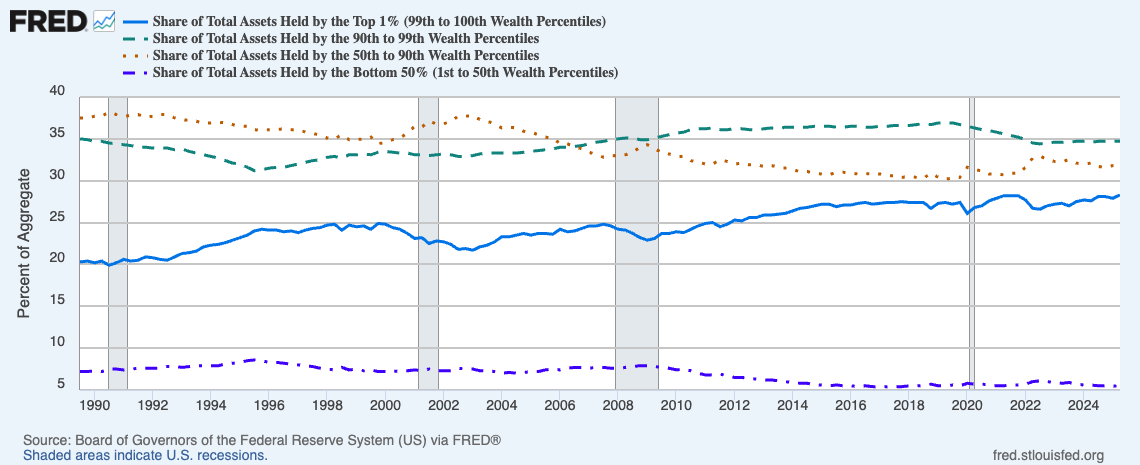
The total value is very high and it matters to a lot of people, but the stakes are quite different depending on your wealth and income. No surprise, assets are highly concentrated among the wealthy. Using data from the Federal Reserve’s Distributional Financial Accounts quarterly data, we can see that when measuring by wealth, the top 1% holds just under 30% of all assets and the 90 to the 99th percent hold 35% of all assets.
Breaking this down further by focusing specifically on financial assets, like stocks and bonds, the concentration of holdings among the top 10% of wealth holders jumps to nearly 75% of all financial assets.
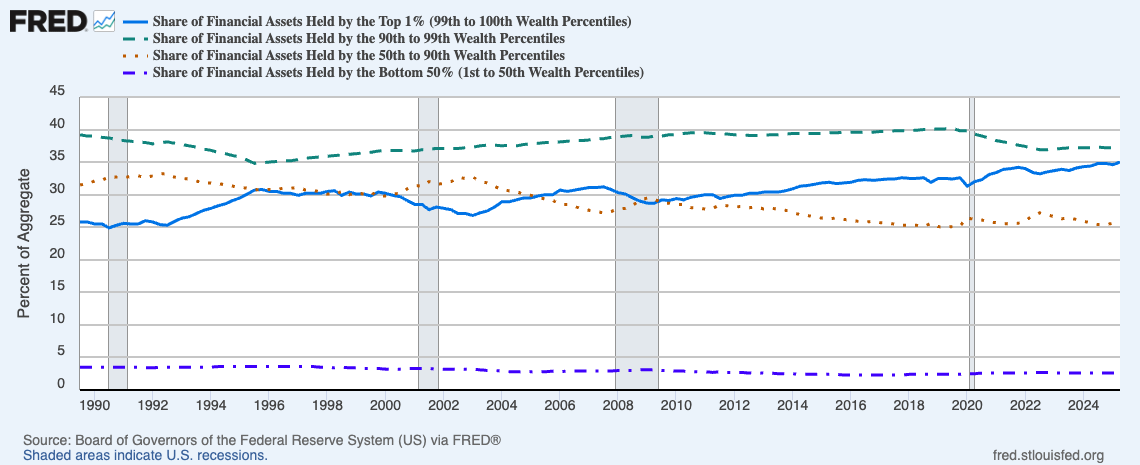
So while predicting macroeconomic conditions matters to most Americans – as most are exposed to financial markets like stocks – it is a whole different ballgame in terms of stakes for those outside of the top 10% of wealth.
I would argue that the stakes for the bottom 90% are much greater and not related to how markets are performing or if the macro winds are shifting, and instead on their employment security or their employment resilience. We are spending too much time analyzing if there will be a recession. If we want to make a difference for most Americans, we need to analyze what we will do when there is a recession. This will require a significant rethinking of our workforce systems and how research and analysis supports them.
When I was at the Federal Reserve, about a year before the pandemic recession, I was asked a simple question, “How is your work going to change if there is a softer economy, or a recession?” At the time, I was leading a research center that worked on applied work that bridged the needs of workforce development practitioners, educators, and corporate human resource leaders with the research being produced by the Fed. We had launched and been operating in one of the strongest economies in quite some time – inflation was low, unemployment was low, and we had seen this confluence as a major opportunity to create greater economic inclusion and to enhance economic mobility for many who had not experienced it. A tight labor market was an asset at the time.
So reasonably, the simple question was an important one. My colleague Julie Hotchkiss had shown how valuable the tight labor markets were for disadvantaged groups, with the caveat that the benefits were more than wiped away when economies crashed. Disadvantaged groups gained the most in tight labor markets, but also suffered the most in recessions.
We started to think about economic resilience as a critical factor in sustaining economic mobility. It isn’t enough for some people to ride booms and suffer in busts. My answer to the what I could do in a weak economy was to lean in on managing transitions, helping people find new work faster, and help make better matches for work.
Economic resilience is a powerful concept – and one that is under appreciated. Resilience is the ability to rebound and manage transitions from a negative shock. Resilience is often discussed in the context of response to natural disasters or climate change, but less so in the context of labor markets - we need to do that more, especially since earned income is often the greatest asset a worker has.
So instead of focusing on whether or not something may happen or not, be sure to have developed scenario plans for when something does come – especially when it is inevitable, like a recession. How would your work change in a weak economy or recession?
Start with the simple question, but spend time building complex scenarios – what if the downturn affects certain groups more than others? The recession had broad and wide effects, as did the Pandemic. One major difference between the two was the root cause of the downturn. Limited foot traffic and in person work meant that the pandemic recession had greater impacts on workers who had to be in person, but weren’t in essential work. The segments of the population affected can change your strategies.
We saw some interesting work from the Tennessee Department of Labor at the time. They focused on creating transitions for workers from hospitality to healthcare roles. In the early days of the pandemic, they helped several thousand workers move from the hospitality sector in the state into front line healthcare and allied health. Many of these moves were more “lifeboat” jobs that transitions with long term economic mobility in mind, but they kept people earning paychecks and helped people be resilient to an unexpected shock. As a side benefit, it helped the state expand its healthcare workforce in a moment of need.
This is a now relatively dated video - but you can see Kenyatta Lovett talk about the program at the 43:00 minute mark on the link below.
Workforce Development Responses to COVID-19
BGI has been involved in several interesting scenario planning projects – more focused on technological change and workforce adaptation to things like artificial intelligence and machine automation. While structural rather than cyclical, the same dynamics are at play – knowing what to do when change comes, rather than focusing directly on which date or year that change will come helps organizations get to action faster.
More broadly, we need to focus on having plans like these for when nearly certain scenarios arrive. Our systems to support workers and support economic mobility are not well prepared for many or have been managed as if recessions won’t happen. Which brings us to our white paper of the moment…
White Paper (or Data) of the Moment
The Upjohn Institute has long studied the unemployment insurance system. Chris O’Leary, Kenneth Kline, and Stephen Wandner have been central researchers on the institute’s study of the unemployment insurance system – and it eroding adequacy to deal with the challenges in it. The unemployment insurance system is a federal program that is managed by states – with a set of boundary regulations around it. What this means is that while every state has unemployment insurance, the experience that a New Jersey worker will have during a spell of unemployment may very well be different than a worker in North Carolina. No two states are quite the same since they draw their own rules.
The federal government requires that each state keeps a trust fund with adequate tax receipts to fund payments when they are needed – such as a recession or major shock to employment. The government does not set a standard for how much must be in the trust fund though – if states run out of money, they can borrow from the federal government to pay unemployment insurance obligations. Repaying these loans can be painful for states and employers may have to pay additional federal unemployment insurance taxes if states are delinquent.
So, maintaining the trust fund is a challenge like many tax collections - there needs to be enough to cover obligations that may come, but policymakers and lawmakers want the collections to be as small as possible so they aren’t creating – or being seen as creating undo taxes on businesses and workers.
Like other budgeting problems, there are two ways to create “solvency” - states can increase revenue by increasing unemployment insurance tax income or they can reduce payments and liabilities in the system. Upjohn has chronicled the erosion of benefits – by reducing the number of weeks eligible for unemployment insurance payments and capping the amount paid through the system by many states. This leaves workers in these places more exposed to recessions and job loss than residents in states that have maintained a more robust UI system.
Even these reductions don’t quite create the solvency many states need. Every few years, Upjohn will publish a study that simulates how many states may see their UI trust fund become insolvent. The whitepaper of the moment by O’Leary and Kline shows that an average recession will make 18 states insolvent. This was published in March 2020, so does not include the deep, but short, pandemic recession in those estimates.
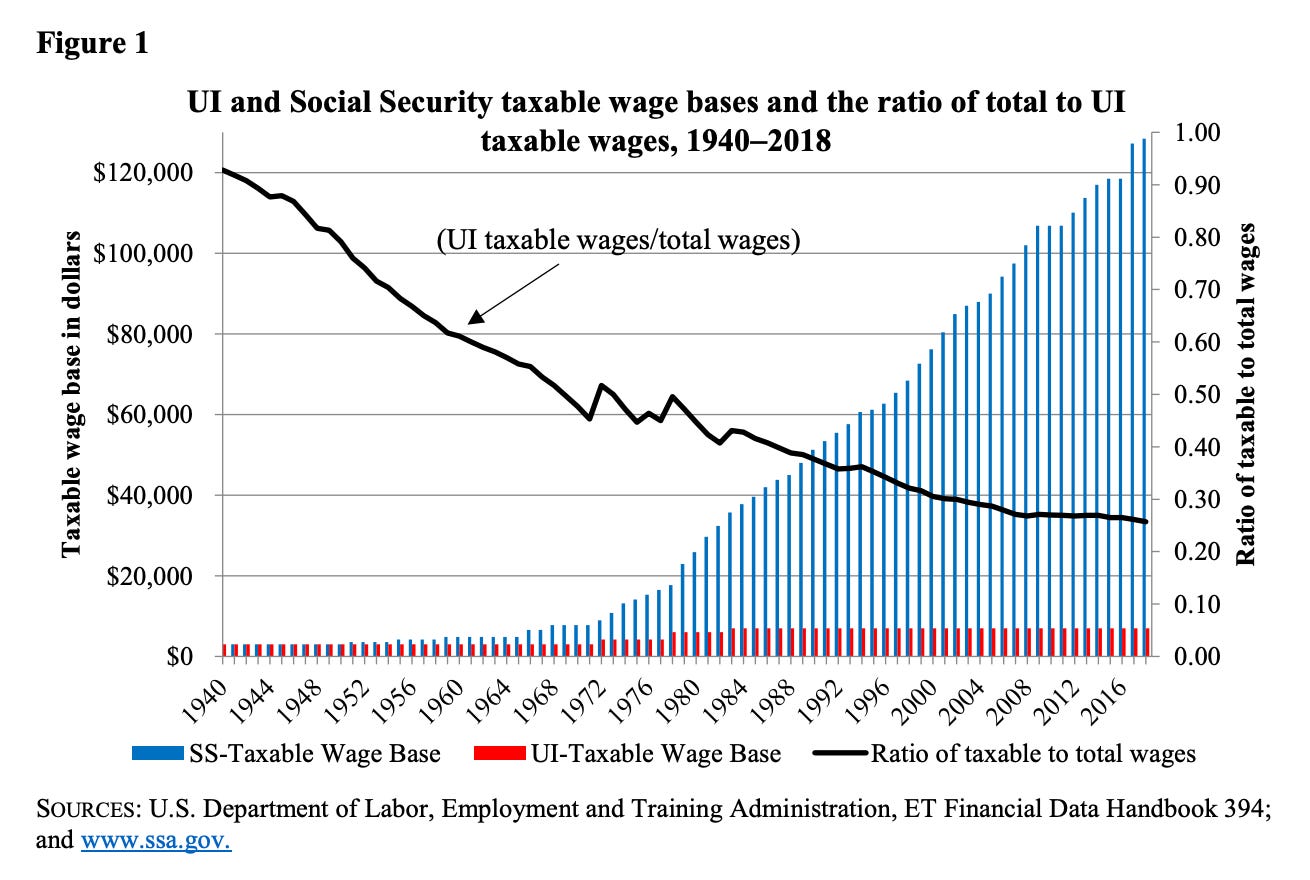
This figure comes from a different 2020 paper by O’Leary and Wandner and shows that generally, there has been very little movement in increasing the taxable wage base for unemployment insurance since 1940 - and almost no change at all since the Carter Administration.
These analyses show that we aren’t fitting the systems we have for known challenges. Scenario planning like Upjohn’s would show that states and the federal government need to take planning for downturns more seriously. The current system allows states to shirk responsibility or plan on federal interventions that expand the generosity of the unemployment insurance systems in times of need – like the eligibility period and payment rate extensions seen in the Great Recession and the Pandemic Recession. If I were a state leader, I would want to be more self reliant and prepared. In terms of preparing to serve workers during hard times and moments of transition, no one should be shirking responsibility or preparedness. It is a matter if when, not if.
Song That Kept Me Working This Week
Vladimir Horowitz playing at Carnegie Hall in 1965. The concerts are some of the greatest piano performances of all time. But they are a study in what excellence is too. In the opening piece – Bach’s Toccata, Adagio, and Fugue in C Major (BWV 564) – Horowitz, plays doesn’t make it through two measures before he plays his first wrong note. He continued to play and put on one of the greatest performances of the piece ever. To be fair, he was playing on a piano, and Bach composed it for an organ – he was short two fingers to play everything there, but the miss wasn’t driven by that.
For those of you that really are interested - modern streaming now means that the rehearsals for these performances are now available as well – you can hear the work that went into preparation for the live show too.
Excellence isn’t perfection – and imperfection doesn’t get in the way of doing something so well that it stands the test of time. As Hemingway said, “We are all apprentices in a craft where no one ever becomes a master.” Everyone has to practice and everyone has to come back from mistakes or setbacks.
Let’s make sure that we plan for when lots and lots of people need to be resilient and how we will help them, not focus on if something bad is coming. It matters to more people if we do that.
Thanks everyone for reading. Have a great first week of 2026. More soon.
Read All Economics & Reason Issues & Subscribe on Substack