
Economics & Reason: Navigating the Messy Middle
In 1987, the Nobel Prize in Economics winning Robert Solow wrote in the New York Times Book Review, “You can see the computer age everywhere but in the productivity statistics.” We are going through the same moment with artificial intelligence.
As such we also see people playing both sides of the hype and uncertainty around artificial intelligence. This also is not a new phenomenon. In 1994, Gartner released what they called the “Hype Cycle” on technology adoption. It might ring true to people when you think about AI.
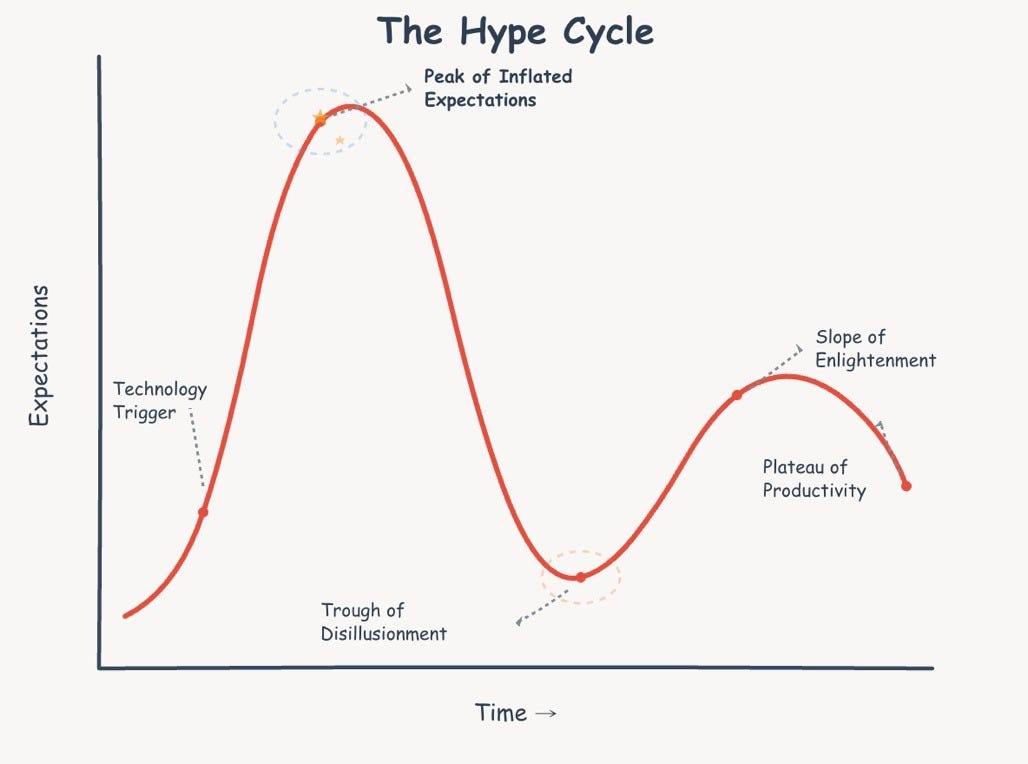
Source: AI Generated Illustration of Gartner’s Hype Cycle from 1994
AI will have profound impacts on the way that work is organized, just as computers did. Yes, in 1987, there was limited evidence of computers’ effects on the economy – people were using them at work and buying them for personal use at home, but it was unclear how they were making the economy different – as noted by a Nobel Prize winning economist.
While he may not have been disillusioned, he was certainly cautious about many of the things that ultimately became commonplace because of computers. In the book review, Solow shows tepid enthusiasm for an American economy that was service based. The computer, and the soon to follow internet facilitated the exports of services and globalization of trade that Solow was skeptical could drive the American economy.
Consider perspective though – in 1981 Steve Jobs said, “What a computer is to me is it’s the most remarkable tool that we’ve ever come up with, and it’s the equivalent of a bicycle for our minds.” Certainly technologists and futurists took a more optimistic public view than the economists at the time. The technologists also had reason to take an optimistic view – their businesses depended on computers becoming the bicycles of the mind – and they needed to help inspire the general population of the power of computing and paint a picture that included more than floppy discs and playing a pixelated Oregon Trail game (the first version dates to 1971!).
The technologists ended up being right – but it certainly took time. Computers are ubiquitous in work – they have been used to make complex jobs more simple and to make complex thinking go further, faster.
Hindsight has 20/20 vision — this isn’t to suggest that Solow’s concern or skepticism about an economy that is based on services rather than on production of goods was unfounded. Computers had been around for some time, but the economic application wasn’t clear. At the time, a skill based, technology driven economy simply hadn’t been done - the communications and logistics technology necessary to make a global economy function, with the US as a largely service oriented economy, did not exist. It was easy to see and suggest that these felt like unlikely or unsound ideas.
Today we have research that suggests that AI is having little impact at the same time that technologists tell us AI could eventually replace all human work. The truth lies in the middle, but just because we don’t see every employment and economic effect, doesn’t mean they aren’t coming. Be sure to keep some perspective on the timeframe of analysis.
To close out this thought, by 2003, a new set of august economists had identified how computers were changing the economy and tilting advantage towards knowledge based roles and away from manual and physical labor. David Autor, Frank Levy and Richard Murnane published “The Skill Content of Recent Technological Change.” They found that computers substituted for workers who did cognitive manual work and complimented workers who did high order, non-routine cognitive work. Does this sound a little similar to the current AI discourse? On to the white paper of the moment…
White Paper of the Moment - Anthropic’s Economic Index - New Building Blocks for Understanding AI Use
The incredibly in-depth report on AI usage as measured by Anthropic’s API and its chatbot Claude show some interesting and confirmatory data on how AI may impact the economy – and it feels like Autor, Levy, and Murnane.
Deep in the paper is one of the charts I found most important. It shows:
- Speed up (increased ability to complete tasks) scales upwards with the implied educational level of tasks that Anthropic AI models perform. Higher levels of education mean higher complexity tasks. Looking at Claude models specifically:
- Tasks that imply a high school degree show 9x speed up
- Tasks that imply a college degree see 12x speed up
At the same time, task accuracy drops based on levels of education. This research suggests that in their current state, AI provides the greatest speed benefits to highly educated workers, but is less reliable at performance. Non-routine work is hard to replace, even with sophisticated software and large language models.
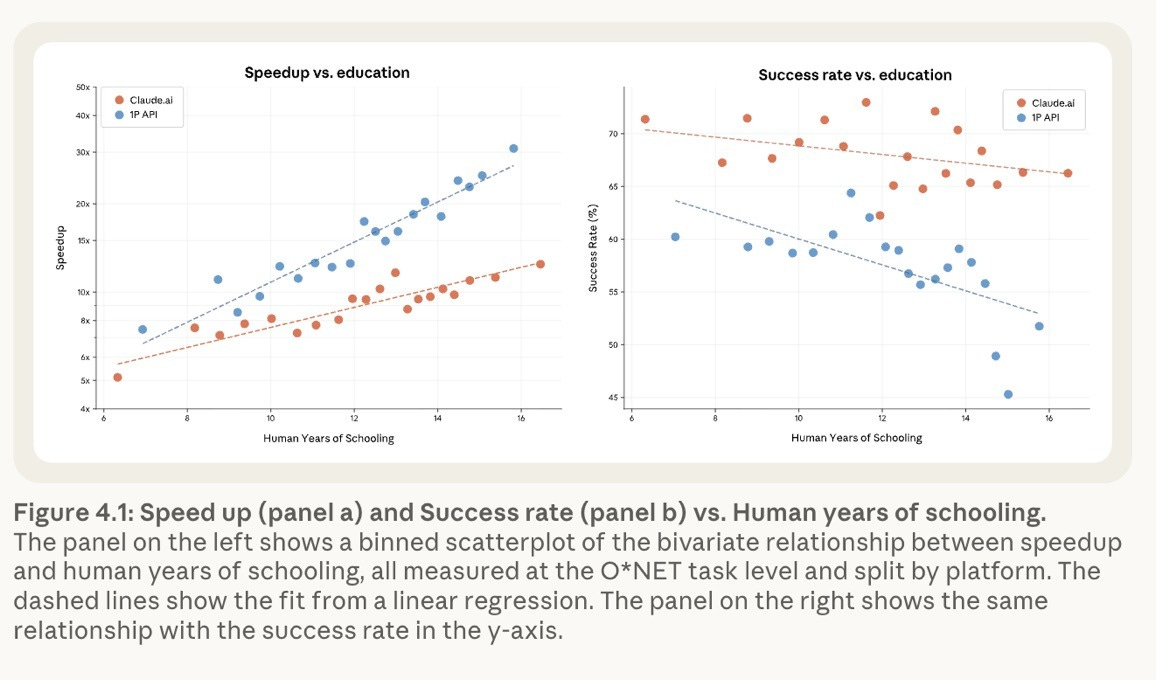
As a short aside, the differences between API performance and Claude performance on speed is stark. Maybe APIs represent more sophisticated models. More likely to me, as the authors suggest, APIs are designed to solve a narrower set of queries. Which makes the accuracy (success rate) measures all the more puzzling – APIs have lower accuracy than Claude as implied education increases. Maybe individuals on Claude aren’t stress testing the models as much.
Song That Kept Me Working This Week
Walking After Midnight/Change, by Ellis Paul
Life is a constant state of change. Economics are intertwined with culture and politics. Ellis Paul, a singer and songwriter, and in this writes about that change.
The first verses of the song are an up tempo cover of an old Patsy Cline song about a midnight wanderer looking to reconnect with a lost lover – trying to keep things going after a big change.
The song then bursts into an ode to a changing America. Remember our historic main street towns across the country?
The dry goods store, a flower shop, a barber, a beauty parlor with chrome chairs? Kids staring at the toys in the window at the five and dime?
Well things change, they change a lot. Those same little girls started working in the stores, and those same little boys got sent off to wars because things change. And when [those boys] got home they found that all the jobs had gone away to all of the places they had been fighting so far away. (Borrowing some direct lyrics from the song).
Here is the Patsy Cline version. She doesn’t do the change part of the song, it was originally performed in 1957 - before the Vietnam War.
The restructuring of the American economy is constant – and it is a confluence of our innovators, policymakers, businesses, civil society, and citizens. Change is broadly our culture. We have to do our best to manage change – and hold on to the best and remember who we are. Things blow cold and hot for different people in all of that change – let’s acknowledge that and be aware of who is getting the hot and the cold of change. It’ll help us embrace and manage change better.
We started with a messy middle, but maybe there isn’t a middle and we are always in a messy bit of change.
Thanks for reading. Have a great weekend. More soon.